

Welcome to my Blog
This blog is for life partners who suspect their relationship problem is not just communication, compatibility, or stress.
It may be a repeating system. These essays explain the patterns. Effective clinical work interrupts them.
Most folks don’t arrive here because something dramatic has happened.
They arrive because something feels… different.
The relationship still works. Conversations still happen. Life continues.
But something important is no longer organizing it the way it used to.
This space is where I write about that shift.
Not just what breaks relationships—but what quietly changes them:
how desire adapts.
how attention moves.
how meaning erodes or deepens over time.
These patterns are not random.
They tend to unfold in a predictable sequence.
If you’re here, you’re likely in one of those moments:
trying to understand what changed.
trying to decide whether it matters.
trying to figure out what to do next.
Start anywhere.
But if something here feels familiar, don’t treat it as abstract.
It usually isn’t.
Where to Begin
If you’re not sure what you’re looking for, these are a few good entry points:
Marriage Is Still Chosen — Even by Those Who Once Stood Outside It.
Epistemic Safety: What It Is and Why It Matters in Relationships.
The Relationship Consequences of Living in a Permanent News Cycle.
The Two Types of People Narcissists Avoid (And Why You Might Be One of Them).
When Narcissists Grieve: Why Their Mourning Looks Cold, Delayed, or Self-Centered
The 3-6-9 Dating Rule: Why Most Relationships Change at Month 3, 6, and 9.
The First Listener Shift: A Precise Relationship Diagnostic Most Couples Miss.
Why Curiosity Is Sacred in Relationships (And What Happens When It Disappears).
If You’re Looking for More Than Insight
Understanding is useful.
But at a certain point, most couples realize they can explain their relationship clearly—and still not change it.
That’s where focused work becomes effective.
I offer structured, high-impact couples intensives designed to produce meaningful movement in a compressed period of time.
Before We Decide Anything
A brief consultation helps determine:
whether this is what you’re dealing with.
whether this format fits.
and whether we should move forward.
Get a Clear Read on Your Relationship
Take your time reading.
But if something here lands in a way that feels specific—pay attention to that.
That’s usually where this work begins.
Continue Exploring
If you prefer to browse more broadly, you can explore posts by topic below.
But most people don’t find what they need by browsing.
They find it when something they read feels uncomfortably accurate.
Be Well, Stay Kind, and Godspeed.
~ Daniel
- Attachment Issues
- Coronavirus
- Couples Therapy
- Extramarital Affairs
- Family Life and Parenting
- How to Fight Fair
- Inlaws and Extended Families
- Intercultural Relationships
- Marriage and Mental Health
- Married Life & Intimate Relationships
- Neurodiverse Couples
- Separation & Divorce
- Signs of Trouble
- Social Media and Relationships
- What Happy Couples Know

Emotional Prestige: How Therapy Language Became a New Form of Social Status
There was a time when emotional dysfunction had the decency to remain mysterious.
A spouse disappeared emotionally for six months, and nobody announced, “He is displaying dismissive-avoidant deactivation strategies rooted in unmet attachment needs.” They simply said, “Frank has become impossible since buying that boat.”
Cleaner era. Fewer syllables.
Now everyone speaks fluent therapy dialect. Entire relationships unfold in the language of psychological interpretation.
Couples no longer merely fight. They “activate each other’s nervous systems.”
A disagreement about holiday plans becomes “an attachment rupture.”
Someone asks for fifteen minutes alone and suddenly there is discussion of boundaries, emotional labor, co-regulation, trauma responses, and whether the dishwasher represents patriarchal oppression.
The internet has accomplished something extraordinary:
it has turned therapy language into social currency.
And like all currencies, it now functions partly as status.

Does Logical Thinking Reduce Religious Belief? New Research Says No
There is a certain modern confidence—especially among educated Westerners—that religion survives mainly because human beings have not thought hard enough yet.
The theory goes something like this: faith belongs to intuition, emotion, and cognitive shortcuts. Rational analysis, meanwhile, belongs to science, skepticism, and logic.
Therefore, if you activate analytical thinking strongly enough, religious belief should weaken.
It is an elegant theory. Clean. Efficient.
The intellectual equivalent of Mid-century furniture.
It is also increasingly difficult to prove.
A new study published in the journal Psychology of Religion and Spirituality found that increasing analytical thinking did not reduce religious belief in any meaningful way.
The findings challenge one of the more popular assumptions in the cognitive science of religion:
that logic naturally overrides faith.
And honestly, ordinary human experience has been quietly arguing this point for years.
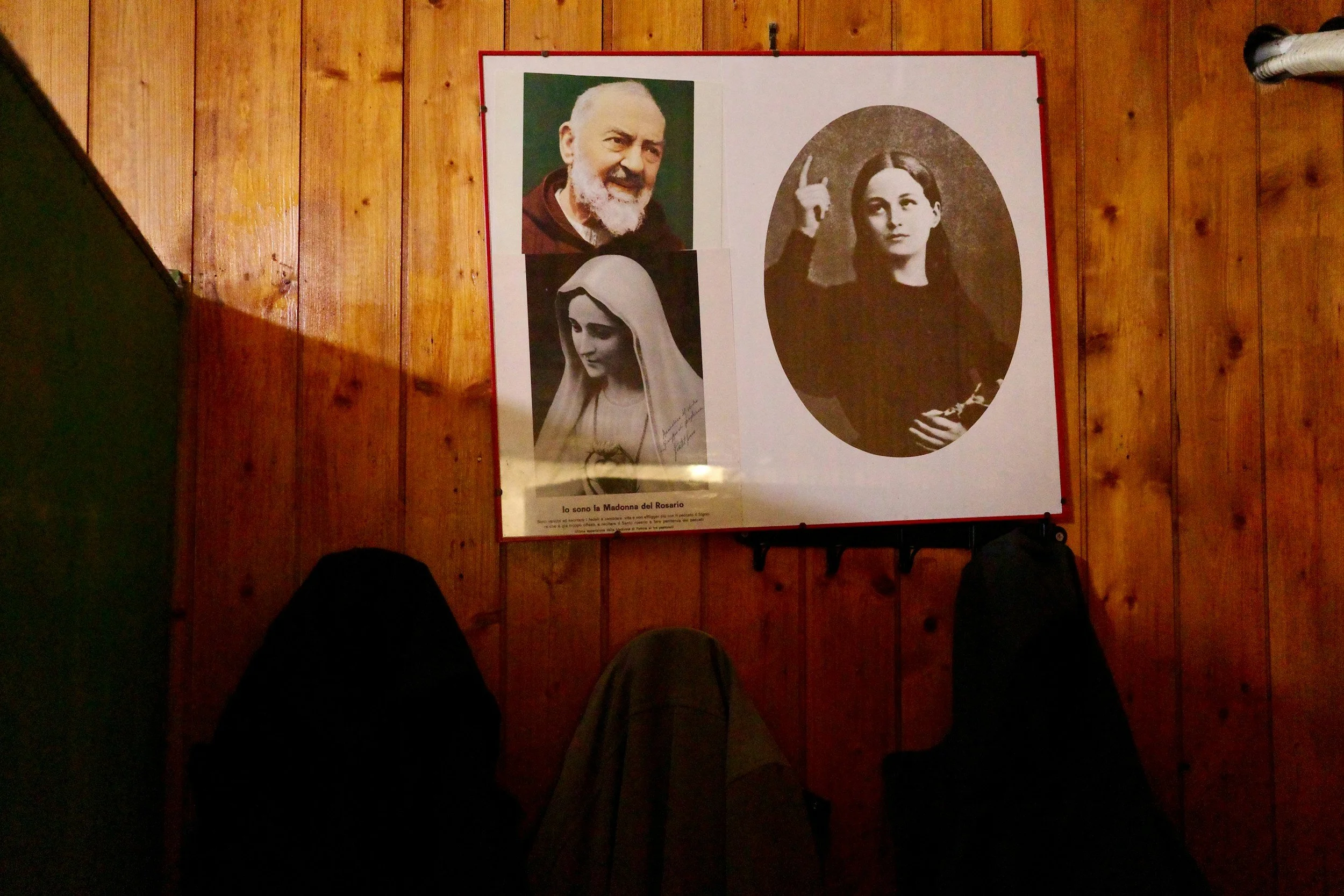
Padre Pio and the Collapse of Reverence: What Modern Relationships Keep Forgetting
Couples now fall apart while technically remaining in constant contact.
They text all day.
Share calendars.
Exchange Instagram reels from opposite ends of the same sectional sofa.
React to each other’s messages with tiny digital hieroglyphics while quietly losing access to one another’s interior worlds.
The modern relationship is exhausted.
Not always dramatic. Worse.
Administratively depleted.
Which is how Padre Pio suddenly becomes relevant again.
Not because he performed miracles. Not because of the stigmata.
Not because modern life secretly longs for supernatural spectacle, though it clearly does.
Every few years the culture becomes briefly obsessed with exorcisms, near-death experiences,
Marian apparitions, psychedelics, “energy work,” or billionaires explaining consciousness on podcasts while wearing sneakers that cost more than a dishwasher.
No. Padre Pio matters because he understood something modern culture keeps forgetting:
Human beings deteriorate when reverence collapses.
Not productivity.
Not communication.
Not optimization.
Reverence.

Why Prayer May Calm the Nervous System Better Than Modern Wellness Culture
Modern Americans have become extremely committed to wellness while simultaneously developing nervous systems that behave like raccoons trapped inside HVAC systems.
This is difficult to ignore.
We now monitor sleep with military precision while sleeping terribly.
We purchase meditation apps to manage the stress created by checking meditation apps.
We discuss cortisol the way medieval peasants discussed demonic possession.
Entire conversations now occur in a dialect composed almost entirely of the phrases “regulate your nervous system,” “hold space,” and “dopamine depletion.”
Meanwhile, somewhere in Massachusetts or Ohio or rural Sicily, an elderly woman is quietly saying the rosary before sunrise and apparently producing a more stable physiological stress response than half the professional class.
This is the sort of thing modern culture dislikes on sight.
A recent study discussed by science writer Eric Dolan on private religious practices and stress physiology found that folks engaging in private religious practices experienced smaller spikes in systolic blood pressure during acute stress tasks.
Not metaphorically calmer.
Actually calmer.
Their nervous systems simply did not escalate as dramatically under pressure.
And immediately you can feel the modern mind trying to negotiate with the implication.

Saint Hildegard and the Prophecy of a Spiritually Exhausted Civilization
There are certain historical figures who remain safely in the past.
And then there are figures who continue wandering forward through history like unresolved psychological material.
Hildegard of Bingen belongs firmly in the second category.
Every few years modern culture rediscovers her with fresh astonishment:
the medieval abbess who seemed to understand ecological imbalance, nervous-system exhaustion, institutional corruption, spiritual numbness, attentional fragmentation, and the peculiar emptiness that emerges when a civilization becomes materially sophisticated but psychologically disordered.
Which is unsettling.
Because Hildegard was writing in the twelfth century.
Long before smartphones.
Long before mass media.
Long before industrial capitalism.
Long before social platforms engineered explicitly to fracture human attention into profitable shards.
And yet her writing often feels less like medieval mysticism than cultural diagnosis.
Partly because Hildegard understood something modern civilization keeps trying very hard not to understand:
Human beings can become spiritually exhausted while remaining highly functional.
In fact, advanced civilizations may become especially vulnerable to this condition.

Don Dolindo Ruotolo and the Modern Crisis of Surrender
There is something deeply revealing about the sudden popularity of Don Dolindo Ruotolo in the age of algorithmic panic.
Not because modern people have become more spiritual. Let us not become hysterical.
But because modern people have become exhausted.
Exhausted by prediction.
Exhausted by optimization.
Exhausted by carrying twelve imaginary futures around in their nervous systems like overpacked grocery bags cutting off circulation to the fingers.
And into this trembling little civilization wanders an obscure priest from Naples saying:
“Jesus, I surrender myself to You, take care of everything.”
Which sounds comforting until you realize he actually meant it.
Not metaphorically.
Not aesthetically.
Not as a decorative quote floating over beige Instagram backgrounds featuring driftwood and cappuccinos.
He meant surrender in the terrifying sense.
The irreversible sense.
The kind that requires relinquishing the fantasy that anxiety itself is a form of control.
That is why Don Dolindo has become catnip for the spiritually overclocked.

Most Affairs Begin With Attention Migration: Why Infidelity Feels Like a Nervous-System Crisis
Most people think they know exactly what they would do after infidelity.
This is adorable.
Americans speak about cheating with the confidence of people discussing a house fire they are certain will only happen to someone else.
“I would leave immediately.”
Of course you would. During emergencies you would also remain calm, administer CPR flawlessly, and somehow locate your passport in under three minutes.
Human beings possess an almost spiritual faith in their future emotional competence.
Then somebody discovers a hidden text thread and suddenly a person who once ignored three consecutive oil changes notices their spouse stopped using heart emojis on March 11th at 9:14 p.m.
Over the past few years, I’ve watched brilliant adults—physicians, executives, attorneys, professors—become psychologically unrecognizable after betrayal.
Folks who once managed investment portfolios begin discussing Instagram story views with the intensity of forensic accountants examining cartel money transfers.
Because infidelity is rarely experienced as a clean moral event.
It is experienced as destabilization.

America’s Private Revenge Theater: Why Millions of Americans Have Imagined Shooting Someone
America now contains millions of people carrying around tiny private revenge films in their heads.
Not plans, necessarily.
Not manifestos.
Often just flashes.
A face.
A humiliation.
A fantasy of force arriving where helplessness used to be.
Researchers recently found that 7.3% of adults in the United States have seriously thought about shooting another person at some point in their lives.
That translates to roughly 19.4 million people. More than 8 million reported having these thoughts within the last year alone.
Violent intrusive thoughts themselves are not rare, and most people who experience them are not dangerous. The researchers explicitly note that most people never act on these fantasies.
But the scale still matters.

Sister Agnes Sasagawa and the Problem of Belief
There are certain religious stories that modern educated people react to with immediate, involuntary facial expressions.
Not thoughts.
Not arguments.
Facial expressions.
A tightening around the mouth.
A tiny retreat of the eyes.
The expression people make when someone at dinner calmly explains that crystals cured their thyroid condition or that their golden retriever understands Swedish.
The Akita story produces this expression in otherwise civilized people.
Partly because it involves Marian apparitions.
Partly because it involves a statue allegedly weeping blood.
But mostly because the central figure in the story—Sister Agnes Katsuko Sasagawa—does not behave the way modern people expect someone connected to extraordinary religious claims to behave.
She was not charismatic.
Not theatrical.
Not evangelical.
Not interested in fame.
This is psychologically inconvenient.
When Confidence Stops Negotiating With Reality: Bipolar Grandiosity Explained
At first, everyone thinks their loved one is finally getting better.
They are awake earlier. Talking more. Laughing again.
Cleaning the kitchen at midnight with the concentration of a Renaissance sculptor restoring the Sistine Chapel.
They suddenly have plans, visions, momentum.
They are calling old friends. Starting ambitious projects. Explaining cryptocurrency with the emotional intensity of a medieval monk describing divine revelation.
The family feels relief.
After months of depression, exhaustion, withdrawal, or hopelessness, the sudden energy can feel miraculous.
Then the spending begins.
Or the rage.
Or the affair.
Or the 3:12 a.m. manifesto about destiny.
Or the terrifying certainty.
And this is where families often realize they are no longer dealing with ordinary confidence or recovery.
They are dealing with acceleration.

Why Intelligent People Become Obsessed With True Crime Podcasts
There is something almost absurdly modern about listening to a podcast about homicide while standing in line for cold brew.
Not because violence is funny.
Because the setting is.
Human beings once gathered around fires to hear cautionary stories about betrayal, disappearance, dangerous strangers, and the hidden nature of evil.
Now we hear them through noise-canceling headphones while buying oat milk and pretending we are “mostly interested in the psychology.”
Which, to be fair, many people genuinely are.
A recent study published in Psychology of Popular Media found that most true crime podcast listeners are motivated less by gore or cruelty than by curiosity, information-seeking, and a desire to understand human behavior.

What Hurling, Gaelic Football, and Australian Footy Reveal About Marriage, Masculinity, and Belonging
Most modern people underestimate how much of emotional life is organized through ritual.
I have become increasingly convinced that relationships rarely collapse all at once. More often, they erode through the slow disappearance of shared emotional worlds.
The rituals vanish first. The recurring points of connection disappear.
Folks stop gathering around the same symbolic fire.
And oddly enough, sports often reveal this more clearly than therapy books do.
There are countries that build identity through armies.
There are countries that build identity through markets.
And then there are countries that build identity by inventing sports so unusual, so elegant, and so faintly dangerous that outsiders watch them briefly and conclude the entire population may have collectively survived some kind of glorious historical concussion.
This is roughly what happens when Americans first encounter hurling.
A man catches a ball traveling at the approximate speed of unresolved childhood shame, balances it on a wooden stick while sprinting full speed across a field, and then launches it skyward with the confidence of someone attempting to settle an argument directly with God.