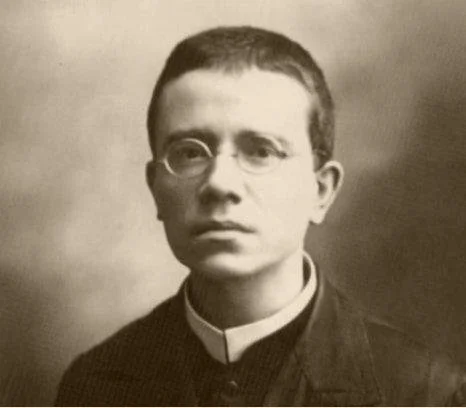
Don Dolindo Ruotolo and the Modern Crisis of Surrender
Monday, May 18, 2026.
Don Dolindo Ruotolo and the Exhausted Modern Nervous System
There is something deeply revealing about the sudden popularity of Don Dolindo Ruotolo in the age of algorithmic panic.
Not because modern people have become more spiritual. Let us not become hysterical.
But because modern people have become exhausted.
Exhausted by prediction.
Exhausted by optimization.
Exhausted by carrying twelve imaginary futures around in their nervous systems like overpacked grocery bags cutting off circulation to the fingers.
And into this trembling little civilization wanders an obscure priest from Naples saying:
“Jesus, I surrender myself to You, take care of everything.”
Which sounds comforting until you realize he actually meant it.
Not metaphorically.
Not aesthetically.
Not as a decorative quote floating over beige Instagram backgrounds featuring driftwood and cappuccinos.
He meant surrender in the terrifying sense.
The irreversible sense.
The kind that requires relinquishing the fantasy that anxiety itself is a form of control.
That is why Don Dolindo has become catnip for the spiritually overclocked.
Don Dolindo Ruotolo was born in 1882 in Naples into severe poverty.
His childhood was marked by instability, deprivation, and emotional hardship.
By many accounts, his early life looked less like the beginning of sainthood and more like the opening chapter of a Russian novel where everyone eventually develops tuberculosis and symbolic despair.
He became a priest, but his life did not unfold in triumphal religious glory. Instead:
he endured chronic illness.
ecclesiastical investigations.
accusations.
humiliation.
restrictions from Church authorities.
Which is important because modern spirituality often imagines holy figures as emotionally radiant lifestyle influencers with luminous lighting.
Catholic mysticism traditionally works differently.
The mystic is usually someone who looks, from the outside, slightly crushed by existence.
Don Dolindo reportedly experienced mystical locutions, visions, and profound contemplative states.
He became associated with surrender spirituality and deep trust in divine providence.
He also produced an enormous body of writing reportedly spanning thousands upon thousands of pages.
Much of his modern fame, however, comes from the prayer now commonly called the “Surrender Novena,” widely circulated through Catholic devotional culture and discussed by organizations like EWTN and Catholic Exchange.
The prayer repeats a phrase that modern people simultaneously crave and resist:
“O Jesus, I surrender myself to You, take care of everything.”
Notice what is psychologically radical about this sentence.
It does not say:
“Help me manage everything.”
“Assist me in optimizing outcomes.”
“Give me a five-step framework.”
“Teach me emotional productivity.”
It says:
Stop gripping reality by the throat.
Anxiety Has Become a Moral Identity
One of the most common misunderstandings I see is the belief that worry equals responsibility.
It does not.
Worry often feels morally superior because it creates the sensation of engagement.
The anxious person believes:
“If I stop mentally rehearsing disaster, catastrophe will arrive through negligence.”
This is one reason anxious partners frequently become controlling partners.
Not because they are evil.
Not because they are narcissists.
But because the nervous system mistakes hypervigilance for love.
Don Dolindo’s spirituality directly attacks this illusion.
Not gently, either.
The Surrender Novena repeatedly frames frantic mental forecasting as spiritually disordered.
The prayer instructs the believer to stop demanding immediate resolution and instead release compulsive future management.
From a psychological perspective, this resembles several mechanisms studied in modern research:
cognitive defusion.
acceptance-based therapy.
reduction of perseverative cognition.
and decreased rumination.
Research on chronic rumination and stress physiology has consistently shown that repetitive anticipatory worry increases sympathetic nervous system activation and worsens emotional distress.
Work by Susan Nolen-Hoeksema on rumination helped establish how repetitive negative thought patterns intensify depression and anxiety rather than resolve them.
Which is the great tragedy of anxious control:
it feels productive while making the organism weaker.
Don Dolindo understood this long before neuroscience acquired expensive scans and TED Talks.
The Strange Appeal of Surrender in an Era of Control
Modern culture worships control so completely that surrender now appears almost subversive.
You can see this everywhere:
productivity systems.
optimization culture.
relationship surveillance.
“last seen” indicators.
location sharing.
sleep metrics.
calorie metrics.
attention metrics.
fertility metrics.
engagement metrics.
We are essentially building emotional support spreadsheets.
And despite all this monitoring, people feel less safe.
This matters because human beings do not become calm through total prediction.
They become calm through trust, attachment security, and meaning.
Which is partly why religious ritual often regulates the nervous system so effectively.
Research exploring contemplative prayer and repetitive devotional practices has found associations with reduced anxiety and greater emotional regulation in some populations, particularly when the practices cultivate acceptance and trust rather than fear-based scrupulosity.
Don Dolindo’s spirituality lands directly in the center of a civilization suffering from attention fragmentation and anticipatory exhaustion.
His message is almost offensively simple:
You cannot think your way into omnipotence.
The Internet’s Apocalyptic Obsession With Mystics
Of course, because this is the internet, Don Dolindo’s legacy has also become tangled with apocalyptic speculation.
Various websites and social media accounts attribute dramatic prophecies to him involving:
Russia.
wars.
global collapse.
divine chastisement.
and civilizational disorder.
Some of these claims may derive from authentic devotional traditions.
Others appear poorly sourced, embellished, or detached from historical verification entirely.
This happens constantly with mystics.
The internet treats mysticism the way cable television treats sharks:
everything becomes more marketable if you imply catastrophe is imminent.
Theologically, this creates problems because Catholic tradition distinguishes between:
public revelation.
private revelation.
devotional interpretation.
and outright speculation.
Many online discussions collapse all four into one emotionally intoxicating slurry.
Ironically, Don Dolindo’s actual spiritual emphasis was less “decode world events” and more:
stop panicking.
Which is not nearly as clickable.
Surrender Is Not Passivity
This part matters enormously.
Surrender spirituality is often misunderstood as emotional collapse, learned helplessness, or avoidance.
But psychologically healthy surrender is not resignation.
It is the relinquishment of omnipotence fantasies.
There is a difference.
Healthy surrender says:
“I will act where action is possible, but I will stop trying to control the uncontrollable.”
Unhealthy collapse says:
“Nothing matters.”
These are not remotely the same nervous-system state.
Research in psychology on locus of control and coping repeatedly shows that adaptive functioning involves distinguishing between:
what can be influenced.
what cannot.
and how emotional energy gets allocated.
The serenity prayer became famous for a reason.
It describes an extraordinarily sophisticated psychological distinction.
Don Dolindo’s spirituality belongs inside that tradition.
Why Burned-Out Professionals Suddenly Love Don Dolindo
There is a reason exhausted professionals, clinicians, caregivers, and overfunctioning adults increasingly circulate Don Dolindo quotes online.
Many high-functioning adults eventually discover a devastating truth:
competence does not eliminate existential uncertainty.
In fact, competence sometimes worsens it because capable souls become accustomed to solving problems through effort. Eventually they encounter realities effort cannot master:
illness.
mortality.
betrayal.
aging.
uncertainty.
children suffering.
marriages changing.
bodies failing.
history destabilizing.
At that point, some people become more rigid.
Others become spiritual.
Not always religious.
But spiritual in the sense that they begin recognizing the psychological limits of control itself.
This is where surrender spirituality becomes emotionally magnetic.
Not because people become irrational.
Because they become tired.
Couples, Control, and the Failure of Hypervigilance
In distressed relationships, anxious control often masquerades as devotion.
One partner monitors:
tone.
timing.
texting patterns.
facial expressions.
responsiveness.
emotional fluctuations.
social media behavior.
They believe enough vigilance will finally create safety.
Instead, the relationship slowly becomes an emotional airport security checkpoint.
The irony is brutal:
the more one partner attempts total emotional management, the less spontaneous intimacy survives.
This is why emotionally secure relationships require tolerating uncertainty.
Love itself involves exposure.
There is no way around this.
Don Dolindo’s spirituality collides sharply with modern attachment panic because it suggests that peace does not emerge from eliminating uncertainty but from developing a different relationship to uncertainty itself.
That idea is psychologically sophisticated enough to irritate nearly everyone.
The Nervous System Cannot Live in Permanent Emergency
One reason Don Dolindo resonates now is because modern life keeps inducing low-grade emergency states.
Notifications.
Political panic.
Economic instability.
Health anxiety.
Continuous comparison.
Digital overstimulation.
The nervous system was not designed for perpetual anticipatory activation.
Research on chronic stress physiology, including work involving allostatic load, has shown how repeated activation of stress systems contributes to emotional exhaustion and physical deterioration over time. The body eventually begins paying for the mind’s refusal to stand down.
Don Dolindo’s central spiritual move is essentially this:
Stop rehearsing catastrophe as a form of self-protection.
For many modern adults, this feels almost impossible because identity itself has become fused with vigilance.
If I stop scanning, who am I?
FAQ
Was Don Dolindo Ruotolo a saint?
Not officially canonized at this time, though devotion to him has grown significantly and there has been increasing interest in his life and writings within Catholic communities.
What is Don Dolindo most famous for?
Primarily the “Surrender Novena” and the repeated prayer:
“Jesus, I surrender myself to You, take care of everything.”
Was Don Dolindo associated with Padre Pio?
Yes. Padre Pio reportedly spoke highly of him, and the two are often linked within Catholic devotional culture.
Are the prophecies attributed to Don Dolindo verified?
Some writings and statements are authentic, but many dramatic internet claims are difficult to source reliably. It is wise to distinguish verified texts from speculative or sensationalized material.
Why does surrender spirituality appeal to anxious people?
Because anxiety often creates the illusion that mental overcontrol prevents disaster. Surrender spirituality challenges compulsive forecasting and encourages trust rather than perpetual hypervigilance.
Is surrender psychologically healthy?
It depends on the form. Healthy surrender involves accepting limits and releasing uncontrollable outcomes while still taking responsible action. It is not the same as helplessness or passivity.
Final Thoughts
What makes Don Dolindo compelling is not merely that he was mystical.
The internet is chock full of full of mystics now.
Most of them are selling supplements.
What makes him compelling is that he diagnosed something psychologically devastating long before the modern therapeutic vocabulary existed:
human beings attempt to calm themselves through control and often end up manufacturing the very panic they are trying to escape.
His spirituality is difficult because it confronts the ego directly.
Not the theatrical ego.
The frightened managerial ego.
The part of the self convinced it can secure existence through relentless mental supervision.
And Don Dolindo essentially says:
You are exhausting yourself trying to become God through worry.
Which is either profoundly comforting or absolutely intolerable depending on the day.
Be Well, Stay Kind, and Godspeed.
REFERENCES:
Nolen-Hoeksema, S. (2000). The role of rumination in depressive disorders and mixed anxiety/depressive symptoms. Journal of Abnormal Psychology, 109(3), 504–511. https://doi.org/10.1037/0021-843X.109.3.504
Pargament, K. I. (1997). The psychology of religion and coping: Theory, research, practice. Guilford Press.
McEwen, B. S. (1998). Protective and damaging effects of stress mediators. New England Journal of Medicine, 338(3), 171–179. https://doi.org/10.1056/NEJM199801153380307
Mahoney, A. (2013). The spirituality of us: Relational spirituality in the context of family relationships. In K. I. Pargament (Ed.), APA handbook of psychology, religion, and spirituality (Vol. 1, pp. 365–389). American Psychological Association.