Sister Agnes Sasagawa and the Problem of Belief
May 2, 2026
There are certain religious stories that modern educated people react to with immediate, involuntary facial expressions.
Not thoughts.
Not arguments.
Facial expressions.
A tightening around the mouth.
A tiny retreat of the eyes.
The expression people make when someone at dinner calmly explains that crystals cured their thyroid condition or that their golden retriever understands French.
The Akita story produces this expression in otherwise civilized people.
Partly because it involves Marian apparitions.
Partly because it involves a statue allegedly weeping blood.
But mostly because the central figure in the story—Sister Agnes Katsuko Sasagawa—does not behave the way modern people expect someone connected to extraordinary religious claims to behave.
She was not charismatic.
Not theatrical.
Not evangelical.
Not interested in fame.
This is psychologically inconvenient.
Modern people understand grifters.
We understand televangelists.
We understand narcissists.
We understand internet mystics with Patreon subscriptions discussing ascension frequencies beneath LED lighting.
Those people make emotional sense.
But quiet folks with difficult lives who appear genuinely indifferent to status disturb us more deeply because they complicate the explanatory framework.
Sister Agnes Sasagawa belonged to this second category.
And before discussing the claims surrounding her, it helps to understand something about the emotional architecture of Japan itself.
Because Akita does not feel emotionally American.
Not even slightly.
Japan Is Not Naturally Hospitable to Religious Spectacle
Americans misunderstand Japan constantly.
We imagine either hyper-technological Tokyo futurism or exquisitely restrained Zen minimalism.
Sometimes both simultaneously, which is impressive considering these are contradictory stereotypes.
But Japan has a long and uneasy relationship with Christianity.
Christianity arrived in the sixteenth century through Jesuit missionaries like Saint Francis Xavier. It initially spread with surprising success before the Tokugawa shogunate became deeply suspicious of Christian influence, partly because Christianity appeared politically entangled with European colonial powers.
This concern was not entirely irrational.
The authorities responded with persecution.
Violent persecution.
Christians were tortured, executed, forced underground, or compelled to publicly renounce their faith. Entire communities of hidden Christians survived secretly for centuries.
This history matters because Christianity in Japan never developed the emotional confidence it possesses in heavily Christian nations.
Japanese Catholicism remained small.
Marginal.
Quiet.
The Akita convent emerged from this atmosphere.
Not from an American megachurch parking lot containing four thousand SUVs and a bookstore selling camouflage devotionals.
The convent belonged to the Handmaids of the Holy Eucharist, a tiny religious community in rural northern Japan.
The setting matters because Akita has none of the emotional aesthetics Americans associate with modern spirituality.
No celebrity energy.
No emotional exhibitionism.
No therapeutic self-disclosure.
The entire story feels cold.
Sparse.
Almost acoustically muted.
Which is one reason some people find it more believable.
Not because coldness proves authenticity.
It does not.
But because fraud usually wants applause.
The Akita story, by contrast, often feels like it actively resists publicity.
Who Was Sister Agnes Sasagawa?
Sister Agnes Katsuko Sasagawa was born in 1931 into a Buddhist family in Japan.
This detail alone already complicates simplistic Western assumptions.
American Christians often unconsciously imagine all religious conversion stories unfolding inside vaguely Protestant emotional terrain.
But Sister Agnes did not emerge from suburban Bible study culture. She converted from Buddhism to Catholicism in postwar Japan—a considerably stranger move culturally than Americans tend to appreciate.
She reportedly experienced significant health problems throughout her life.
At one point she became severely deaf.
Not metaphorically deaf.
Not spiritually deaf.
Actually deaf.
This matters because hearing loss produces a particular social psychology.
People who lose hearing often become isolated in ways outsiders underestimate.
Human beings are social creatures organized around rhythm, interruption, tone, timing, overheard conversation, casual sound.
Silence alters cognition.
Silence alters emotional life.
Silence alters a person’s relationship to reality itself.
And it is inside this atmosphere that the events associated with Akita reportedly began. But another concomitant event is noteworthy:
In mid-October 1973, the Middle East was in the middle of one of the most consequential wars of the twentieth century: the Yom Kippur War, also called the October War or Ramadan War.
Also in mid-October 1973, Sister Agnes claimed to experience supernatural phenomena connected to a wooden statue of the Virgin Mary inside the convent chapel.
The reports included visions.
Messages.
Wounds.
And eventually the alleged weeping of the statue.
Now, modern people immediately divide into predictable camps at this point.
One group hears this and thinks: Obviously false.
Another group hears it and thinks: Obviously miraculous.
The interesting people are the third group.
The people who think: I do not know what happened here, but something psychologically and historically unusual appears to have occurred.
That is the intellectually responsible position.
Because contrary to popular internet opinion, certainty is not always a sign of intelligence.
Sometimes it is merely a sign of emotional hunger.
The Messages of Akita
According to reports, Sister Agnes received messages from the Virgin Mary emphasizing prayer, repentance, sacrifice, and reparation.
This is important because the content of the messages feels strikingly pre-modern.
No therapeutic affirmations.
No empowerment language.
No advice about self-actualization.
The tone is severe.
At times almost frightening.
One of the messages warned of catastrophe and division within humanity and even within the Church itself.
The most famous—and most controversial—message associated with Akita came on October 13, 1973. According to the reported translation approved locally at the time, the warning read:
“If men do not repent and better themselves, the Father will inflict a terrible punishment on all humanity.
It will be a punishment greater than the Deluge, such as one will never have seen before.
Fire will fall from the sky and will wipe out a great part of humanity, the good as well as the bad.”
Now here modern readers tend to split instantly into camps.
One group hears this and immediately imagines nuclear war.
Another imagines metaphor.
Another hears only medieval religious panic wrapped in apocalyptic imagery.
And honestly, all three reactions are historically understandable.
Because the twentieth century permanently altered humanity’s symbolic imagination.
After Hiroshima and Nagasaki, “fire from the sky” ceased sounding purely biblical.
It became technologically plausible.
This matters enormously.
People often discuss apparitions as though they emerge outside history, floating in some antiseptic supernatural chamber untouched by politics, fear, war, or culture.
But religious symbolism always interacts with historical atmosphere.
A Japanese nun living in the postwar shadow of nuclear devastation would naturally inhabit a civilization psychologically marked by the possibility of annihilation.
Even skeptics should recognize this.
And believers should recognize it too.
Because one of the intellectually immature habits inside religious culture is pretending symbolism and historical context somehow weaken spiritual significance.
They do not.
Religious language has always borrowed from the deepest anxieties available inside a civilization.
Biblical apocalypse itself emerged from cultures acquainted with conquest, empire, famine, collapse, and war.
The Akita warning therefore sounds simultaneously ancient and modern.
Biblical in structure.
Nuclear in emotional tone.
Which is partly why it continues haunting people decades later.
Naturally this attracted enormous fascination because human beings adore apocalyptic material.
We pretend otherwise.
But humanity consumes apocalypse stories the way raccoons consume unsecured garbage.
Enthusiastically.
With glowing eyes.
At odd hours.
And to be fair, history occasionally rewards apocalyptic people.
The twentieth century was not exactly reassuring.
World wars.
Atomic bombs.
Totalitarianism.
Industrialized slaughter.
The emotional background of Akita matters because the apparitions emerged less than thirty years after Hiroshima and Nagasaki.
Americans often forget how psychologically devastating the war remained for Japan long afterward.
A nation does not simply absorb nuclear annihilation and continue emotionally unchanged.
Collective trauma lingers.
Cultural anxiety lingers.
Questions about suffering linger.
The Akita messages unfolded inside this broader atmosphere.
Which raises a difficult question.
Were the messages supernatural?
Psychological?
Symbolic?
Culturally conditioned?
Trauma-inflected?
Collectively projected?
The answer is probably some combination nobody can cleanly untangle.
And this is where intellectually serious people often become uncomfortable.
Because we prefer explanations that eliminate ambiguity.
But human beings themselves are ambiguous creatures.
Religious experience especially so.
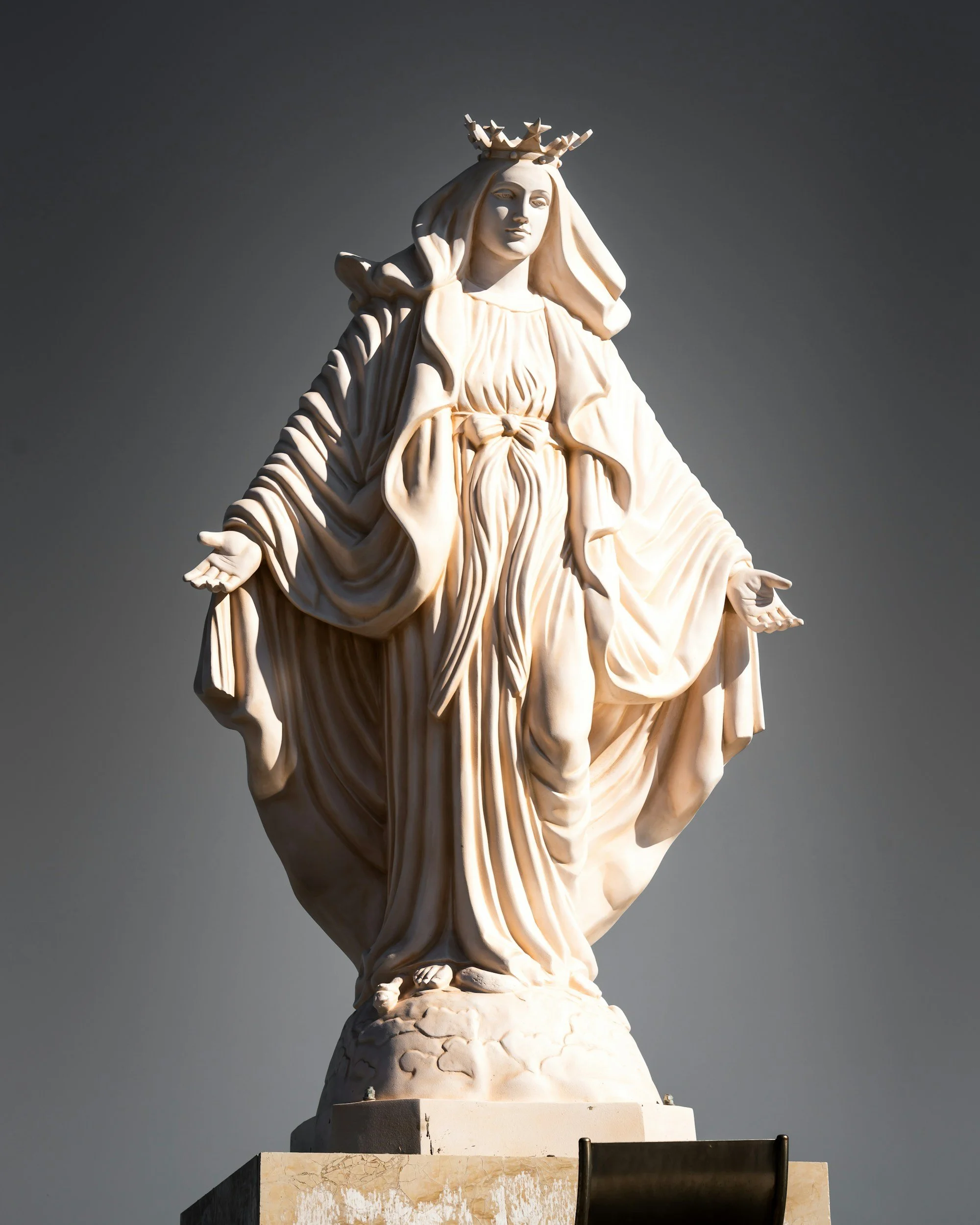
The Statue
Now we arrive at the part modern folks either obsess over or immediately dismiss.
The statue.
The wooden statue of Mary reportedly wept multiple times. 101 to be exact.
Blood.
Tears.
Perspiration.
Scientists examined samples associated with the statue and identified human biological material.
This sentence tends to produce immediate emotional polarization.
Believers interpret it as confirmation.
Skeptics interpret it as contamination, fraud, or misinterpretation.
Both responses are understandable.
But something else is historically interesting here.
Catholicism has always been a profoundly physical religion.
Modern secular culture increasingly treats spirituality as abstract emotional weather.
Catholicism historically did the opposite.
Bodies matter.
Blood matters.
Food matters.
Touch matters.
Pain matters.
The faith is filled with bones, relics, incense, wounds, tears, statues, rituals, smells, gestures, kneeling, standing, fasting, singing.
It is almost offensively embodied.
Which partly explains why highly intellectual Protestant cultures have often viewed Catholic mysticism with suspicion bordering on dermatological concern.
Too emotional.
Too medieval.
But Catholicism has always understood something modernity struggles to admit:
Human beings do not experience meaning abstractly.
We experience meaning physically.
The body is never merely transportation for the brain.
It is part of consciousness itself.
This does not prove the Akita claims.
It simply explains why stories like this persist.
Because they speak to parts of human psychology modern rationalism frequently underestimates.
The Problem of the Victim Soul
Eventually people began describing Sister Agnes as a “victim soul.”
This phrase immediately alarms contemporary readers because it sounds either masochistic or cult-like.
Understandably. Her stigmata is highly document and is also inconvenient.
But historically the phrase referred to people believed to voluntarily offer suffering for the spiritual benefit of others.
Now here modern culture encounters a genuine conceptual problem.
Because contemporary Western civilization possesses almost no coherent framework for meaningful suffering.
We have frameworks for trauma.
We have frameworks for pathology.
We have frameworks for optimization.
We have frameworks for productivity.
We even have frameworks for “wellness,” which mostly means affluent people paying eighty dollars to sit near eucalyptus leaves.
But sacrifice?
Voluntary suffering?
Offering pain for another person?
These concepts now sound emotionally foreign.
And yet every functioning civilization historically depended on precisely these ideas.
Soldiers sacrifice.
Nurses sacrifice.
Teachers sacrifice.
Marriage itself requires sacrifice.
Every enduring human bond eventually collides with the reality that love costs something.
Modern culture simultaneously depends upon sacrifice while becoming philosophically suspicious of it.
This creates confusion.
Sister Agnes emerged from a much older moral universe.
A universe in which suffering could possess relational meaning.
Again, this does not prove anything supernatural.
But it does explain why some religious people found her compelling.
She appeared sincere.
And sincerity is increasingly rare.
The Tension Between Skepticism and Contempt
One of the great intellectual failures of modernity is the assumption that skepticism requires contempt.
It does not.
A person can doubt extraordinary claims without sneering at the people involved.
Unfortunately the internet has destroyed this distinction.
Now every disagreement becomes theatrical.
Either hysterical belief or aggressive mockery.
But the Akita story deserves something more mature.
Because even if one rejects every supernatural interpretation entirely, Sister Agnes still represents an important historical figure.
Why?
Because she became the focal point for a religious event that profoundly affected thousands of people.
That matters sociologically.
Psychologically.
Historically.
Religious phenomena shape civilizations regardless of whether outsiders consider them objectively true.
Joan of Arc altered French history.
The Fatima apparitions altered Portuguese Catholicism.
The Taiping Rebellion in China emerged partly from mystical religious claims and resulted in catastrophic loss of life.
Human beings organize themselves around meaning.
Always have.
Always will.
The modern fantasy that secular rationality permanently displaced myth was one of the funniest intellectual mistakes of the twentieth century.
People still crave transcendence.
They simply relocated it.
Now we worship celebrity.
Politics.
Technology.
Personal identity.
Productivity.
Algorithms.
Nationalism.
The self.
Modernity did not eliminate religious instinct.
It redistributed it.
Which is why stories like Akita continue resurfacing.
Why Akita Disturbs Educated People
Educated people often experience particular discomfort around mystical claims because intelligence frequently creates an illusion of explanatory sovereignty.
We begin imagining reality is only real once categorized.
Only respectable once measured.
Only meaningful once peer-reviewed.
Now to be fair, peer review is generally preferable to medieval plague management.
Science is wonderful.
Antibiotics are wonderful.
Air conditioning is arguably humanity’s greatest moral achievement.
But scientific reasoning was never designed to answer every category of human question.
It cannot determine whether suffering possesses meaning.
It cannot determine whether consciousness transcends matter.
It cannot determine whether prayer changes reality.
Science describes mechanisms magnificently.
Meaning is harder.
The Akita story therefore lands inside a difficult intellectual space.
Because many educated people fear that taking religious experiences seriously threatens rationality itself.
But history suggests the opposite danger also exists.
People can become so terrified of appearing irrational that they develop emotional illiteracy.
They lose the capacity to engage mystery without either collapsing into gullibility or retreating into sarcasm.
Sister Agnes became a test case for this tension.
The Emotional Texture of Akita
One reason Akita persists in cultural memory is tonal.
The emotional atmosphere feels unusually coherent.
This is difficult to explain unless one has spent time around highly theatrical religious movements.
Many modern “apparitions”feel emotionally inflated.
Too eager.
Too dramatic.
Too hungry for attention.
Akita feels almost reluctant.
The story possesses a strange austerity.
Cold weather.
Small rooms.
Silence.
Illness.
Isolation.
Prayer.
The emotional texture resembles an Ingmar Bergman film accidentally colliding with a convent.
And importantly, Sister Agnes herself reportedly continued living quietly.
No celebrity circuit.
No empire.
No merchandising strategy.
This matters psychologically.
Fraud is usually expansionary.
Authentic conviction—whether objectively true or not—is often contractionary.
People become quieter.
Not louder.
More hidden.
Not more performative.
Which brings us to the deepest tension inside the Akita story.
Modern culture no longer knows how to interpret serious spiritual claims without collapsing into either credulity or contempt.
We have become intellectually sophisticated and symbolically illiterate at the same time.
The moment a story involves suffering, silence, sacrifice, or transcendence, contemporary people reach instinctively for one of two emotional shelters.
Mockery.
Or fanaticism.
But Akita resists both.
Because even if one rejects every supernatural claim entirely, the historical atmosphere surrounding Sister Agnes still feels unusually coherent.
A deaf nun in postwar Japan.
A tiny convent.
Cold rooms.
Prayer.
Silence.
Warnings about catastrophe less than thirty years after Hiroshima.
A civilization haunted by annihilation.
The story feels psychologically real even to people uncertain it is supernaturally true.
And that distinction matters.
Because history is filled with events that become culturally important long before anyone fully understands them.
The most unsettling possibility surrounding Akita is not that a statue may have wept or that a nun may have heard voices in prayer.
Human history is crowded with such claims.
The unsettling possibility is that modern civilization may no longer possess the emotional equipment necessary to distinguish between spectacle and warning.
We have become so saturated with noise, branding, irony, stimulation, and algorithmic distraction that silence itself now feels suspicious.
And somewhere in the background of all this, a deaf nun in rural Japan spent years insisting that humanity had mistaken technological advancement for moral advancement.
Looking around at the twenty-first century—with its loneliness epidemics, spiritual exhaustion, genocide, digital addiction, ambient rage, and permanent psychological overstimulation—one begins to understand why the Akita story refuses to die.
Not because everyone believes it.
But because too many people quietly suspect it may have understood something about modern humanity before modern humanity understood it about itself.
Again, none of this proves supernatural causation.
But human beings unconsciously evaluate credibility behaviorally.
And Sister Agnes behaved less like a public manipulator than many expected.
Catholics and Private Revelation
Another thing modern audiences misunderstand is that Catholics are not required to believe in Akita.
This distinction matters enormously.
Catholicism differentiates between public revelation—the foundational teachings of the faith—and private revelations, which individuals may accept or reject.
Even approved apparitions do not become mandatory belief.
This surprises non-Catholics, who often imagine the Church operating as a mystical dictatorship issuing supernatural press releases.
In reality Catholic institutions historically approach apparitions with substantial caution.
Sometimes excessive caution.
The Church has rejected many claims.
Investigated others for decades.
Allowed local devotion while withholding broader endorsement.
The bishop associated with Akita eventually approved belief in the events at the diocesan level after years of investigation.
This gave the story credibility among many Catholics.
But Rome never transformed Akita into universally binding belief.
This institutional restraint is psychologically healthier than outsiders sometimes appreciate.
Because mystical experiences are combustible.
Humans are highly suggestible social creatures.
Mass psychology is real.
Collective projection is real.
Fraud is real.
Delusion is real.
Religious ecstasy is real.
The challenge is that genuine religious depth may also be real.
History does not simplify the problem.
Silence in an Age of Exhibitionism
Perhaps the deepest reason Sister Agnes fascinates people today is that she represented a personality structure modern society increasingly lacks.
Interiority.
Not privacy exactly.
Something deeper.
Interiority means possessing an inner life not organized around display.
This quality is disappearing.
Social media transformed millions of people into full-time publicists for their own emotional experiences.
Every feeling now arrives with imagined audience metrics.
People no longer merely experience life.
They experience themselves being observed experiencing life.
This alters consciousness.
The philosopher Guy Debord described modernity as a “society of the spectacle.”
He was correct.
But even Debord probably underestimated how fully ordinary identity itself would become performative.
By contrast, Sister Agnes appears almost anti-spectacular.
Not because the Akita claims were small.
They were enormous.
But because she herself seemed emotionally recessed from publicity.
This discrepancy is psychologically compelling.
A person associated with dramatic events who nonetheless appears uninterested in personal inflation.
That combination is rare.
Suffering and Modern Confusion
Modern people frequently misunderstand religious suffering because we increasingly assume suffering possesses value only if escaped quickly.
Now obviously unnecessary suffering should generally be reduced.
No reasonable person romanticizes untreated infection.
Morphine exists for a reason.
But older spiritual traditions understood something psychologically profound:
Human beings sometimes become transformed through suffering they cannot avoid.
Not automatically.
Suffering can also destroy people.
Make them cruel.
Bitter.
Hopeless.
But suffering can also deepen compassion.
Humility.
Patience.
Moral seriousness.
The question becomes not whether suffering exists.
It does.
The question becomes whether suffering can possess meaning.
Sister Agnes answered yes.
Modern secular culture increasingly answers no.
This disagreement is larger than Akita.
It is civilizational.
The Historical Report Problem
There is another difficulty here.
Modern people often assume history functions like a courtroom.
Evidence enters.
Conclusions emerge.
Reality stabilizes.
Unfortunately history behaves more like weather.
Messy.
Layered.
Partial.
Human testimony is unreliable.
Memory distorts.
Institutions protect themselves.
Witnesses exaggerate.
Skeptics overcorrect.
Believers overinterpret.
Every historical event arrives contaminated by human perception.
This includes wars.
Political movements.
Religious experiences.
Scientific revolutions.
Everything.
The Akita reports therefore exist inside ordinary historical ambiguity.
Documents exist.
Witnesses existed.
Investigations occurred.
None of this eliminates uncertainty.
But uncertainty is not the same thing as falsehood.
Modern discourse increasingly struggles with this distinction.
People now assume ambiguity itself discredits an event.
But ambiguity accompanies almost all meaningful human experience.
Especially spiritual experience.
Why Folks Keep Returning to Akita
People continue returning to Akita because the story touches several deep human anxieties simultaneously.
Fear of catastrophe.
Fear of meaninglessness.
Fear of spiritual emptiness.
Fear that modern civilization has become emotionally unmoored.
And honestly, looking around at contemporary culture, one can understand why some people feel spiritually alarmed.
We are technologically advanced and emotionally exhausted.
Hyperconnected and lonely.
Constantly stimulated and strangely numb.
People scroll through apocalypse while eating lunch.
Children develop anxiety disorders before learning long division.
Adults now discuss “dopamine fasting” because we accidentally converted civilization into a neurological slot machine.
Against this background, the Akita story feels less bizarre than critics sometimes pretend.
A suffering nun warning about spiritual collapse in the aftermath of world war may actually be psychologically coherent.
Whether supernatural or not.
The Strange Credibility of Humility
One thing repeatedly noted about Sister Agnes was humility.
Now humility is difficult to discuss because contemporary culture has corrupted the term.
Many people now perform humility aggressively.
Which defeats the purpose.
Actual humility often looks socially unimpressive.
Quiet.
Reserved.
Uninterested in self-advertisement.
This matters because modern celebrity culture rewards precisely the opposite traits.
Visibility.
Confidence.
Personal branding.
Narrative control.
Sister Agnes appears to have possessed little interest in these things.
Again, this does not prove the apparitions.
But it complicates simplistic dismissals.
People searching for power usually behave differently.
The Intellectual Temptation of Reductionism
Highly educated people often experience enormous temptation toward reductionism.
Reductionism is emotionally satisfying because it shrinks mystery into mechanism.
The nun had trauma.
The convent projected meaning.
The witnesses were suggestible.
The tears were contamination.
The messages reflected Cold War anxiety.
Done.
Case closed.
Now some of these explanations may partially contain truth.
Probably several do.
Human events usually involve multiple causes simultaneously.
But reductionism becomes intellectually lazy once it assumes explaining part of something explains all of it.
A sunset can be scientifically described without exhausting its meaning.
Love can be neurochemically described without exhausting its meaning.
Religious experience can be psychologically analyzed without exhausting its meaning.
The Akita story therefore remains stubborn.
Not because evidence conclusively proves supernatural intervention.
But because human experience itself exceeds clean categorization.
Frequently Asked Questions
Was Sister Agnes Sasagawa officially declared a saint?
No. Sister Agnes Sasagawa was not canonized by the Catholic Church. She became known internationally because of her association with the reported apparitions at Akita.
Did the Catholic Church approve the Akita apparitions?
The local bishop, John Shojiro Ito, approved belief in the events connected to Akita after years of investigation. However, Catholics are not required to believe in Akita because private revelations are never considered equal to core Church doctrine.
Did the statue at Akita really weep blood and tears?
Reports and investigations documented alleged instances of the statue weeping blood, tears, and perspiration. Laboratory testing reportedly identified human biological material. Believers interpret this as miraculous. Skeptics propose explanations ranging from contamination to fraud to misunderstanding.
What is a victim soul?
In lay Catholic spirituality, a victim soul is someone believed to voluntarily offer suffering to God for the spiritual benefit of others. The term is part of devotional spirituality rather than formal Church doctrine.
Why does Akita still fascinate people?
Because the story sits directly between skepticism and transcendence. It combines suffering, war-era anxiety, religious symbolism, institutional caution, psychological ambiguity, and profound questions about whether modern society has lost the ability to interpret spiritual experience seriously.
Was Sister Agnes mentally ill?
No definitive evidence established severe psychiatric illness. However, skeptics often interpret mystical experiences psychologically rather than supernaturally. The historical difficulty is that religious experience and psychological experience are not always cleanly separable categories.
Why does the Akita story feel emotionally different from many modern apparitions?
Many people notice the austerity of the story. Akita lacks celebrity culture, emotional spectacle, and triumphalism. The atmosphere feels quiet, cold, restrained, and psychologically severe.
The Final Difficulty
The final difficulty with Sister Agnes Sasagawa is this:
If she was sincere, then modern culture must confront a type of person it no longer understands.
A person organized around sacrifice instead of self-expression.
Silence instead of visibility.
Prayer instead of performance.
Duty instead of identity optimization.
This does not mean one must believe the apparitions.
Reasonable people disagree.
But even skeptics should recognize that the disappearance of this personality type may represent a civilizational loss.
Not because suffering is inherently noble.
But because civilizations require people capable of enduring difficulty without immediately converting experience into spectacle.
Sister Agnes belonged to a moral and spiritual world modernity increasingly struggles to interpret.
Which is precisely why she continues haunting it.
Not as proof.
Not as disproof.
But as a question.
A profoundly uncomfortable one.
What if modern civilization has become extremely sophisticated about information while becoming increasingly illiterate about transcendence?
The Akita story persists because it refuses to disappear cleanly into either category.
Not miracle.
Not fraud.
Something harder.
A historical event saturated with mystery, suffering, symbolism, psychology, faith, ambiguity, and the ancient human suspicion that reality may contain dimensions our cleverness alone cannot fully domesticate.
The most unsettling possibility surrounding Akita is not that a statue may have wept, or that a nun may have heard voices in prayer.
Human history is crowded with such claims.
The unsettling possibility is that modern civilization may no longer possess the emotional equipment necessary to distinguish between spectacle and warning.
We have become so saturated with noise, branding, irony, stimulation, and algorithmic distraction that silence itself now feels suspicious to us.
And somewhere in the background of all this—a deaf nun in rural Japan spent years insisting that humanity had mistaken technological advancement for moral advancement.
Looking around at the twenty-first century, with its loneliness epidemics, collapsing trust, spiritual exhaustion, digital addiction, ambient rage, and permanent psychological overstimulation, one begins to understand why the Akita story refuses to die.
Not because everyone believes it.
But because too many people quietly fear it may have understood something about us before we understood it ourselves.
Which is, unfortunately, the sort of thing history occasionally does.
Be Well, Stay Kind, and Godspeed.
REFERENCES:
Aune, D. E. (1998). Prophecy in early Christianity and the ancient Mediterranean world. Wm. B. Eerdmans Publishing.
Bynum, C. W. (1987). Holy feast and holy fast: The religious significance of food to medieval women. University of California Press.
Debord, G. (1994). The society of the spectacle (D. Nicholson-Smith, Trans.). Zone Books. (Original work published 1967)
Eliade, M. (1959). The sacred and the profane: The nature of religion (W. R. Trask, Trans.). Harcourt.
James, W. (1985). The varieties of religious experience. Harvard University Press. (Original work published 1902)
McClenon, J. (2002). Wondrous healing: Shamanism, human evolution, and the origin of religion. Northern Illinois University Press.
Rambo, L. R. (1993). Understanding religious conversion. Yale University Press.
Sullivan, L. E. (Ed.). (1987). Hidden Christians of Japan. University of Hawai‘i Press.
The Holy See. (1978). Norms regarding the manner of proceeding in the discernment of presumed apparitions or revelations.
Turner, V. (1969). The ritual process: Structure and anti-structure. Aldine Publishing.
Whelan, R. (1996). The miracle of Fatima. Image Books.