
Friday, March 13, 2026.
Most people believe relationships end because of conflict.
In my work with marriages and families, that explanation almost never survives careful inspection.
Conflict is loud. Conflict is dramatic. Conflict gives everyone something to point at.
But the deeper cause of relational collapse is usually quieter and far more gradual.
Relationships end when attention slowly migrates away from the bond.
Not all at once. Not with a dramatic betrayal. But through thousands of small moments when one partner’s emotional signals go unnoticed, unanswered, or misinterpreted.
If you observe couples long enough, a pattern begins to appear.
Love is not primarily sustained by feelings.
Feelings fluctuate. Feelings behave like weather systems.
Love is sustained by patterns of attention.
Where attention flows, intimacy deepens.
Where attention thins out, connection slowly begins to starve.
Modern life has made this fragile system far more difficult to maintain.
Smartphones fracture our focus. Work follows us home through laptops.
Social media introduces a constant parade of alternative lives, alternative partners, and alternative narratives about what our own lives should look like.
In the middle of all this, many couples discover something they were never taught.
A relationship is not merely an emotional bond.
And when that system breaks down, the relationship begins to deteriorate in ways that feel confusing and strangely invisible to the people inside it.
Why do relationships fail when attention disappears?
Relationships often fail when partners stop responding to each other’s emotional bids. Over time this lack of attention creates emotional disconnection, loneliness, and declining intimacy. Psychologists describe this process as an attentional breakdown in the relationship.
What Is the Attention Economy of Love?
The attention economy of love refers to the psychological principle that romantic relationships are sustained by patterns of emotional attention.
Partners continuously send signals requesting recognition—often called emotional bids—and the stability of the relationship depends on whether those signals receive responsive attention.
In short:
Attention is the primary currency of intimacy.
Where attention goes, emotional reality follows. Attention windows matter.
When attention reliably returns to the bond, intimacy grows.
When attention is ignored, distorted, or redirected elsewhere, emotional disconnection slowly begins to develop.
Relationships, in other words, behave very much like economic systems.
Only the currency is not money.
The currency is attention.
The Small Signals That Sustain Love
Picture a quiet moment between two partners.
Someone says something small:
“I had the strangest meeting today.”
Or perhaps:
“You won’t believe what happened at the grocery store.”
In relationship science these small signals are called emotional bids.
A bid is a request for attention.
Not dramatic attention.
Just the ordinary human acknowledgment that says:
I see you.
The research of John Gottman demonstrated how important these tiny moments can be.
In long-term observational studies of couples, researchers found that stable couples respond positively to emotional bids far more often than distressed couples.
What matters most in a relationship is rarely the big romantic gesture.
It is the tiny moments of attention that accumulate over time.
Marriage, in many ways, is simply the adroit long-term management of small moments.
Ignore enough of those moments, and the relationship begins to drift. Deftly attend to them, and your relationship becomes “good enough.”
The Neuroscience of Attention and Attachment
Attention is not merely a social habit.
It is a neurological process.
The human brain contains specialized attentional systems that detect emotionally meaningful cues from important people in our lives. When a partner’s signals are noticed and responded to, the brain’s reward systems reinforce the bond.
When those signals are repeatedly ignored, a very different neurological pattern appears.
Research by Naomi I. Eisenberger demonstrated that social rejection activates many of the same neural pathways associated with physical pain.
In other words, when a partner repeatedly fails to notice us, the brain interprets that absence as something very close to injury.
From an evolutionary perspective this makes sense.
For most of human history, the attentiveness of close others was essential for survival.
Being ignored by someone important was never simply unpleasant.
It was dangerous. Painful.
And profoundly unsettling.
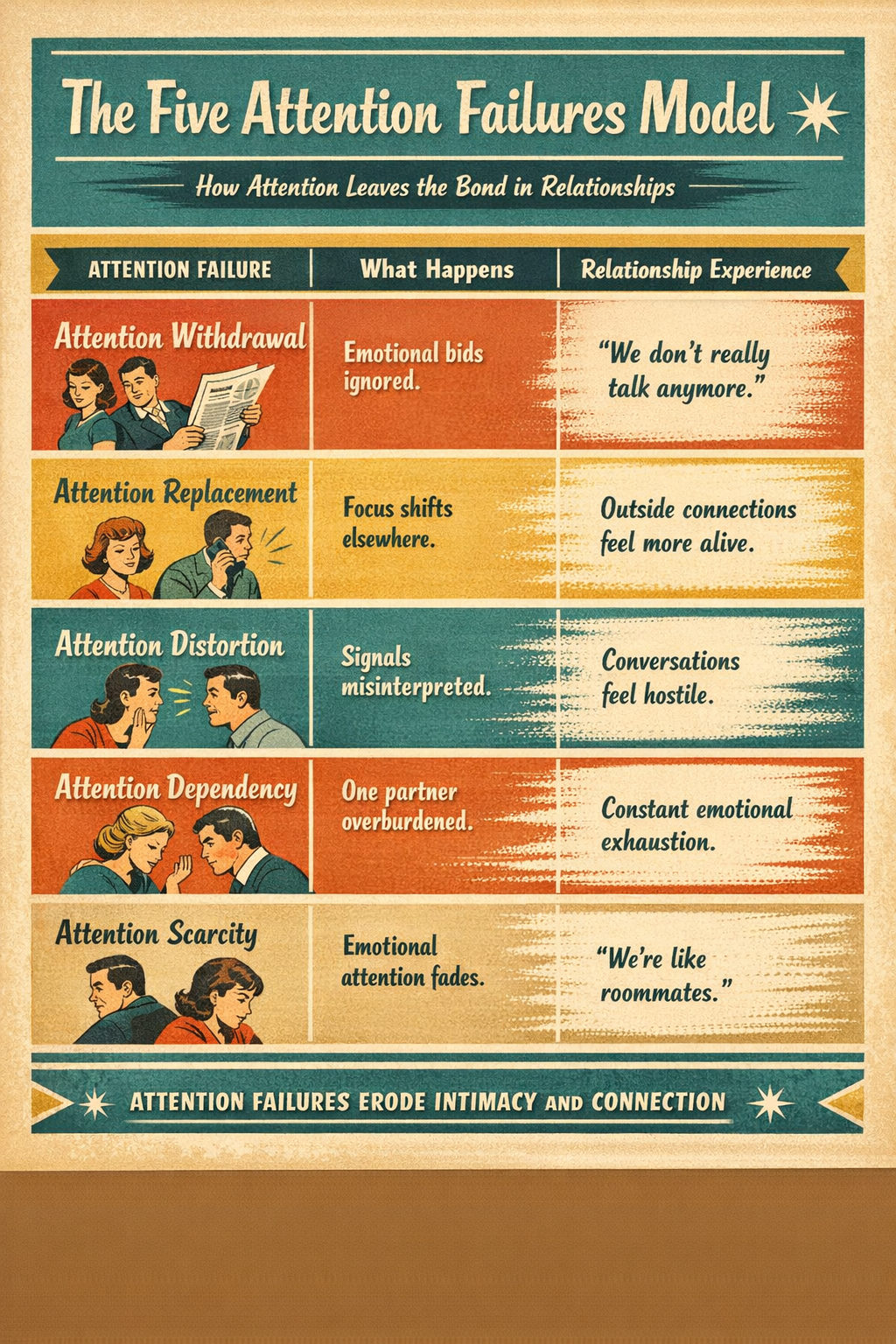
The Five Attention Failures That Quietly Destroy Relationships
Relationships rarely collapse randomly.
They tend to deteriorate through a small set of recurring attentional failures.
Each one appears small.
But together they quietly reorganize the emotional structure of the relationship.
Attention Withdrawal
Attention withdrawal occurs when a partner gradually stops responding to emotional signals.
Conversations become shorter. Curiosity fades. Emotional engagement is replaced by logistical exchanges about schedules, errands, and the children’s orthodontist.
Life partners begin saying things like:
“We don’t really talk anymore.”
This is usually not because people have nothing to say.
It is because bestowed attention has left the room.
In many relationships this is the first stage of what I sometimes call relationship quiet quitting.
No dramatic exit.
Just the slow disappearance of emotional presence.
Attention Replacement
Sometimes attention does not disappear.
It simply relocates.
Attention replacement occurs when emotional energy that once flowed toward a partner begins flowing elsewhere. Narrative gravity finds a new home.
This can happen through:
texting a colleague.
confiding in a friend.
constant engagement with social media.
This is often where narrative infidelity subtly begins.
Narrative infidelity is not yet a physical affair.
It is the quiet psychological rehearsal of intimacy somewhere outside the relationship.
Someone else becomes the person who hears about your day.
Someone else becomes the person who understands your frustrations.
Over time the emotional center of gravity shifts.
Attention Distortion
In some relationships attention is still present.
It is simply distorted.
Partners begin interpreting each other’s signals through increasingly negative assumptions.
A request for closeness becomes criticism.
Concern becomes accusation.
Curiosity becomes control.
This is closely related to a dynamic I have described elsewhere as interpretive trespassing— often seen as the habit of assigning hostile intentions to neutral behavior.
Once this pattern becomes established, every conversation begins to feel like a courtroom.
Someone is always on trial.
And intimacy rarely survives a courtroom atmosphere.
Attention Dependency
Some relationships develop a different imbalance.
One partner gradually becomes responsible for regulating the emotional stability of the other.
The relationship begins functioning as though one nervous system is stabilizing two people.
This dynamic is common in relationships involving trauma histories, anxiety disorders, or certain neurodivergent conditions.
Over time the caregiving partner becomes exhausted.
Not because love disappears.
But because emotional regulation is a job description no adult nervous system can perform indefinitely.
Eventually the caregiving partner withdraws simply to breathe again.
Attention Scarcity
The final stage occurs when attention becomes rare enough that the relationship begins to feel empty.
Partners say things like:
“I feel invisible.”
Or the classic modern marital diagnosis:
Loneliness inside a relationship can feel more destabilizing than loneliness outside one.
At least when you are single, loneliness makes sense.
Loneliness inside a partnership feels like a contradiction.
Modern Technology and the Fragmentation of Attention
A couple sitting on a couch in 1926 typically had one primary outlet for bestowed attention.
Each other.
A couple sitting on a couch in 2026 has dozens.
Phones vibrate. Notifications flash. Algorithms quietly study our preferences and feed us an endless stream of stimulation.
The modern relationship is not competing against another person.
It is competing against the entire attention economy of the internet.
And the internet is very, very good at winning that competition.
The Curious Thing About Attention
Attention always moves toward whatever feels most urgent.
Unfortunately, modern culture excels at manufacturing urgency.
Breaking news.
Incoming messages.
The irresistible gravitational pull of scrolling.
Meanwhile the person sitting next to us rarely announces themselves with flashing lights.
They simply exist quietly beside us, hoping to be noticed.
The tragedy of many relationships is not that partners stop loving each other.
It is that they stop looking up long enough to see each other.
A Quick Attention Check for Your Relationship
Ask yourself a few questions.
When my partner speaks, do I pause and look at them?
Do I respond to small emotional bids?
Do I check my phone while they are talking?
When was the last time I asked a curious question about their inner world?
If several of these questions feel uncomfortable, the relationship may not be suffering from a lack of love.
It may be suffering from attention drift.
When Attention Leaves, Meaning Often Leaves With It
Attention does not merely shape perception.
It shapes meaning.
Existential psychiatrist Viktor Frankl argued that human beings derive meaning from the experiences to which they direct their attention.
Relationships follow the same principle.
When partners consistently attend to each other’s emotional world, the relationship becomes a source of meaning.
When attention drifts away, meaning often drifts with it.
Couples sometimes describe this shift very simply:
“I don’t know what happened. We just stopped feeling connected.”
What often disappeared was not love.
It was sustained attention to each other’s inner lives.
The Paradox of Modern Love
The strange paradox of modern relationships is this:
We have never had more ways to communicate.
And never been worse at paying attention.
Couples today exchange thousands of messages.
But the deeper experience of being fully seen by another person is becoming rare.
And relationships, like living organisms, cannot survive long without oxygen.
Attention is the oxygen.
Frequently Asked Questions About the Attention Economy of Love
What is the attention economy of love?
The attention economy of love describes the idea that romantic relationships are sustained by patterns of emotional attention. Partners continually send signals requesting recognition—often called emotional bids—and the stability of the relationship depends on whether those signals receive responsive attention.
When attention consistently returns to the bond, intimacy grows. When attention is ignored or redirected elsewhere, emotional disconnection develops.
Why does attention matter so much in relationships?
Attention communicates recognition and emotional safety. Attachment research shows that when partners respond to each other’s emotional signals, the nervous system registers security and connection.
When attention repeatedly fails to return, partners often experience loneliness, resentment, and emotional distance.
What are emotional bids in relationships?
Emotional bids are small signals people use to request connection from their partner. These can include comments about daily experiences, expressions of vulnerability, humor, or subtle body language.
Research by John Gottman shows that couples who respond to each other’s bids consistently tend to maintain stronger and more stable relationships.
Why do couples stop paying attention to each other?
Couples rarely stop paying attention intentionally. More often attention becomes fragmented by modern pressures such as work stress, smartphones, unresolved resentment, and emotional exhaustion.
Over time these small attentional failures accumulate and partners begin to feel emotionally unseen.
Can a relationship recover after emotional disconnection?
Yes. Many distressed relationships improve once partners begin restoring attentional behaviors—responding to emotional bids, listening without distraction, and showing curiosity about each other’s inner lives.
When emotional attention returns to the relationship, intimacy often begins to recover as well.
Do smartphones damage attention in relationships?
Research increasingly suggests that smartphone interruptions during conversations—sometimes called technoference—can reduce relationship satisfaction because they disrupt emotional responsiveness between partners.
Even brief attentional interruptions can weaken the feeling of being fully seen by a partner.
Final Thoughts
Relationships rarely collapse because love suddenly disappears.
More often, love remains present while attention quietly drifts away.
It drifts toward work.
Toward phones.
Toward resentment.
Toward the thousand small distractions of modern life.
Love rarely dies from conflict.
It dies from the slow misdirection of attention.
And when attention leaves the bond long enough, intimacy quietly follows it out the door.
Yet attention is one of the few relational resources couples can consciously restore.
Sometimes repair does not begin with dramatic apologies.
It begins with something simpler.
And allowing your attention to return to the person who has been quietly waiting for it.
Be Well, Stay Kind, and Godspeed.
REFERENCES:
Eisenberger, N. I., Lieberman, M. D., & Williams, K. D. (2003). Does rejection hurt? An fMRI study of social exclusion. Science, 302(5643), 290–292.
Frankl, V. E. (1963). Man’s search for meaning. Beacon Press.
Gottman, J. M., & Levenson, R. W. (1992). Marital processes predictive of later dissolution: Behavior, physiology, and health. Journal of Personality and Social Psychology, 63(2), 221–233.
Kahneman, D. (2011). Thinking, fast and slow. Farrar, Straus and Giroux.
Reis, H. T., & Shaver, P. (1988). Intimacy as an interpersonal process. In S. Duck (Ed.), Handbook of personal relationships. Wiley.