Emotional Affairs Rarely Begin Where Couples Think They Do
Friday, March 13, 2026.
Most emotional affairs do not begin with attraction.
They begin with attention.
In my work with couples, the discovery moment almost always looks the same.
Someone opens a phone.
A series of messages appears.
A conversation clearly carries more emotional energy than it should.
And suddenly the betrayed partner asks the same question every time:
“How did this happen?”
From the outside it can look abrupt.
But in therapy these moments rarely appear without warning. What couples experience as a sudden betrayal is usually the final stage of a much quieter psychological process.
Long before anyone uses the word affair, something else has already happened.
Attention has begun to move.
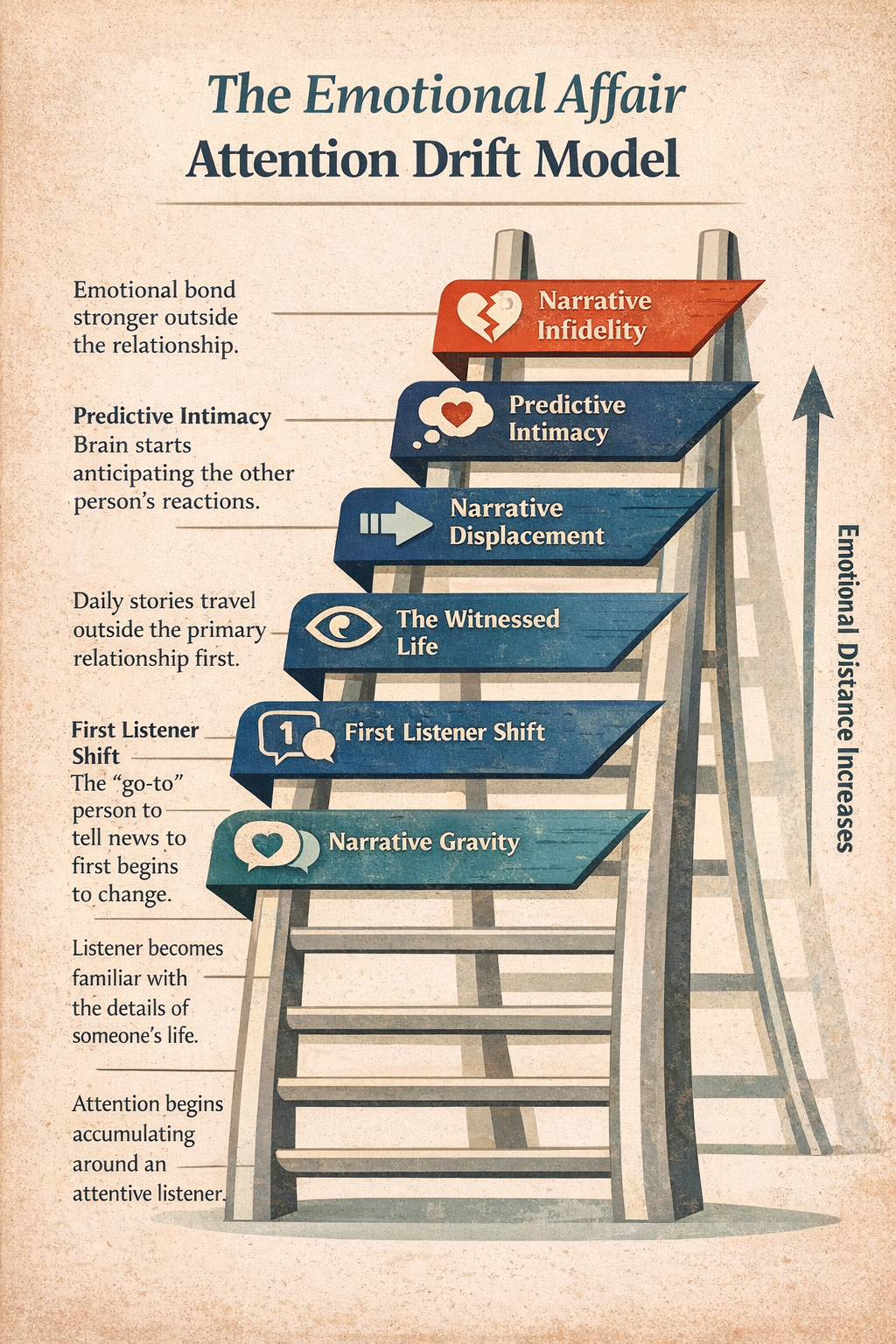
And once attention begins shifting, it tends to follow a recognizable pattern.
Over time that movement unfolds through subtle changes in where people tell the stories of their lives.
If you are reading this and quietly recognizing parts of your own relationship in these patterns, you are not alone. Many couples do not notice these shifts until emotional distance has already begun.
The encouraging news is that attention can move back as well as away.
The Narrative Fidelity Principle
Every long-term relationship runs on an invisible rule.
Partners remain emotionally close when they remain each other’s primary audience.
Daily life generates a constant stream of experiences:
small frustrations
observations
moments of humor
victories
annoyances
hopes
When those stories are shared primarily inside the relationship, emotional intimacy deepens.
But when the storytelling begins moving elsewhere, emotional gravity follows.
This dynamic can be summarized in a simple principle:
Emotional intimacy tends to form around the person who consistently receives the story of your life.
This is why emotional affairs so often begin with conversation.
Conversation is how emotional presence accumulates.
Five Attention Shifts That Often Precede Emotional Affairs
Attention begins accumulating around the person who listens most carefully.
Human beings respond powerfully to attentive witnessing. The person who shows curiosity about our experiences begins to occupy space in our emotional world.
Conversation becomes the starting point of closeness.
Not because conversation is inherently intimate — but because being understood is.
At some point something subtle begins to change.
The person someone instinctively wants to tell things to first begins to move.
The coworker hears about the difficult meeting.
The friend receives the late-night message.
The online acquaintance hears the good news before anyone else.
This moment is often invisible.
But psychologically it is profound.
Because the first listener reveals where emotional gravity is moving.
As stories accumulate, the listener becomes familiar with the emotional landscape of another person's life.
They know the characters.
They remember what happened last week.
They understand the tensions shaping everyday experiences.
Over time the listener begins to feel psychologically present inside that life.
People bond not only through shared experiences.
They bond through shared narrative awareness.
Eventually the small stories of daily life begin traveling outside the relationship first.
This stage is rarely dramatic.
But it signals something important.
The frustrations.
The funny observations.
The small victories.
They are increasingly shared somewhere else first.
When that happens, emotional gravity has already begun shifting.
By the time emotional affairs become visible, the brain has often reorganized around the new listener.
Someone begins anticipating the other person’s reaction.
“I can’t wait to tell them.”
“They’ll understand this.”
“How will they respond?”
This is often the moment couples first realize something has shifted — when another person becomes the one whose reaction matters most.
When the mind begins predicting emotional exchanges with someone, attachment has already deepened.
By the time an emotional affair becomes visible, the process is usually well underway.
The emotional bond created through repeated storytelling and witnessing has grown stronger than the storytelling bond inside the primary relationship.
What appears sudden is usually the final stage of a gradual narrative shift.
The affair did not begin with attraction.
It began cognitively, with your bestowed attention permitted to move somewhere else.
The Daily Story Test
Couples sometimes ask how they can recognize this shift early.
One surprisingly powerful diagnostic question is this:
Who hears the story of your day first?
Not the dramatic events.
The small ones.
The strange moment in a meeting.
The funny thing someone said.
The irritation that lingered all afternoon.
These small stories are not trivial.
They are the building blocks of emotional intimacy.
If someone outside your relationship has quietly become the first person you want to tell things to, it does not necessarily mean your relationship is doomed.
But it does mean something important is happening.
These shifts are exactly the kinds of patterns couples therapy is designed to address.
When couples intervene early, emotional closeness can often be rebuilt surprisingly quickly.
Why Understanding These Shifts Matters
Viewing emotional affairs through the lens of attention and storytelling changes how couples understand what happened.
Instead of focusing only on the moment of betrayal, couples can begin recognizing the earlier shifts that allowed emotional gravity to move elsewhere.
And that recognition opens the door to something hopeful.
Because restoring emotional intimacy often begins with something deceptively simple:
Partners reclaiming the habit of telling each other the story of daily life.
One conversation at a time.
FAQ
What is narrative gravity?
Narrative gravity describes the tendency for emotional closeness to form around the person who consistently listens to someone’s experiences and daily stories.
What is predictive intimacy?
Predictive intimacy occurs when the brain begins anticipating emotional exchanges with a specific person. The mind begins mentally simulating conversations with them.
Why do emotional affairs often begin with conversation?
Repeated conversation creates emotional familiarity and psychological presence. The listener becomes integrated into the storyteller’s emotional world.
What is narrative infidelity?
Narrative infidelity occurs when the most meaningful stories of a person's life are increasingly shared outside the primary relationship, gradually shifting emotional intimacy elsewhere.
When Reading About Relationships Isn’t Enough
My gentle readers often arrive here the way most of us arrive anywhere on the internet.
Something in their relationship has started to feel different.
A little more distance.
A little more uncertainty.
A quiet sense that the emotional center of the relationship may be shifting.
Articles like this can help people understand what might be happening.
But relationships rarely change through insight alone.
They change through conversation — the kind that most couples find difficult to have on their own.
In my work with couples, we slow these moments down and examine the patterns together.
What looks like sudden betrayal often turns out to be a series of subtle attention shifts that can still be repaired when couples understand them in real time.
If your relationship feels like it may be entering one of these stages, you do not have to navigate that process alone.
I work with couples in private intensive sessions designed to help partners restore emotional connection and rebuild the habit of being each other’s primary listener.
If that kind of conversation would be helpful for you, you can learn more about working together here.
Be Well, Stay Kind, and Godspeed.
REFERENCES:
Aron, A., Aron, E., & Melinat, E. (1997). The experimental generation of interpersonal closeness. Personality and Social Psychology Bulletin, 23, 363–377.
Laurenceau, J.-P., Barrett, L. F., & Pietromonaco, P. R. (1998). Intimacy as an interpersonal process: The importance of self-disclosure and partner responsiveness in interpersonal exchanges. Journal of Personality and Social Psychology, 74(5), 1238–1251.
Reis, H. T., & Shaver, P. (1988). Intimacy as an interpersonal process. In S. Duck (Ed.), Handbook of personal relationships. Wiley.
Sprecher, S., Treger, S., & Wondra, J. D. (2013). Effects of self-disclosure role on liking, closeness, and other impressions in get-acquainted interactions. Journal of Social and Personal Relationships, 30(4), 497–514.