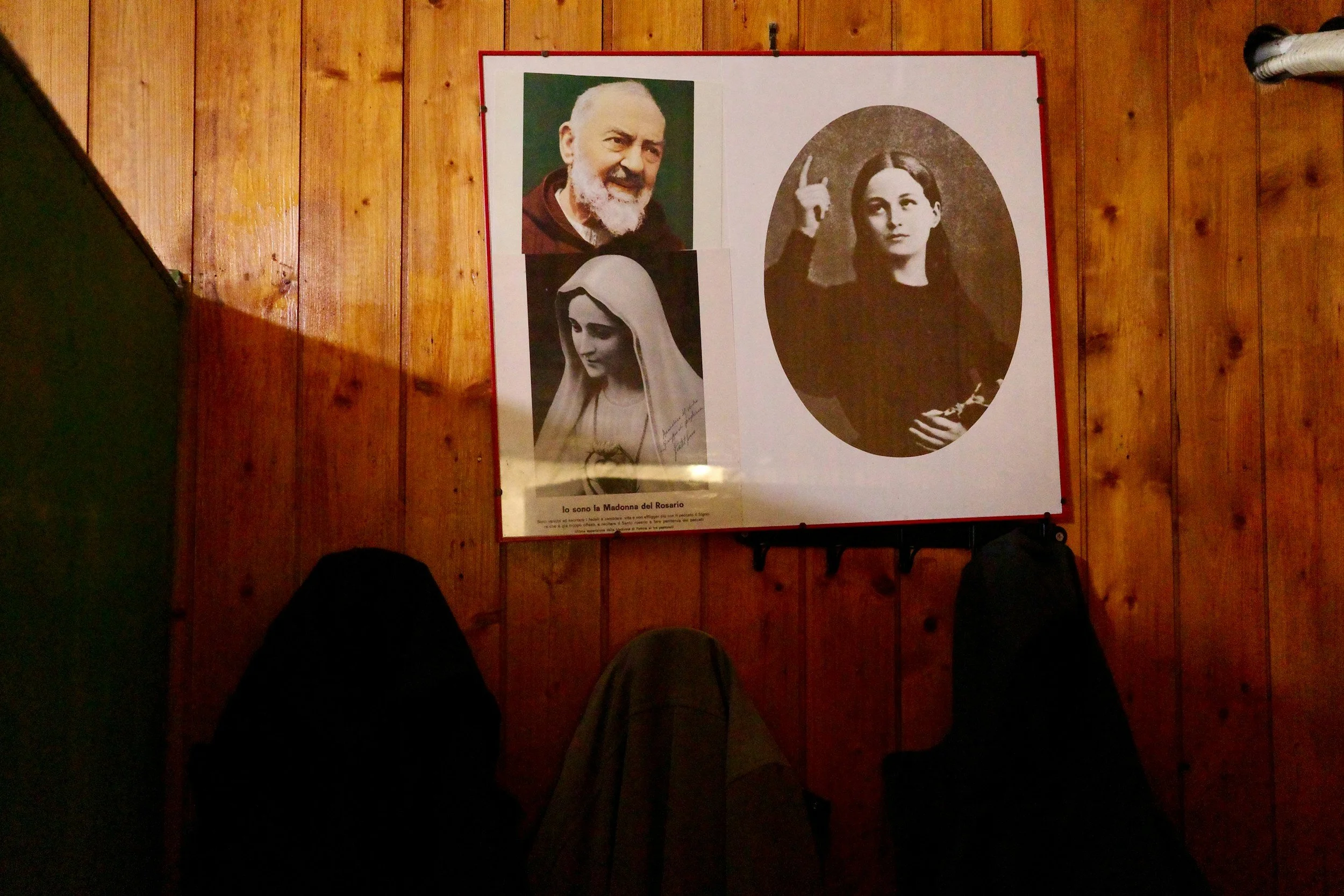
Padre Pio and the Collapse of Reverence: What Modern Relationships Keep Forgetting
Monday, May 18, 2026.
What a Twentieth-Century Mystic Understood About Love Before Modern Relationship Culture Did
Couples now fall apart while technically remaining in constant contact.
They text all day.
Share calendars.
Exchange Instagram reels from opposite ends of the same sectional sofa.
React to each other’s messages with tiny digital hieroglyphics while quietly losing access to one another’s interior worlds.
The modern relationship is exhausted.
Not always dramatic. Worse.
Administratively depleted.
Which is how Padre Pio suddenly becomes relevant again.
Not because he performed miracles. Not because of the stigmata.
Not because modern life secretly longs for supernatural spectacle, though it clearly does.
Every few years the culture becomes briefly obsessed with exorcisms, near-death experiences,
Marian apparitions, psychedelics, “energy work,” or billionaires explaining consciousness on podcasts while wearing sneakers that cost more than a dishwasher.
No. Padre Pio matters because he understood something modern culture keeps forgetting:
Human beings deteriorate when reverence collapses.
Not productivity.
Not communication.
Not optimization.
Reverence.
And once reverence disappears, relationships begin dying from perceptual neglect long before they die from open conflict.
How often partners stop studying one another long before they stop loving one another.
They stop remaining curious.
They stop noticing subtle shifts in mood, posture, humor, exhaustion, loneliness. The relationship becomes cognitively automated.
The nervous system experiences this as abandonment.
Not metaphorically.
Physiologically.
If this sounds familiar, you’ve probably heard it before. Many relationships are not destroyed in explosions. They erode through sustained inattentiveness that neither person fully recognizes until the emotional climate has already changed.
Padre Pio understood this decades before smartphones industrialized distraction.
The Self: Examined Versus Displayed
Padre Pio belonged to a civilization that assumed the self should be examined.
Modern culture belongs to a civilization that assumes the self should be displayed.
That difference is not cosmetic. It is psychologically enormous.
Born Francesco Forgione in southern Italy in 1887, Padre Pio became a Capuchin friar and eventually one of the most famous religious figures in the world.
Reports surrounding him included prophetic insight, miraculous healings, bilocation, spiritual visions, and the stigmata — wounds corresponding to the crucifixion of Christ.
The Vatican investigated him repeatedly.
Some church authorities believed he was a genuine mystic.
Others suspected emotional instability, fraud, mass suggestion, or dangerous religious enthusiasm.
Which, honestly, makes the story more compelling.
Mystics are rarely treated like convenient employees.
But the deeper significance of Padre Pio is not supernatural controversy. It is attentional intensity.
The man spent decades hearing confessions for up to sixteen hours a day.
Imagine that psychologically.
Cigarette breath.
Shame disguised as sarcasm.
Affairs narrated in evasive language.
Petty cruelties described as justified reactions.
Loneliness so profound it no longer sounded emotional but geological.
Then imagine hearing this for decades.
Modern therapeutic culture often frames suffering as interruption.
Padre Pio belonged to an older framework that treated suffering as revelation.
Not because pain is inherently noble. Not because misery should be romanticized.
But because suffering often exposes what the self is organized around.
That is a terrifying idea to modern culture.
Because modern culture prefers distraction to confrontation.
The Confessional Versus the Algorithm
The confessional assumes:
truth liberates.
conscience matters.
attention heals.
honesty changes perception.
and the soul requires examination.
The algorithm assumes:
outrage sustains engagement.
insecurity increases monetization.
stimulation prevents disengagement.
and vanity is profitable.
One system deepens moral awareness.
The other industrializes psychic fragmentation.
This is not merely technological change. It is civilizational change.
Modern couples are now attempting to sustain intimacy while immersed in systems specifically engineered to fracture sustained noticing. Their perceptual field is constantly interrupted. Their nervous systems remain partially elsewhere even while physically together.
And then they wonder why closeness feels strangely unfelt.
Because witness deteriorated.
Not communication necessarily. Witness.
That distinction matters.
Research from John Gottman repeatedly demonstrates that stable couples consistently “turn toward” one another’s bids for connection.
Tiny gestures matter enormously. Tone shifts matter.
Small acknowledgments matter. Micro-moments accumulate into relational atmosphere.
Padre Pio understood something similar from a spiritual direction perspective:
Where attention goes, emotional reality follows.
The marriage did not collapse in one catastrophic betrayal.
It slowly stopped being vividly perceived.
Modern Culture Has Confused Exposure With Intimacy
One of the stranger developments in contemporary relationships is the assumption that constant disclosure automatically creates closeness.
It does not.
Many couples now engage in perpetual emotional processing while remaining existentially unknown to one another.
Every mood becomes a summit meeting.
Every irritation becomes a committee review.
Every silence becomes suspicious.
The result is often not intimacy but surveillance.
Padre Pio emphasized silence repeatedly. Reflection. Interior examination. Restraint.
This feels almost offensively countercultural now.
The modern self fears silence because silence removes stimulation. And once stimulation disappears, individuals often encounter something deeply uncomfortable:
their actual emotional condition.
The modern nervous system is extraordinarily practiced at avoidance while simultaneously believing itself emotionally transparent.
This would not have impressed Padre Pio.
Reverence Is a Relationship Stabilizer
One of the most overlooked variables in long-term relationships is admiration.
Not idealization.
Admiration.
Idealization is fantasy.
Admiration is sustained recognition under conditions of reality.
This is why contempt is so corrosive psychologically.
Contempt collapses reverence.
Once one partner begins viewing the other primarily through annoyance, mockery, dismissal, or chronic disappointment, perceptual generosity narrows dramatically.
The relationship becomes emotionally claustrophobic.
Research consistently supports this.
Gottman’s work repeatedly identifies contempt as one of the strongest predictors of relational collapse. But modern culture often misunderstands the deeper mechanism.
Contempt is not merely hostility.
Contempt is failed reverence.
And contemporary culture quietly incentivizes it.
Irony has become the dominant emotional posture of late modernity.
Everything must be winked at. Nothing can remain sacred for very long before attracting mockery, distancing, or performative skepticism.
But marriages cannot survive perpetual ironic detachment.
Someone eventually wants to be encountered sincerely.
Not optimized.
Not psychoanalyzed continuously.
Not reduced to content.
Not converted into a running commentary thread.
Simply encountered.
Padre Pio’s entire spiritual framework depended upon the possibility that another human being remained mysteriously valuable even when flawed.
That assumption alone now feels almost radical.
The Modern Relationship Is Suffering From Attention Migration
Many relationships do not end because affection disappears.
They end because psychic prioritization shifts elsewhere.
Toward work.
Toward devices.
Toward online identities.
Toward ambient anxiety.
Toward exhaustion.
Toward stimulation.
Toward other audiences and first listeners.
The nervous system notices this long before conscious language catches up.
One of the most painful moments in couples therapy is when a partner realizes:
“You no longer light up perceptually when I enter the room.”
Not sexually necessarily.
Not dramatically.
Perceptually.
That sentence alone contains entire divorces.
Padre Pio understood sustained noticing and bestowed attention as a spiritual discipline.
Prayer itself functioned as perceptual retraining.
Reverence required slowing attention long enough for meaning to become visible again.
Modern life increasingly makes this impossible.
Or at least extremely difficult.
The Collapse of Sacrifice
Padre Pio also belonged to a moral world where sacrifice retained dignity.
Modern culture distrusts sacrifice intensely unless it produces visible status rewards.
But long-term love requires chosen inconvenience constantly.
Marriage disagrees with consumer logic every day.
Children disagree with it.
Caregiving disagrees with it.
Aging disagrees with it.
Stable love repeatedly demands asymmetrical labor under imperfect emotional conditions.
Contemporary culture often interprets inconvenience as evidence something is wrong.
Older spiritual traditions frequently interpreted inconvenience as the beginning of transformation.
Those frameworks produce radically different marriages.
This does not mean suffering should be glorified or abuse tolerated. Some relationships absolutely require boundaries, distance, or dissolution. But modern culture increasingly struggles to distinguish between:
healthy self-protection.
andintolerance of ordinary relational burden.
That confusion creates fragile attachment systems.
Why Mystics Continue to Haunt Modernity
Despite technological sophistication, modern populations remain fascinated by mystics.
Why?
Because purely mechanistic existence eventually feels emotionally insufficient.
Human beings continue searching for indications that consciousness possesses depth beyond transaction and management.
This is partly why interest in contemplation, pilgrimage, liturgy, mindfulness, psychedelics,
Marian apparitions, and transcendence repeatedly resurfaces during periods of cultural acceleration.
The nervous system appears to require meaning the way lungs require oxygen.
William James recognized this more than a century ago in The Varieties of Religious Experience. So did Viktor Frankl in his work on meaning and suffering.
Padre Pio belonged to this older understanding:
that the human person cannot survive indefinitely on stimulation alone.
Eventually the soul demands gravity.
Marriage Is Partly a Perceptual Discipline
Modern couples are often told they need better communication.
Sometimes they do.
But many distressed relationships are suffering from something deeper:
the collapse of sustained perception.
Partners stop witnessing one another carefully.
Stop protecting shared rituals.
Stop remaining psychologically available.
Stop extending interpretive generosity.
Stop making room for reverence.
And then the relationship becomes emotionally procedural.
High-conflict systems become self-protective.
Some relationships are no longer suffering from misunderstanding. They are suffering from toxic repetition.
This pattern usually escalates.
Most couples wait too long because the system temporarily stabilizes.
Then one day two life partners realize they have become highly competent co-managers of a spiritually undernourished institution.
Padre Pio would have recognized this immediately.
Because beneath all the theological controversy, mystical phenomena, and devotional mythology was a man attempting to teach sustained moral and spiritual attention in an increasingly distracted world.
Which makes him feel strangely contemporary.
Perhaps more contemporary than much of modern relationship advice.
FAQ
Who was Padre Pio?
Padre Pio was a twentieth-century Italian priest and Capuchin friar known for reports of the stigmata, mystical experiences, healing claims, and extensive ministry hearing confessions.
Why does Padre Pio matter psychologically?
His life raises enduring questions involving suffering, attention, conscience, reverence, ritual, moral examination, and emotional transformation.
What does this have to do with marriage?
Long-term relationships depend heavily on sustained noticing, admiration, emotional responsiveness, and reverence. Many modern couples experience attentional fragmentation that gradually erodes intimacy.
Did Padre Pio believe suffering had meaning?
Yes. Like many traditional spiritual thinkers, he viewed suffering as potentially transformative rather than merely pathological.
Is there scientific support for the importance of attention in relationships?
Yes. Research from John Gottman and others consistently demonstrates that responsiveness, emotional attunement, and repeated small moments of connection strongly predict relational stability.
Why are modern relationships struggling with attention?
Digital distraction, chronic stress, algorithmic stimulation, work overload, and fragmented cognitive environments all compete directly with sustained emotional presence.
Final Thoughts
Modern couples do not merely need better communication.
Many need recovery from fragmentation.
They need environments where sustained perception becomes possible again.
Where irony quiets.
Where stimulation slows.
Where another human being becomes vividly real again.
This is partly why contemplative traditions continue resurfacing inside technologically saturated cultures. The nervous system eventually rebels against perpetual fragmentation.
Padre Pio understood this before smartphones existed.
Which may be why he now feels less outdated than much of contemporary relationship culture.
Not because modern couples need to become mystics.
But because they may need to recover reverence before they can fully recover one another.
Be Well, Stay Kind, and Godspeed.
REFERENCES:
Frankl, V. E. (2006). Man’s search for meaning. Beacon Press.
Gottman, J. M., & Silver, N. (2015). The seven principles for making marriage work. Harmony Books.
James, W. (1985). The varieties of religious experience. Harvard University Press. (Original work published 1902)
Mahoney, A. (2013). The spirituality of us: Relational spirituality in the context of family relationships. In K. I. Pargament (Ed.), APA handbook of psychology, religion, and spirituality (Vol. 1, pp. 365–389). American Psychological Association.
Puglisi, M. (2010). Padre Pio: Miracles and politics in a secular age. Metropolitan Books.
Ruffin, C. B. (1991). Padre Pio: The true story. Our Sunday Visitor.