Saint Hildegard and the Prophecy of a Spiritually Exhausted Civilization
Monday, May 18, 2026.
There are certain historical figures who remain safely in the past.
And then there are figures who continue wandering forward through history like unresolved psychological material.
Hildegard of Bingen belongs firmly in the second category.
Every few years modern culture rediscovers her with fresh astonishment:
the medieval abbess who seemed to understand ecological imbalance, nervous-system exhaustion, institutional corruption, spiritual numbness, attentional fragmentation, and the peculiar emptiness that emerges when a civilization becomes materially sophisticated but psychologically disordered.
Which is unsettling.
Because Hildegard was writing in the twelfth century.
Long before smartphones.
Long before mass media.
Long before industrial capitalism.
Long before social platforms engineered explicitly to fracture human attention into profitable shards.
And yet her writing often feels less like medieval mysticism than cultural diagnosis.
Partly because Hildegard understood something modern civilization keeps trying very hard not to understand:
Human beings can become spiritually exhausted while remaining highly functional.
In fact, advanced civilizations may become especially vulnerable to this condition.
Hildegard Was Not a Fringe Mystic
Modern readers often imagine Hildegard as a kind of medieval eccentric floating around a monastery having poetic visions while monks copied manuscripts nearby.
This dramatically understates the situation.
She was:
theologian.
composer.
philosopher.
herbalist.
physician.
abbess.
political correspondent.
advisor to powerful leaders.
one of the most influential women in medieval Europe.
In 2012, Pope Benedict XVI declared Hildegard a Doctor of the Church — one of only four women in Catholic history to receive the title. Vatican profile on Saint Hildegard
That matters.
Because Hildegard was not treated as a marginal curiosity in her own time.
She corresponded with emperors, bishops, clergy, and political leaders with astonishing boldness.
She publicly criticized corruption and spiritual vanity inside powerful institutions while also producing visionary theological works like Scivias (“Know the Ways of the Lord”).((Here’s Britannica entry on Scivias )
And what she described repeatedly was not merely catastrophe.
It was interior collapse.
Hildegard Believed Civilizations Decay From the Inside Out
This is the key to understanding her prophecies.
Modern audiences tend to think prophecy means prediction:
wars.
dates.
famines.
secret codes.
maps.
apocalyptic timelines narrated by men with suspicious lighting and aggressive YouTube thumbnails
But Hildegard’s visions were rarely literal forecasts.
They were symbolic descriptions of what happens when human beings lose contact with moral and spiritual vitality.
She believed:
spiritual disorder becomes psychological disorder.
psychological disorder becomes social disorder.
social disorder becomes political disorder.
political disorder eventually becomes ecological disorder.
To modern readers this can sound mystical.
And yet it increasingly resembles contemporary interdisciplinary thinking about how stress, alienation, ecological instability, emotional dysregulation, institutional distrust, and attentional fragmentation interact with one another systemically.
Hildegard saw civilization as an organism.
When the organism lost vitality, every system began deteriorating simultaneously.
Her Most Important Idea Was Viriditas
If there is one Hildegardian concept modern adults urgently need, it is viriditas.
The word is often translated as:
greenness.
vitality.
flourishing.
fecundity.
living spiritual energy.
But none of those translations fully capture its emotional force.
For Hildegard, viriditas was the feeling of being inwardly alive.
Healthy souls possessed viriditas.
Healthy communities possessed viriditas.
Healthy spirituality possessed viriditas.
Corruption dried this vitality out.
Greed dried it out.
Vanity dried it out.
Cruelty dried it out.
Spiritual numbness dried it out.
The civilization became brittle because the interior life became brittle first.
And honestly, it is difficult to read Hildegard today without feeling she would diagnose modern culture as catastrophically dehydrated at the level of the soul.
Modern adults increasingly describe themselves using language that sounds almost anti-viriditas:
burned out.
numb.
exhausted.
overstimulated.
emotionally flattened.
detached.
depleted.
unable to focus.
spiritually dead inside.
Hildegard would have recognized the condition immediately.
Not because she predicted smartphones.
Because she understood exhaustion.
Hildegard Believed Attention Was a Spiritual Force
This may be the most modern thing about her.
Hildegard understood that what human beings repeatedly attend to eventually shapes consciousness itself.
Modern neuroscience increasingly confirms that chronic overstimulation alters attention, emotional regulation, stress physiology, memory formation, and attachment behavior. Researchers studying attentional fragmentation and digital overload now routinely describe symptoms that resemble civilizational nervous-system fatigue.
Hildegard arrived at a symbolic version of the same insight nearly nine centuries earlier.
What human beings repeatedly contemplate reorganizes the soul.
And this is where her writing begins feeling almost frighteningly contemporary.
Because modern civilization is now organized around the industrial extraction of human attention.
Every platform competes for cognitive capture.
Every algorithm competes for emotional activation.
Every notification competes for psychological occupation.
The average adult now consumes more information in a single day than many medieval communities encountered in months.
And yet modern culture remains confused about why:
anxiety is rising.
concentration is collapsing.
loneliness is intensifying.
relationships feel emotionally flattened.
spiritual life feels increasingly inaccessible.
Hildegard would likely say the organism has become disordered through overstimulation and fragmentation.
Too much noise.
Too little interiority.
Too much consumption.
Too little contemplation.
Too much information.
Too little coherence.
The Five Beasts and the Psychology of Collapse
One prophetic sequence associated with Hildegard describes symbolic “beasts” representing phases of societal decline. Translation and analysis of the Five Beasts prophecy
The images include:
the fiery dog.
the tawny lion.
the pale horse.
the black pig.
the grey wolf.
Now before somebody online starts assigning these creatures to geopolitical leaders while dramatic music plays underneath:
These were archetypes.
Not medieval code-breaking exercises.
The symbolism described moral and psychological conditions.
The fiery dog represented ideological aggression and conflict.
The tawny lion represented decaying political authority and militarism.
The pale horse represented spiritual exhaustion and emotional numbness.
The black pig represented corruption inside religious institutions.
The grey wolf represented fragmentation, predation, and social collapse.
Notice the progression.
The danger moves inward before it moves outward.
The civilization becomes psychologically unstable before it becomes structurally unstable.
That insight is remarkably sophisticated.
Hildegard understood that institutions rarely collapse suddenly.
Trust erodes first.
Meaning erodes first.
Attention erodes first.
Moral legitimacy erodes first.
The visible collapse comes later.
Hildegard’s Visions Were Intensely Cinematic
One reason Hildegard still feels alive today is that her visions were extraordinarily visual.
Not abstract theology.
Images.
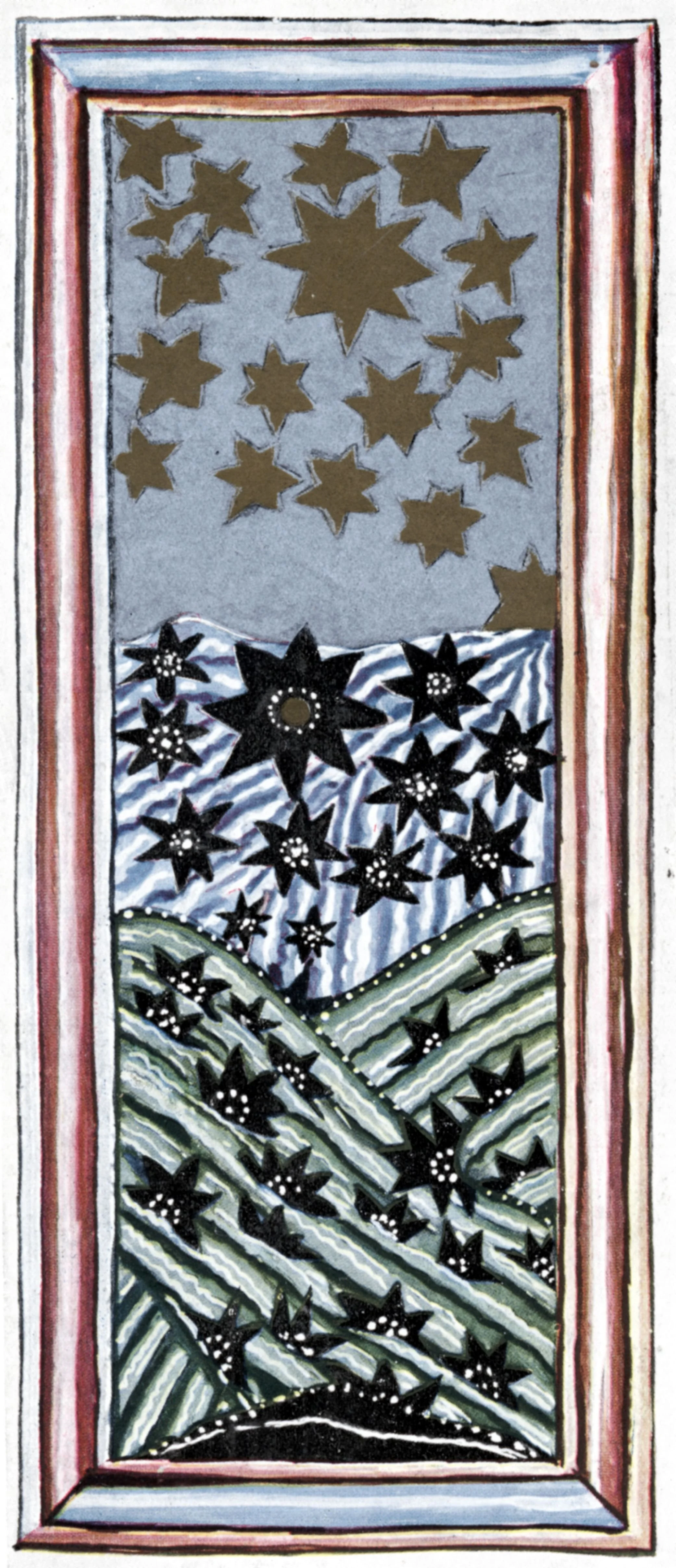
She described cosmic eggs, living lights, stars falling into dark waters, mountains vomiting smoke, radiant figures covered in wounds, and the universe itself as a breathing organism. The New Yorker on Hildegard’s visionary cosmology
In one vision, divine reality appears as a blazing, living luminosity surrounding creation itself.
Not static.
Alive.
This matters because Hildegard understood imagination differently than modern culture does.
Modernity often treats imagination as entertainment.
Hildegard treated imagination as perception.
The symbolic imagination allowed human beings to recognize truths too emotionally large to perceive directly.
And frankly, this may explain why modern culture feels spiritually undernourished despite constant stimulation.
We are flooded with imagery but starving for meaning.
Those are not the same thing.
Hildegard Believed Souls Could Become Dim
This may be the most haunting thing about her writing.
Hildegard believed souls could lose luminosity.
Not necessarily become evil.
Dim.
Too distracted to perceive reality clearly.
Too spiritually overstimulated to recognize meaning.
Too psychologically fragmented to sustain reverence.
And honestly, it is difficult not to think about this while watching modern adults scroll numbly through five hours of algorithmically optimized content while simultaneously reporting:
exhaustion.
anxiety.
loneliness.
emotional numbness.
loss of meaning.
inability to focus.
Hildegard would not have been shocked.
She believed civilizations could lose interior vitality while preserving outward complexity.
In fact, that was one of her central warnings.
She Was Ruthless About Institutional Corruption
One reason Hildegard remains compelling inside religious and intellectual circles alike is that she openly criticized spiritual corruption inside powerful institutions.
She warned repeatedly against:
vanity disguised as holiness.
bureaucracy replacing transformation.
performance replacing sincerity.
At one point she openly rebuked Emperor Frederick Barbarossa during conflicts involving Church authority. (Here’s Britannica’s biography of Frederick Barbarossa).
Which, in the twelfth century, required either:
immense courage.
mystical certainty.
a complete indifference toward self-preservation.
Possibly all three.
But Hildegard’s critique extended beyond individuals.
She feared institutional hollowing.
The moment systems continue functioning administratively while losing living legitimacy.
That concern now feels almost painfully contemporary.
Because many modern institutions increasingly appear emotionally exhausted while remaining structurally operational.
The shell survives.
The vitality disappears.
Hildegard considered this extraordinarily dangerous.
Her Visions Were Severe — But Not Nihilistic
This is important.
Modern collapse culture often treats despair as sophistication.
Cynicism becomes a personality style.
Detachment becomes intellectual branding.
Hopelessness becomes evidence of seriousness.
Hildegard believed renewal remained possible.
Corruption could provoke awakening.
Exhaustion could provoke clarity.
Decay could provoke repentance.
Vitality could return.
And this may be the deepest reason modern readers continue rediscovering her.
Not because she offers secret knowledge about the future.
But because she offers language for what spiritual exhaustion feels like from the inside.
She understood that civilizations do not merely collapse politically.
They collapse attentively.
Emotionally.
Morally.
Imaginatively.
First the interior world fragments.
Everything else follows afterward.
FAQ
Who was Hildegard of Bingen?
Hildegard of Bingen was a twelfth-century Benedictine abbess, theologian, composer, visionary, natural philosopher, and political correspondent. She became one of the most influential women in medieval Christianity and was later declared a Doctor of the Church by Pope Benedict XVI in 2012. Vatican biography of Saint Hildegard
What were Saint Hildegard’s prophecies about?
Hildegard’s prophecies focused less on predicting specific events and more on describing the moral and spiritual deterioration of civilizations. Her visions explored themes like corruption, spiritual exhaustion, ecological imbalance, fragmentation, pride, and the collapse of moral coherence.
Did Hildegard predict modern society?
Not literally. Internet culture often exaggerates or distorts medieval prophecy into simplistic “predictions” about technology or politics. What makes Hildegard feel modern is that she identified recurring psychological and spiritual patterns that continue appearing in human societies.
What does viriditas mean?
Viriditas is one of Hildegard’s central concepts and is often translated as:
greenness.
vitality.
flourishing.
fecundity.
living spiritual energy.
For Hildegard, viriditas described the inward aliveness of healthy souls, healthy communities, and healthy spiritual life.
What are the “Five Beasts” associated with Hildegard?
The “Five Beasts” prophecy symbolically describes stages of societal decline:
fiery dog.
tawny lion.
pale horse.
black pig.
grey wolf.
These creatures represented moral and psychological conditions rather than literal future events. Analysis of the Five Beasts prophecy
Why does Hildegard resonate with modern readers?
Many readers feel Hildegard anticipated aspects of modern life because she wrote about:
attentional fragmentation.
spiritual numbness.
institutional corruption.
ecological imbalance.
emotional exhaustion.
social disconnection.
Her work feels psychologically relevant in a culture increasingly shaped by overstimulation and chronic distraction.
Was Hildegard recognized by the Catholic Church?
Yes. Hildegard was canonized and later declared a Doctor of the Church, one of the highest honors in Catholic intellectual and theological history.
Did Hildegard write about ecology?
In a symbolic and theological sense, yes. Hildegard believed humanity, nature, spirituality, and morality formed an interconnected living system. Modern environmental thinkers frequently revisit her writings because of this integrated worldview.
Was Hildegard psychologically insightful?
Remarkably so. Although she lived centuries before modern psychology, Hildegard explored attention, imagination, embodiment, emotional regulation, desire, despair, and moral exhaustion in ways that feel strikingly contemporary.
Why are medieval mystics becoming popular again?
Many exhausted modern adults are searching for language that explains emotional numbness, fragmentation, loss of meaning, and overstimulation. Medieval mystics like Hildegard often describe these conditions with surprising psychological depth.
Final Thoughts
The most prophetic thing about Hildegard was not that she foresaw wars, disasters, or political upheaval.
It was that she foresaw exhaustion.
Civilizational exhaustion.
The kind that emerges when:
attention becomes permanently fragmented.
institutions become performative.
imagination becomes mechanized.
meaning becomes unstable.
nervous systems become chronically overstimulated.
.human beings lose contact with interior stillness.
And perhaps that is why exhausted modern adults keep returning to medieval mystics.
Not because they want predictions.
Because they want language for what the culture feels like when it can no longer feel itself properly.
Be Well, Stay Kind, and Godspeed.
REFERENCES:
Bain, J. (1998). Hildegard of Bingen and musical reception: The modern revival of a medieval composer. Cambridge University Press.
Flanagan, S. (1989). Hildegard of Bingen, 1098–1179: A visionary life. Routledge.
Hildegard of Bingen. (1990). Scivias (C. Hart & J. Bishop, Trans.). Paulist Press.
King-Lenzmeier, A. (2001). Hildegard of Bingen: An integrated vision. Liturgical Press.
Newman, B. (1987). Sister of wisdom: St. Hildegard’s theology of the feminine. University of California Press.
Newman, B. (1998). Voice of the living light: Hildegard of Bingen and her world. University of California Press.
Sweet, V. (2015). God’s hotel: A doctor, a hospital, and a pilgrimage to the heart of medicine. Riverhead Books.
Britannica biography of Hildegard of Bingen
The New Yorker essay on Hildegard’s cosmology
Vatican News biography of Saint Hildegard