

Welcome to my Blog
Most people don’t arrive here because something dramatic has happened.
They arrive because something feels… different.
The relationship still works. Conversations still happen. Life continues.
But something important is no longer organizing it the way it used to.
This space is where I write about that shift.
Not just what breaks relationships—but what quietly changes them:
how desire adapts.
how attention moves.
how meaning erodes or deepens over time.
These patterns are not random.
They tend to unfold in a predictable sequence.
If you’re here, you’re likely in one of those moments:
trying to understand what changed.
trying to decide whether it matters.
trying to figure out what to do next.
Start anywhere.
But if something here feels familiar, don’t treat it as abstract.
It usually isn’t.
Where to Begin
If you’re not sure what you’re looking for, these are a few good entry points:
Marriage Is Still Chosen — Even by Those Who Once Stood Outside It.
Epistemic Safety: What It Is and Why It Matters in Relationships.
The Relationship Consequences of Living in a Permanent News Cycle.
The Two Types of People Narcissists Avoid (And Why You Might Be One of Them).
When Narcissists Grieve: Why Their Mourning Looks Cold, Delayed, or Self-Centered
The 3-6-9 Dating Rule: Why Most Relationships Change at Month 3, 6, and 9.
The First Listener Shift: A Precise Relationship Diagnostic Most Couples Miss.
Why Curiosity Is Sacred in Relationships (And What Happens When It Disappears).
If You’re Looking for More Than Insight
Understanding is useful.
But at a certain point, most couples realize they can explain their relationship clearly—and still not change it.
That’s where focused work becomes effective.
I offer structured, high-impact couples intensives designed to produce meaningful movement in a compressed period of time.
Before We Decide Anything
A brief consultation helps determine:
whether this is what you’re dealing with.
whether this format fits.
and whether we should move forward.
Get a Clear Read on Your Relationship
Take your time reading.
But if something here lands in a way that feels specific—pay attention to that.
That’s usually where this work begins.
Continue Exploring
If you prefer to browse more broadly, you can explore posts by topic below.
But most people don’t find what they need by browsing.
They find it when something they read feels uncomfortably accurate.
Be Well, Stay Kind, and Godspeed.
~ Daniel
- Attachment Issues
- Coronavirus
- Couples Therapy
- Extramarital Affairs
- Family Life and Parenting
- How to Fight Fair
- Inlaws and Extended Families
- Intercultural Relationships
- Marriage and Mental Health
- Married Life & Intimate Relationships
- Neurodiverse Couples
- Separation & Divorce
- Signs of Trouble
- Social Media and Relationships
- What Happy Couples Know

The Relationship Power Blind Spot: Why You Have More Influence Than You Think
Most people believe they have less power in their relationships than they actually do.
They assume their partner controls the emotional weather, sets the terms of conflict, and ultimately determines how things go. Their own role feels reactive—trying not to upset the balance.
In my work with couples, this belief appears constantly.
Someone says, often with genuine frustration:
“I feel like I have no say.”
Clinical research suggests something surprising.
Many of those people are wrong.
A study published in Personality and Social Psychology Bulletinfound that folks consistently underestimate how much influence they have over their romantic partners and close friends.
Partners reported feeling significantly more influenced than the individuals themselves believed.
In other words, life partners frequently walk through their relationships quietly assuming they matter less than they actually do.
That misperception has a name:
The Relationship Power Blind Spot.
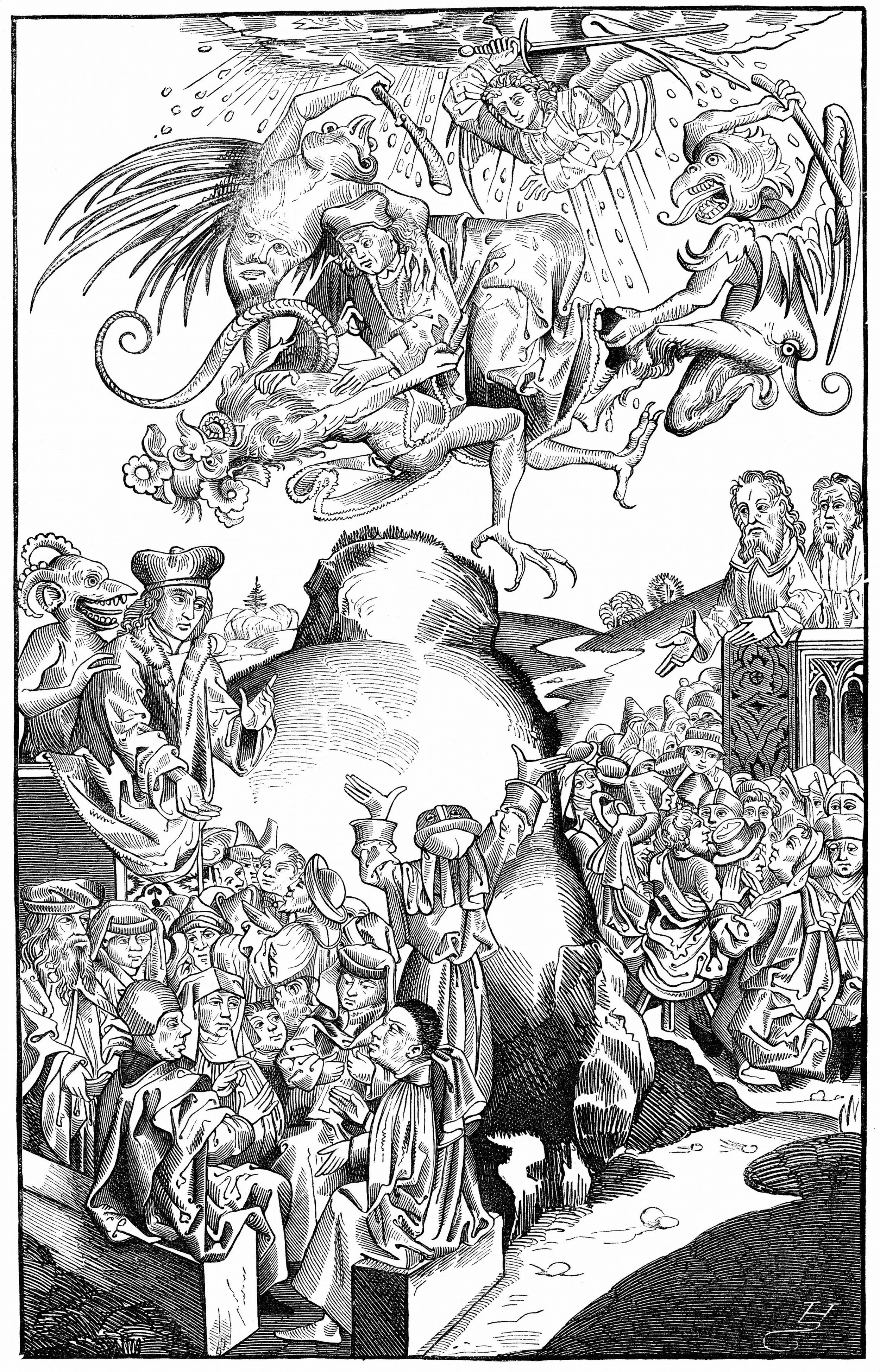
Peter Thiel, the Antichrist, and Silicon Valley’s Hidden Techno-Religion
Rome has hosted many theological debates.
Emperors argued with bishops. Reformers confronted popes. Philosophers spent centuries arguing about salvation, sin, and the destiny of humanity.
But even by Roman standards, the latest visitor introduces a certain novelty.
A Silicon Valley billionaire has arrived to lecture about the Antichrist.
According to recent reporting, venture capitalist and Peter Thiel is delivering a series of closed-door talks in Rome warning that people who worry about artificial intelligence may themselves be paving the way for a global totalitarian regime.
It is an interesting warning.
It is also an unusual one to hear from a man whose company builds large-scale data analysis systems used by governments and intelligence agencies.
If irony were electricity, Rome would currently be illuminating most of southern Europe.

Why Couples Are Losing Sexual Desire (And What Smartphones Have to Do With It)
Something peculiar has happened to sexual desire.
We are living through the most erotically saturated moment in human history.
A person with a smartphone can access more nudity in eight seconds than a Venetian aristocrat encountered in a lifetime of gondola rides and questionable decisions.
Entire industries now exist to supply stimulation at the speed of curiosity.
And yet therapists everywhere are hearing a strangely modest complaint.
Desire is thinning out.
Not scandal. Not repression. Not some newly invented kink.
Just ordinary erotic energy quietly fading inside long-term relationships while the Wi-Fi signal remains heroic.

High-IQ Relationship Gridlock: Why Intelligent Couples Argue So Much
There is a particular style of argument that only intelligent couples seem capable of producing.
You know the one.
The conversation begins with something small. Someone forgot to call the contractor. Someone misread a text message. Someone made a slightly sharp remark during dinner that landed with the grace of a dropped piano.
Within minutes the discussion expands.
Now the couple is debating emotional labor, attachment theory, childhood conditioning, fairness in household governance, and possibly the philosophical definition of responsibility itself.
Both partners are articulate.
Both partners are insightful.
Both partners are making extremely persuasive points.
And after twenty minutes of extraordinarily intelligent conversation, neither person feels remotely understood.
In my work with couples, I see this pattern often among highly analytical partners. The conversation is sophisticated, psychologically literate, and occasionally brilliant.
It is also completely stuck.
I sometimes refer to this phenomenon as High-IQ Relationship Gridlock.

The Insight Trap: When Understanding Your Partner Keeps the Relationship Stuck
Modern relationships possess more psychological insight than any relationships in human history.
We know about attachment styles.
We can identify trauma responses.
We talk about emotional triggers with a fluency that would have sounded like graduate school to our grandparents.
And yet something curious keeps happening.
The couples who understand the most about psychology are not always the couples who escape their relationship problems the fastest.
Sometimes the opposite occurs.
In my work with couples, I often meet thoughtful partners who understand their relationship extraordinarily well. They can describe their partner’s childhood dynamics, emotional vulnerabilities, and behavioral triggers with remarkable clarity.
Yet the relationship itself remains stuck.
This paradox appears so often that it deserves a name.
I call it: the Insight Trap.

Why Intelligent People Fall for Narcissists: The Psychology Behind the Insight Trap
The internet believes narcissists prey on the weak.
In my experience, they often choose the most psychologically perceptive person in the room.
The kind of person who reads books about relationships.
The kind of person who reflects on their own behavior.
The kind of person who assumes problems can be solved through insight and patience.
In my work with couples, the partner who feels most embarrassed about having fallen for a narcissistic partner is often the most intelligent one sitting across from me.
They say things like:
“I should have seen it sooner.”
But intelligence does not protect people from narcissistic relationship dynamics.
In some ways, it can make those dynamics harder to detect.
Thoughtful people tend to assume that if something goes wrong in a relationship, the solution is understanding. They believe that deeper insight will restore the connection that once felt so promising.
Sometimes that instinct is exactly right.
But sometimes that instinct becomes the very mechanism that keeps the relationship stuck.

The Surveillance Relationship: Why Smartphones Are Quietly Replacing Trust in Modern Couples
Once upon a time jealousy left fingerprints.
A lipstick stain.
A mysterious phone call.
A receipt someone forgot to throw away.
Today jealousy leaves metadata.
In my work with couples, I increasingly meet partners who know each other’s battery levels, location histories, and message timestamps better than they know each other’s emotional lives.
They can tell you when their partner left the grocery store, when their phone stopped moving, and when a message was read but not answered.
Ask them how their partner has been feeling lately, however, and the room sometimes fills with a silence so complete it could pass for architecture.
If this sounds familiar, you are not alone.
Many modern couples are quietly entering something new.
Something I have begun to call the surveillance relationship.
The surveillance relationship is an emerging dynamic with some modern couples where smartphones quietly transform love into monitoring.

The Hidden Psychology of Sugar Relationships: What Research Reveals About Transactional Dating
The loudest conversations about sugar relationships are usually the least illuminating.
One camp treats the arrangement as empowerment with a payment schedule.
Another treats it as a moral collapse, as though romance and economics had only just discovered each other in the modern world.
Both sides miss the more interesting question.
Not whether sugar relationships are empowering or exploitative.
But why some people find them psychologically appealing in the first place.
Psychology, inconveniently, has begun to offer an answer.
A recent study published in Archives of Sexual Behavior examined openness to sugar relationships among young women and found a pattern worth paying attention to.
Women who reported greater openness to transactional intimacy also showed greater impairments in personality functioning, stronger early maladaptive schemas, and heavier reliance on maladaptive emotional coping strategies.
In other words, the appeal of sugar relationships may not primarily be about money.
It may be about how someone learned to manage intimacy.

Why Some People Trust Science and Others Trust Faith: The Psychology Behind Our Worldviews
Most people like to imagine that their worldview emerged from careful reasoning.
They picture themselves as intellectual pioneers, arriving at their beliefs after examining evidence, weighing arguments, and deciding—on their own terms—what is true.
It is a flattering story.
It is also, according to modern psychological research, only partly accurate.
In my work with couples and families, I often see the same phenomenon: two intelligent people can interpret the exact same reality in completely different ways.
One partner trusts evidence, data, and scientific reasoning. The other leans toward faith, spiritual meaning, and divine purpose.
They assume the disagreement is philosophical.
In truth, it often began decades earlier—inside the homes they grew up in.
If this sounds familiar, you are not alone.
Many couples discover that their deepest disagreements about meaning, morality, and reality are rooted in childhood experiences neither partner consciously chose.

Relationship Attention Deficit: Why Modern Couples Feel Ignored — Even When They’re Still Together
Why Modern Couples Feel Ignored — Even When They’re Still Together
Most relationships do not collapse because of betrayal.
They collapse because attention slowly migrated somewhere else.
Not dramatically.
Not with shouting.
Just gradually.
A phone appears during dinner.
A notification interrupts a conversation.
Someone answers a message while their partner is talking.
Nothing catastrophic happens.
And yet, something essential begins to fade.
Because intimacy depends on a surprisingly fragile ingredient:
attention.

The Attention Economy of Love
Most people believe relationships end because of conflict.
In my work with marriages and families, that explanation almost never survives careful inspection.
Conflict is loud. Conflict is dramatic. Conflict gives everyone something to point at.
But the deeper cause of relational collapse is usually quieter and far more gradual.
Relationships end when attention slowly migrates away from the bond.
Not all at once. Not with a dramatic betrayal. But through thousands of small moments when one partner’s emotional signals go unnoticed, unanswered, or misinterpreted.
If you observe couples long enough, a pattern begins to appear.
Love is not primarily sustained by feelings.
Feelings fluctuate. Feelings behave like weather systems.
Love is sustained by patterns of attention.
Where attention flows, intimacy deepens.
Where attention thins out, connection slowly begins to starve.
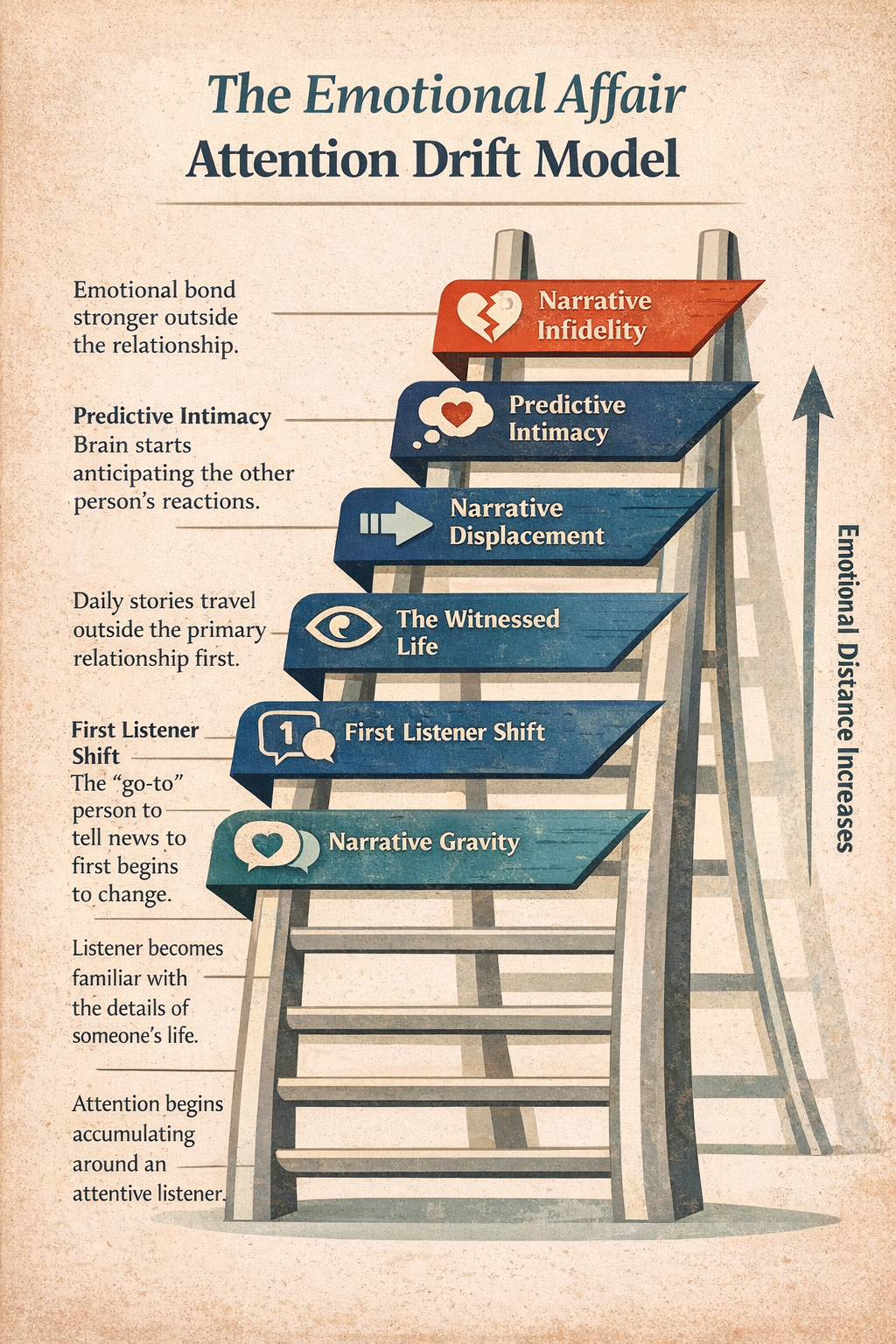
Emotional Affairs Rarely Begin Where Couples Think They Do
Most emotional affairs do not begin with attraction.
They begin with attention.
In my work with couples, the discovery moment almost always looks the same.
Someone opens a phone.
A series of messages appears.
A conversation clearly carries more emotional energy than it should.
And suddenly the betrayed partner asks the same question every time:
“How did this happen?”
From the outside it can look abrupt.
But in therapy these moments rarely appear without warning. What couples experience as a sudden betrayal is usually the final stage of a much quieter psychological process.
Long before anyone uses the word affair, something else has already happened.
Attention has begun to move.
And once attention begins shifting, it tends to follow a recognizable pattern.
Over time that movement unfolds thr
ough subtle changes in where people tell the stories of their lives.
If you are reading this and quietly recognizing parts of your own relationship in these patterns, you are not alone.
Many couples do not notice these shifts until emotional distance has already begun.
The encouraging news is that attention can move back as well as away.