Welcome to my Blog
Thank you for stopping by. This space is where I share research, reflections, and practical tools drawn from my experience as a marriage and family therapist with an international practice.
I write about what happens to desire, attachment, and meaning once the early myths stop working.
Are you a couple looking for clarity? A professional curious about the science of relationships? Or simply someone interested in how love and resilience work? I'm glad you've found your way here. I can help with that. I'm accepting new clients, and this blog is for the benefit of all my gentle readers.
Each post is written with one goal in mind: to help you better understand yourself, your partner, and the hidden dynamics that shape human connection
Grab a coffee (or a notebook), explore what speaks to you, and take what's useful back into your life and relationships.
And if a post sparks a question, or makes you realize you could use more support, l'd love to hear from you. Let's explore the scope of work you'd like to do together.
Be Well, Stay Kind, and Godspeed.
~ Daniel
P.S.
Feel free to explore the categories below to find past blog posts on the topics that matter most to you. If you're curious about attachment, navigating conflict, or strengthening intimacy, these archives are a great way to dive deeper into the research and insights that l've been sharing for years.
- Attachment Issues
- Coronavirus
- Couples Therapy
- Extramarital Affairs
- Family Life and Parenting
- How to Fight Fair
- Inlaws and Extended Families
- Intercultural Relationships
- Marriage and Mental Health
- Married Life & Intimate Relationships
- Neurodiverse Couples
- Separation & Divorce
- Signs of Trouble
- Social Media and Relationships
- What Happy Couples Know


Why Laughter Is So Often Misunderstood in Couples Therapy
In couples therapy, laughter is often treated as a symptom of avoidance when it is frequently a sign of successful regulation.
That misunderstanding is more costly than it looks.
Modern couples therapy takes feelings very seriously.
Sometimes too seriously.
Laughter, in particular, has acquired a bad reputation in the therapy room. When couples laugh during moments of tension or conflict, therapists are often trained to slow them down, redirect them, or ask what the laughter is “covering.”
Sometimes that instinct is correct.
But often, it misses the body entirely.
With many couples, laughter is not dismissal or deflection.
It is regulation.
And when therapists misunderstand it, they can accidentally dismantle one of the most effective stabilizing forces the couple has.

Why Parked-Car Fights Are Worse
Most couples believe the worst part of a driving fight is the drive.
It isn’t.
It’s the moment the car stops — the ignition clicks off, the world goes quiet, and you are suddenly forced to face the emotional debris field you created somewhere between the exit ramp and the parking lot.
A moving car is stressful.
A parked car is revealing.
It’s the only place where the conflict has nowhere left to go — and neither do you.
The Body Hasn’t Stopped; It’s Suspended
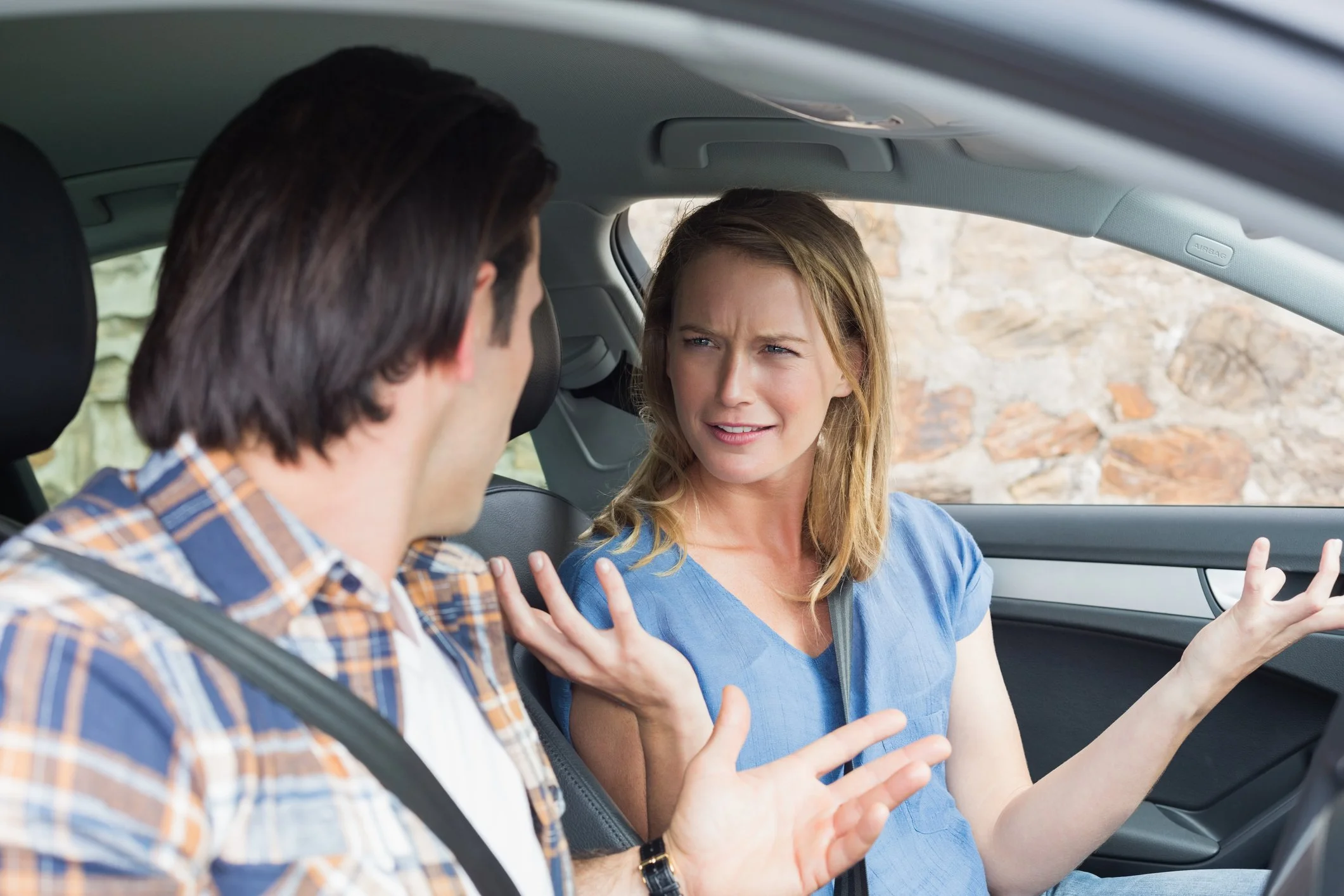
Why Passengers Start Most Car Fights: The Hidden Science
Passengers have a secret: they believe the car is a place where conversations go to thrive.
It’s enclosed! It’s private!
You’re trapped together!
What better time to discuss her father’s declining boundaries, or why the neighbor’s dog seems to like you more?
Unfortunately, passengers are wrong—spectacularly, confidently, devastatingly wrong.
Because while the passenger is busy enjoying their mobile chaise lounge, the driver is performing a delicate neurobiological balancing act that would make a surgeon sweat.

Why Couples Fight in the Car: The Science Behind Car Fights
Somewhere along the way, we all quietly accepted a strange cultural delusion:
that barreling down a highway in a metal box at 65 mph while surrounded by thousands of other metal boxes —
all piloted by humans of varying skill, sobriety, and judgment — is a normal, everyday experience.
Because while the driver is in a state of vigilance, scanning for hazard, anticipating idiot maneuvers from the guy in the white SUV, the passenger is — physiologically speaking — reclining on a chaise lounge, deciding whether now is a good time to discuss taxes, your last argument, or the mysterious tone you used at breakfast.
A driver in sympathetic arousal + a passenger in parasympathetic ease =a dyadic mismatch begging to become a fight.
And this is where the trouble begins.

Why Your Partner’s Stress Becomes Your Stress: The Science
There comes a point in every long-term relationship when you discover you are no longer the sole proprietor of your emotional life.
You wake up fine—perhaps even optimistic, which is already suspicious.
The coffee is decent. Nothing hurts. You think: Maybe today will behave itself.
And then your partner walks in.
Not yelling.
Not upset.
Just… placing their keys on the counter in a way your nervous system interprets as a prelude to war.
Suddenly, you are stressed too.
This is not pathology.
This is not poor boundaries.
This is not “being too attuned.”
This is something far more democratic and far less voluntary: bio-behavioral synchrony—the process by which two nervous systems begin sharing emotional data like a couple on a family phone plan.
It’s the reason couples can have entire conversations without speaking.
It’s also why one person’s anxiety can detonate the whole household.

Why Some Smart Couples Fall Apart
Some smart couples don’t implode. They erode.
They don’t hurl plates or storm out the front door. They draft position papers.
They index their grievances. They quote the relevant literature.
Then they slide quietly into marital loneliness while congratulating themselves on how impressively civilized they’ve been.
This is the paradox of the bright, articulate, emotionally over-educated marriage:
the couple can describe their relationship in exquisite detail while completely failing to live inside it.
It’s like watching two brilliant meteorologists discuss barometric pressure while ignoring the tornado forming over their heads.

Why Couples Fight in December: The Emotional Math of Holiday Stress
December arrives with such theatrical promise—lights twinkling, cookies cooling, the cultural insistence that this month be “magical”—that it’s almost unfair how quickly it exposes the cracks in a relationship.
Couples don’t plan to fight in December. Really they don’t.
They just sorta drift into it the way people wander into snowstorms they should have seen coming.
If November is the month you pretend everything’s fine over turkey, December is the month the emotional bookkeeping comes due.
And couples do fight. A lot.
Not because something is wrong with them individually, but because something peculiar happens collectively: December elevates their expectations and depletes their capacities at the exact same time.
It’s the only month where joy has a deadline. Yikes.

The 7 Most Dangerous Marital Argument Dynamics
Every couple fights. Some quarrels are trivial — the thermostat set to “monk’s cell” vs. “Miami Beach.”
Others are theatrical enough to scare the dog.
But the most toxic fights?
They’re the ones that corrode trust, hollow intimacy, and, according to the latest APA-cited research, even raise your inflammation levels.
Yes, the wrong argument can change your biology. Marriage: the only romance that doubles as a stress study.
If you’ve ever walked away from a fight feeling like it took more than it gave, this list is for you.
Here are the seven most dangerous marital arguments — the ones most likely to sabotage your health and your relationship.

The 2025 Best Practices for Fighting Fair
Fighting is inevitable. The only couples who “never fight” are lying, repressed, or heavily sedated.
The rest of us fight about money, dishes, politics, sex, in-laws, phones, and whether the thermostat is set by science or sorcery.
In 2025, fights don’t happen in private. They happen in group chats, over family dinners, in multigenerational households, and sometimes with your AI scheduling assistant chiming in: “Would you like me to resolve this conflict for you?” No thanks, Siri.
This is not a call to avoid fighting. It’s a manifesto for fighting fair.

How Attachment Styles Shape the Way Couples Fight (and Make Up)
Every couple fights. The question isn’t whether you’ll fight, it’s how.
Some couples argue like trial lawyers, stacking exhibits and cross-examining witnesses.
Others retreat into silence like diplomats waiting for their visas.
Some cry, some slam doors, some negotiate like grown-ups at the U.N. And, infuriatingly, some laugh and make up before you’ve even finished your sentence.
Why the difference?
Often it’s not about the topic of the fight (“you left the dishes again”), but the attachment styles each partner brings into the relationship.
Attachment isn’t just about childhood wounds and therapy jargon. It’s the emotional blueprint that determines whether you lean in, pull away, or regulate together when the tension rises.

The Silent Treatment vs. Healthy Pauses: Knowing the Difference
We’ve all heard it: “silence speaks volumes.”
In relationships, silence can indeed say everything — but sometimes it says the wrong thing entirely.
There’s the silence that soothes, that gives each partner space to breathe and self-regulate.
And then there’s the silence that burns: the stonewalling, the deliberate freeze-out, the “you’re dead to me until further notice.”
The first is a pause. The second is punishment.
One strengthens intimacy; the other corrodes it. And confusing the two is how couples slip from conflict into cold war.

Why “Never Go to Bed Angry” Is the Worst Relationship Advice
Everyone’s heard it: “Never go to bed angry.”
It’s passed around at weddings, stitched on throw pillows, and quoted as if embroidered clichés can save a marriage.
The fantasy is tidy: hash it out, kiss, and drift off in blissful peace.
But reality—and neuroscience—say otherwise.
Midnight is not when love triumphs. It’s when your brain is cranky, your patience is frayed, and your words are more destructive than healing.
Sometimes the healthiest thing you can do for your relationship is to go to bed angry—and wake up with your brain restored.