Welcome to my Blog
Thank you for stopping by. This space is where I share research, reflections, and practical tools drawn from my experience as a marriage and family therapist with an international practice.
I write about what happens to desire, attachment, and meaning once the early myths stop working.
Are you a couple looking for clarity? A professional curious about the science of relationships? Or simply someone interested in how love and resilience work? I'm glad you've found your way here. I can help with that. I'm accepting new clients, and this blog is for the benefit of all my gentle readers.
Each post is written with one goal in mind: to help you better understand yourself, your partner, and the hidden dynamics that shape human connection
Grab a coffee (or a notebook), explore what speaks to you, and take what's useful back into your life and relationships.
And if a post sparks a question, or makes you realize you could use more support, l'd love to hear from you. Let's explore the scope of work you'd like to do together.
Be Well, Stay Kind, and Godspeed.
~ Daniel
P.S.
Feel free to explore the categories below to find past blog posts on the topics that matter most to you. If you're curious about attachment, navigating conflict, or strengthening intimacy, these archives are a great way to dive deeper into the research and insights that l've been sharing for years.
- Attachment Issues
- Coronavirus
- Couples Therapy
- Extramarital Affairs
- Family Life and Parenting
- How to Fight Fair
- Inlaws and Extended Families
- Intercultural Relationships
- Marriage and Mental Health
- Married Life & Intimate Relationships
- Neurodiverse Couples
- Separation & Divorce
- Signs of Trouble
- Social Media and Relationships
- What Happy Couples Know


Which Mothers Do We Choose to Understand?
Two Massachusetts mothers killed their children.
There is no graceful way into that sentence.
Lindsay Clancy, of Duxbury, is accused of killing her three children in 2023. Her defense argues that she was suffering from postpartum psychosis and could not appreciate the wrongfulness of what she was doing.
Latarsha Sanders, of Brockton, was convicted in 2022 of killing her two sons.
Her lawyers also argued that she was psychotic and not criminally responsible.
This month, the Massachusetts Supreme Judicial Court threw out Sanders’s convictions and ordered a new trial, concluding that jurors had been prevented from seeing important psychiatric evidence.
And there is a remarkable overlap.
The same judge who presided over Sanders’s trial is now presiding over Clancy’s.
The cases are not the same.
But placed beside each other, they ask a question larger than either defendant:
Which mothers do we readily imagine as sick, and which do we imagine as monstrous?

When the Therapist Has Already Decided Who the Villain Is
A recent Wall Street Journal article asks a question that should make the mental-health profession uncomfortable:
Is your therapist biased?
The immediate answer is yes.
Every therapist is biased. We arrive in the consulting room with a history, a temperament, a politics, a theory of human suffering, and a private collection of people we have not entirely forgiven.
Training does not remove these things.
It is supposed to help us notice them.
That distinction matters because therapy is an unusual form of power.
One person arrives distressed and uncertain. The other sits in a comfortable chair with credentials on the wall and a vocabulary capable of making ordinary human conflict sound clinically conclusive.
Therapeutic bias can end marriages. It can separate parents and children. It can turn a painful season into a permanent identity.
The danger is not that therapists possess values.
The danger begins when we mistake our values for psychological truth.

Joe Cocker: You Are So Beautiful Is the Easy Part
There are people who are exceptionally good at feeling love.
This is not necessarily the same thing as being good at loving someone.
Joe Cocker understood the distinction more intimately than most.
Watch him sing You Are So Beautiful in the 1970s and the performance seems almost indecently exposed.
Cocker does not so much sing the song as allow it to happen to his body.
His shoulders contract. His hands search the air. His face registers something between gratitude and injury.
There is no wink in it.
No protective irony.
He seems, for three minutes, incapable of withholding anything.
And yet the man capable of expressing tenderness with that astonishing intensity was, during much of the same period, living a life that made sustained intimacy extraordinarily difficult.
That is the interesting thing about Joe Cocker.
He could feel everything.
It took him considerably longer to learn how to stay.

The Moon Was Never Home
There is a particular kind of disappointment that arrives in a long marriage.
It does not necessarily announce itself with an affair.
Nobody has emptied the bank account.
Nobody has developed a secret family in Cincinnati.
Sometimes nothing particularly terrible has happened at all.
You simply look across the kitchen one morning at the person you once regarded as an astonishing event in the history of the universe, and they are standing there in slippers, opening cabinets, asking whether you remembered to buy coffee filters.
This can be unsettling.
Because once, they were the moon.

Lesley Gore and the Terrible Education of the American Girl
In the spring of 1963, a sixteen-year-old Lesley Gore recorded “It’s My Party.”
The premise was simple enough.
It is the narrator’s birthday. Her boyfriend, Johnny, disappears for a while with her friend Judy. When Judy returns wearing Johnny’s ring, the birthday girl understands what has happened.
She cries.
What else could she do?
The remarkable thing about “It’s My Party” is not that a teenage girl cries after being publicly humiliated. Crying is probably the most psychologically sensible thing anyone does in the entire story.
The remarkable thing is that the song grants her permission.
“It’s my party, and I’ll cry if I want to” is usually remembered as petulance—an adolescent stamping of the foot. But it also contains a primitive declaration of emotional ownership.

The Light Was There. The Ship Went Down Anyway.
The Outer Banks are beautiful in the slightly unnerving way of places that have killed a great many people.
The beaches are wide. The dunes hold their pale line against the Atlantic.
Pelicans pass overhead with the composure of creatures that have not spent much time reconsidering their marriages.
And beneath the water lie the ships.
These waters are called the Graveyard of the Atlantic.
Storms gather quickly. Currents collide. Sandbars move.
The coastline rearranges itself without consulting the charts.
A captain could possess a sound vessel, an experienced crew, and a respectable understanding of the sea—and still strike something that had not been there the last time anyone looked.
This is the first uncomfortable thing shipwrecks know about marriage:
The map can be accurate and still become useless.

What the Sea Gives Back: Sea Glass, Rising Water, and the Shape of Love
Today, I am in the Outer Banks looking for sea glass.
This is an occupation requiring very little intelligence and a surprising amount of attention.
You walk slowly at the waterline, looking down.
Brown glass is pretty common. Green is better. Blue can produce an excitement wildly disproportionate to the monetary value of the glass in question.
The best pieces are cloudy and smooth.
They did not begin that way.
A newly broken bottle is sharp, transparent, dangerous.
Only after years in the water does glass acquire the softness we prize: rolled through sand, thrown against shells and stone, buried, uncovered, carried offshore, returned again.
The frosting on its surface is damage accumulated exquisitely slowly.
Its rounded edges are evidence of collision.
What we pick up and call beautiful is glass altered by what happened to it.
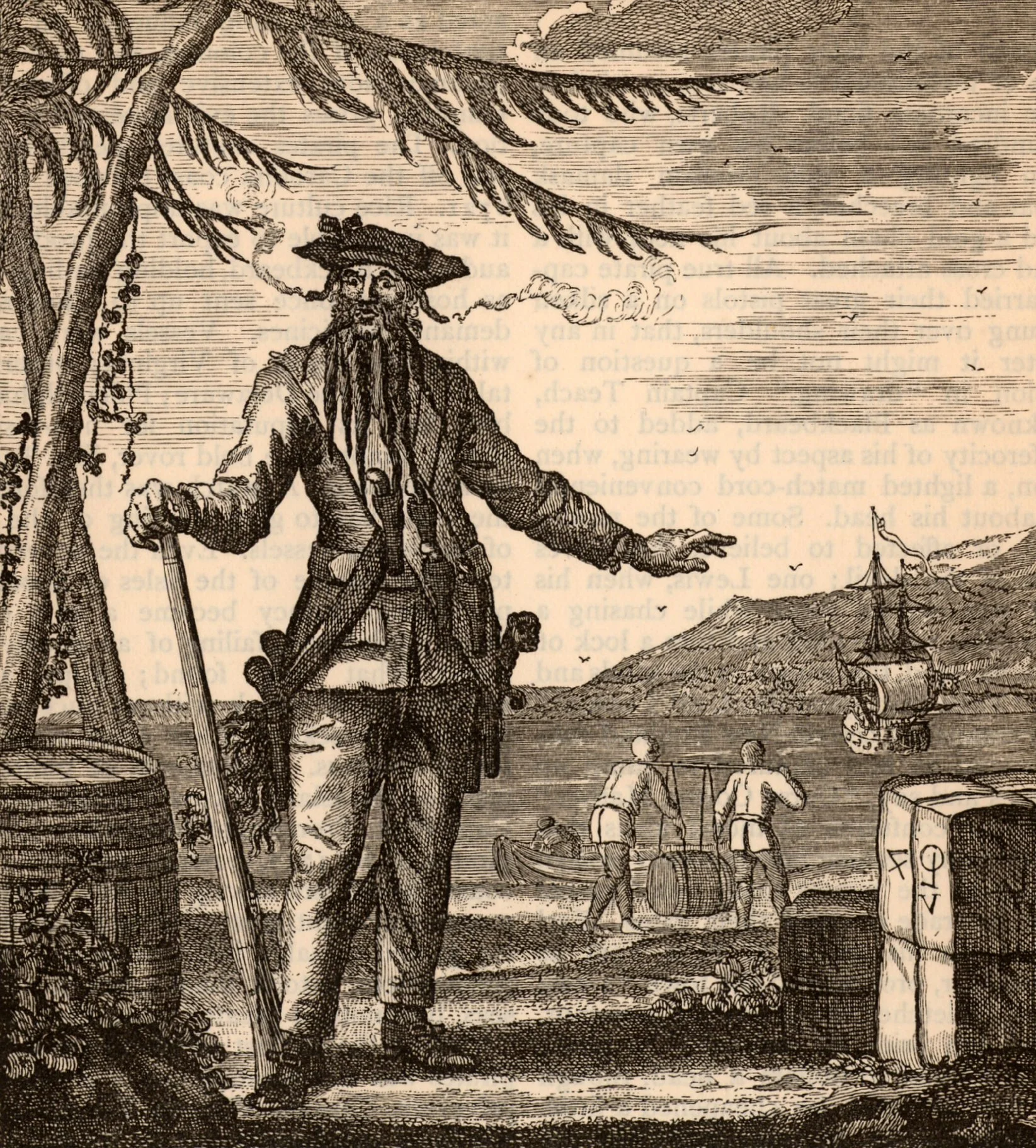
Who Knew Edward Teach?
There are places in the Outer Banks where Blackbeard is difficult to avoid.
He is on flags and T-shirts. He appears on signs, mugs, restaurant walls, and the assorted merchandise through which Americans convert dangerous men into charming local economic activity.
Three centuries have been good to Blackbeard.
They have been less good to Edward Teach.
Teach—or Thatch, or one of several spellings that appear in the historical record—was the man generally believed to have become Blackbeard.
We know surprisingly little about him.
There is no known diary in which he explains himself.
No collection of intimate letters.
No memoir.
No reliable account of what frightened him, whom he loved, what embarrassed him, whether he regretted anything, or what he thought about when nobody was watching.
We know the beard.
We know the guns.
We know the smoke.
We have almost completely lost the man.
Perhaps that is simply what three hundred years does to a life.

Happiness Is the Receipt, Not the Purchase
A great many couples arrive in therapy with a reasonable-sounding complaint:
“We aren’t happy anymore.”
It feels like a diagnosis. Usually, it is closer to a receipt.
Happiness tells us something about what has already been happening inside a relationship.
It reflects whether two people feel safe, connected, respected, purposeful, and sufficiently free to remain themselves.
Couples often respond by trying to produce happiness directly.
They schedule date nights. They book a vacation.
They buy concert tickets and sit beside each other privately wondering whether the parking was worth it.
None of this is foolish. Pleasure matters. Fun matters.
Novelty can interrupt the administrative trance into which long marriages sometimes drift.
But happiness cannot be ordered as a separate marital service.
It tends to appear after certain conditions have been created.
A new consensus study on positive mental health offers a useful distinction—and may help explain why some couples remain unhappy despite trying so hard to become happier.

Robert Heinlein Imagined Free Love. Then He Built a Forty-Year Marriage
Robert Heinlein spent much of his career designing improved arrangements for the human race.
Improved governments. Improved armies. Improved sexual customs. Improved marriages. Improved methods for occupying other planets, where presumably nobody would insist upon bringing the same tedious rules from Connecticut.
His novels considered communal families, plural marriages, nudism, sexual freedom, and the possibility that jealousy might be one more primitive habit intelligent people could learn to outgrow.
He was fascinated by relationships constructed deliberately rather than inherited wholesale from parents, priests, and county clerks.
Then, in 1948, he married Virginia Gerstenfeld.
They remained together for forty years.
It was not quite the domestic conclusion one might expect from the great speculative engineer of unconventional love. Heinlein imagined households populated by several unusually attractive adults sharing affection with astonishing administrative efficiency. What he created for himself was more concentrated: an intensely bonded marriage to one brilliant, disciplined, indispensable woman.
The man who kept redesigning marriage in his fiction appears to have found his greatest freedom inside a partnership of two.

Hermann Hesse Wanted Love. He Was Less Enthusiastic About Somebody Being There.
Hermann Hesse became a patron saint of the 1960s without having the good manners to remain alive for most of them.
Young Americans like me discovered Siddhartha, Steppenwolf, and Demian and recognized a fellow traveler: suspicious of authority, hostile to bourgeois conformity, interested in Eastern spirituality, and convinced that the authentic self was hiding somewhere beyond the reach of parents, pastors, employers, and anyone wearing a necktie.
At the time, I was less interested in his marital history.
This was understandable.
The counterculture preferred its prophets wandering beside rivers, not negotiating childcare with an exhausted wife.
The same young readers like me who struggled with the notion that love should be free also tended to believe it should be easy—an arrangement history has not often managed to provide.
Hesse married three times. Some might suggest that Hesse displayed a degree of Avoidant Attachment.
The marriages were very different, but together they revealed something central about him.
He longed for intimacy, depended upon it, and repeatedly experienced its ordinary demands as an encroachment upon the sovereignty of the self.
He wanted love.
He was less enthusiastic about somebody being there.

The Founder Comes Home: When Entrepreneurial Confidence Risks Becoming Marital Narcissism
There is a particular sort who can enter a room, notice what everyone else has missed, announce that the future is arriving early, and persuade three people to finance it before lunch.
We often call this soul an entrepreneur.
At home, the terminology may be less admiring. Let me explain.
A recent study published in Acta Psychologica found that narcissism and psychopathy were associated with stronger entrepreneurial tendencies.
This does not mean entrepreneurs are psychopaths, despite what several former business partners may be muttering into their coffee.
It does suggest that qualities rewarded in entrepreneurial life can become complicated once the founder comes home.
Confidence becomes certainty. Risk tolerance becomes unilateral decision-making.
Vision becomes a household government in which one adult receives divine transmissions and the other is asked to “get on board.”
The business calls this leadership.
The marriage calls it “whatever.”