Monday, August 17, 2026.
There are places in the Outer Banks where Blackbeard is difficult to avoid.
He is on flags and T-shirts. He appears on signs, mugs, restaurant walls, and the assorted merchandise through which Americans convert dangerous men into charming local economic activity.
Three centuries have been good to Blackbeard.
They have been less good to Edward Teach.
Teach—or Thatch, or one of several spellings that appear in the historical record—was the man generally believed to have become Blackbeard.
We know surprisingly little about him.
There is no known diary in which he explains himself.
No collection of intimate letters.
No memoir.
No reliable account of what frightened him, whom he loved, what embarrassed him, whether he regretted anything, or what he thought about when nobody was watching.
We know the beard.
We know the guns.
We know the smoke.
We have almost completely lost the man.
Perhaps that is simply what three hundred years does to a life.
Or perhaps it is the most interesting thing about Blackbeard.
The Invention of Blackbeard
Blackbeard seems to have understood something modern people would recognize immediately.
Identity can be manufactured.
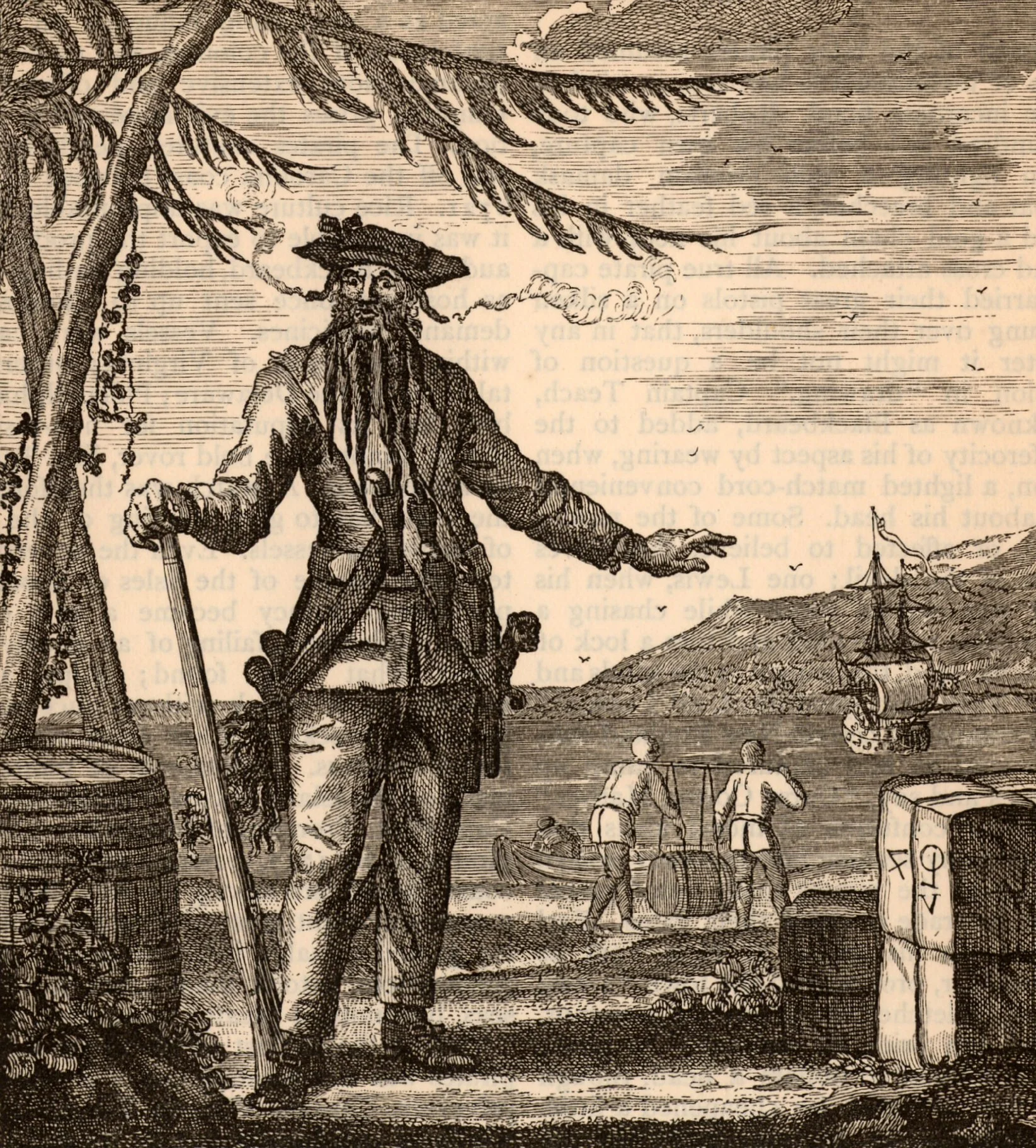
Contemporary descriptions emphasize the enormous beard, weapons strapped conspicuously across his body, and slow-burning matches reportedly placed around his head during battle, surrounding his face with smoke.
It was theater.
Excellent theater.
A merchant captain confronted by this apparition had to make a quick calculation: resist and discover whether the monster was as violent as advertised, or surrender the cargo and remain alive.
Reputation could do the work of violence.
The popular Blackbeard is considerably more murderous than the historical evidence securely establishes. His usefulness depended partly upon people believing what he might do.
Blackbeard therefore wasn't merely a pirate.
He was, in some measure, a performance of piracy.
And the performance worked.
The Self That Solves a Problem
Human beings do this on a smaller scale.
We discover that certain versions of ourselves work.
The funny child.
The beautiful girl.
The frightening boy.
The responsible daughter.
The successful husband.
The agreeable wife.
The person who needs nothing.
The person who always knows what to do.
These identities aren't necessarily false.
That is what makes them complicated.
They solve something.
If I am funny, perhaps nobody notices that I am frightened.
If I am indispensable, perhaps nobody leaves.
If I am successful enough, perhaps nobody sees what I doubt about myself.
If I am intimidating, perhaps nobody discovers that I can be hurt.
A persona begins as an adaptation.
Then folks respond to it.
They admire it.
Fear it.
Reward it.
Depend upon it.
Eventually the world begins handing the mask back to us.
Here. This is who you are.
And the identity that once protected the person can begin to imprison him.
Edward Teach Goes Home
In 1718, Blackbeard accepted a royal pardon and spent time in Bath, North Carolina.
Early accounts say he married a local woman, traditionally identified as Mary Ormond.
The evidence surrounding his marriage is thin, and some early pirate accounts mixed history with sensational storytelling. We should be careful about pretending to know what happened inside that house.
The absence is more interesting.
For a brief moment, the historical record offers something astonishingly ordinary.
Blackbeard becomes a husband.
Edward Teach goes home.
And there is one question I cannot quite get past:
Was there anyone before whom Blackbeard stopped?
We don't know.
Perhaps the distinction between Teach and Blackbeard is one we are imposing centuries later.
Perhaps the pirate persona never came off because there was nothing underneath it substantially different.
But anyone who has lived long enough knows that public selves and private selves are rarely identical.
Someone, somewhere, may have known the sound of his ordinary voice.
That person has disappeared too.
Within months, Teach was operating at sea again.
By November, he was dead.
The Person We Learn to Be
There is a particular danger in becoming extremely successful at being one version of yourself.
Other people begin requiring it.
The executive comes home and continues being the executive.
The caretaker cannot permit herself to need care.
The intellectual cannot say, I don't know.
The strong husband cannot say, I'm frightened.
The competent wife cannot say, I cannot carry this anymore.
None of these people is lying.
The persona is real.
It is simply incomplete.
And intimacy eventually asks for precisely what the performance was designed to conceal.
Not competence.
Fear.
Not charm.
Need.
Not certainty.
Confusion.
Not the story we tell convincingly about ourselves.
The person who exists when the story stops.
This is why being admired and being known are such different experiences.
Admiration can occur at a distance.
So can fear.
So can desire.
Being known requires proximity.
And proximity is dangerous to a persona.
Someone standing close enough eventually sees the seams.
The Successful Marriage to a Role
There is another problem.
Personas don't belong only to the people who create them.
The people who love us become attached to them.
I may need you to remain strong because your strength organizes my anxiety.
I may need you to remain dependent because being needed organizes my identity.
I may need you to remain successful because your success tells me something reassuring about the life I chose.
I may even need you to remain difficult because I have built an entire moral identity around being the reasonable one.
Then you change.
And I say:
You're not yourself anymore.
Sometimes what I mean is:
You are no longer being the self I knew how to be married to.
There are many ways to disappear from a marriage.
One is to leave.
Another is to become extremely good at playing your part.
You can be loved for decades without being entirely known.
Worse, you can be loved precisely because you remain recognizable.
The Most Dangerous Audience
Perhaps the most dangerous person in the world to a carefully constructed identity is someone who loves you.
Enemies are easy.
You already know what to show them.
Strangers are easier still.
But the person who sleeps beside you keeps seeing things.
The pause before you answer.
The fear beneath the anger.
The disappointment hidden inside the joke.
The exhaustion beneath competence.
The loneliness inside independence.
The child still living somewhere inside the formidable adult.
This can feel invasive.
It can also feel like home.
Because there is an extraordinary relief in discovering that someone can see behind the performance and remain.
Not because the performance was fraudulent.
Because it was never all of us.
And all this brings me back to Edward Teach.
Perhaps someone saw him this way.
Perhaps nobody ever did.
History cannot tell us.
And that absence begins to feel strangely appropriate.
The man who became famous by making himself terrifyingly visible became personally invisible.
Ocracoke
In November 1718, Lieutenant Robert Maynard came looking for Blackbeard near Ocracoke.
The final battle was brutal.
Blackbeard was killed.
His head was severed and carried away as proof.
His body went into the water.
And then something remarkable happened.
Blackbeard became immortal.
The historical man had lived an obscure early life and an extraordinarily brief career as a major pirate. The character he created lasted much longer.
The beard grew larger.
The cruelty became more extravagant.
The wives multiplied.
The stories accumulated.
The pirate became legend.
Edward Teach receded.
Three centuries later, we still recognize the performance instantly.
We can buy it on a coffee mug.
But somewhere underneath the beard and smoke there was once a man who woke in the morning, became tired, wanted things, feared things.
Someone may once have known him without the costume.
But, apparently, all we have left is Blackbeard.
Perhaps there is something unsettling in that.
We spend enormous portions of our lives becoming recognizable.
Husband.
Wife.
Parent.
Professional.
Successful one.
Dependable one.
Strong one.
Funny one.
The one who has everything under control.
These selves help us survive.
Some help us flourish.
But intimacy asks something success does not.
Not:
Can you become someone the world recognizes?
But:
Is there anyone with whom you no longer have to be that person?
Blackbeard survived Ocracoke extraordinarily well.
Edward Teach did not.
Three hundred years later, I am still looking for him.
Be Well, Stay Kind, and Godspeed.