
Welcome to my Blog
Thank you for stopping by. This space is where I share research, reflections, and practical tools drawn from my experience as a marriage and family therapist with an international practice.
I write about what happens to desire, attachment, and meaning once the early myths stop working.
Are you a couple looking for clarity? A professional curious about the science of relationships? Or simply someone interested in how love and resilience work? I'm glad you've found your way here. I can help with that. I'm accepting new clients, and this blog is for the benefit of all my gentle readers.
Each post is written with one goal in mind: to help you better understand yourself, your partner, and the hidden dynamics that shape human connection
Grab a coffee (or a notebook), explore what speaks to you, and take what's useful back into your life and relationships.
And if a post sparks a question, or makes you realize you could use more support, l'd love to hear from you. Let's explore the scope of work you'd like to do together.
Be Well, Stay Kind, and Godspeed.
~ Daniel
P.S.
Feel free to explore the categories below to find past blog posts on the topics that matter most to you. If you're curious about attachment, navigating conflict, or strengthening intimacy, these archives are a great way to dive deeper into the research and insights that l've been sharing for years.
- Attachment Issues
- Coronavirus
- Couples Therapy
- Extramarital Affairs
- Family Life and Parenting
- How to Fight Fair
- Inlaws and Extended Families
- Intercultural Relationships
- Marriage and Mental Health
- Married Life & Intimate Relationships
- Neurodiverse Couples
- Separation & Divorce
- Signs of Trouble
- Social Media and Relationships
- What Happy Couples Know


Why Narcissism Wins Job Interviews While Psychopathy Hides
There is an old idea that success belongs to the smartest person in the room.
There has never been much evidence for it.
Success often belongs to the person who appears smartest for forty-five minutes.
That is a different skill entirely.
Modern adulthood requires a surprising amount of performance. We don't simply have personalities anymore.
We present them. We curate them.
We learn which stories make us sound resilient, which weaknesses seem charming rather than alarming, and which accomplishments should be mentioned just casually enough to look effortless.
The performance begins long before the job interview.
It starts on LinkedIn, where ordinary careers become "leadership journeys."
It continues on dating apps, where everyone somehow loves hiking, traveling, and meaningful conversations.
It reaches its peak in the annual performance review, where employees explain that their greatest weakness is caring too much.
Psychologists have a wonderfully dry name for all of this.
They call it impression management.

The Weekend Was Never Free
Or, how ordinary families won the right to ordinary lives
There is a sentence almost nobody says anymore.
"Thank goodness somebody fought for Saturday."
Perhaps we should.
This weekend, millions of Americans will sleep a little later than usual.
Parents will stand beside soccer fields holding paper cups of coffee.
Grandparents will drift in for dinner. Teenagers will sleep until noon.
Couples will wander through hardware stores arguing amiably over paint colors they don't actually need.
Dogs will be walked a little farther. Pancakes will burn. Someone, somewhere, will decide that today is a perfectly good day to take an afternoon nap.
None of these moments feel historical.
That is history's greatest trick.
Its finest achievements become so ordinary that we stop seeing them altogether.
The weekend is one of those achievements.
It did not arrive with modern life like electricity or indoor plumbing. It was imagined, argued over, marched for, struck for, and, in some cases, died for.
The weekend is not simply two days off.
It is one of the greatest democratic achievements of the modern world.
And because it succeeded so completely, we have forgotten it was ever missing.

When Your Boss Owns Your Calendar: The Hidden Relationship Cost of Unpredictable Work
New research suggests unstable schedules undermine happiness. Labor studies explains why.
Most folks think of work as something that takes up time.
Labor studies teaches something different.
Work doesn't merely consume hours. It organizes life.
Who eats dinner together.
Who picks up the kids.
Who can commit to a softball league.
Who cancels therapy.
Who keeps disappointing their spouse despite having every intention of showing up.
A recent study published in Social Indicators Research found that workers with unpredictable schedules reported substantially lower life satisfaction than workers whose schedules remained stable.
In some analyses, the association between scheduling unpredictability and happiness rivaled—or even exceeded—the association between household income.
That's remarkable.
But it also misses something larger.
The real issue isn't scheduling.
The issue is who absorbs uncertainty in modern capitalism.

Love Addiction Isn't One Thing. It's Three Different Ways We Ask Our Life Partner to Regulate Our Lives.
There are certain phrases that become so popular they stop meaning very much.
Everyone is "burned out."
Everyone has "trauma."
Everyone is "gaslighting" someone.
And in the world of romantic relationships, everyone seems to have "love addiction."
The phrase has become an Attachment Style junk drawer.
A person who cannot stop texting an ex is said to have love addiction.
A spouse who becomes panicked whenever their partner pulls away has love addiction. Someone who falls intensely in love, becomes consumed with jealousy, and mistakes emotional chaos for intimacy? Love addiction again.
It is a wonderfully efficient label because it explains almost everything—and therefore almost nothing.
A new meta-study of studies published in Archives of Sexual Behavior suggests that relationship science has been wrestling with exactly this problem.

When Love Feels Scarce: The Psychology Behind "Simping"
Every generation invents a new insult for an old psychological problem.
In 2026, the insult is: Simp.
The word is usually aimed at a man who gives too much, waits too long, spends too freely, apologizes too quickly, and remains devoted to someone who has not earned—or perhaps never intended to earn—that devotion.
The internet laughs.
But researchers asked a different question:
What problem is this behavior trying to solve?
That is almost always the more interesting question.
A recent study published in the Journal of Personality suggests that the strongest predictor of these excessive and obsessive courtship behaviors isn't low attractiveness, poor social status, or even a man's own perception of his "mate value."
Instead, the best predictor was remarkably simple.
A fear of being single.
At first glance, that sounds almost disappointingly obvious.

Why Some Breakups Hurt the Brain More Than Others
A broken heart has always felt physical.
It steals your appetite.
Your sleep becomes unreliable.
Music suddenly becomes unbearable.
You drive somewhere familiar and realize you've missed your exit because your mind has been replaying one conversation for forty-three consecutive miles.
Poets noticed this centuries before neuroscientists owned MRI scanners.
Now neuroscience is catching up.
A fascinating new study published in the European Journal of Neuroscience suggests that for adults who experienced childhood maltreatment, romantic breakups may be associated with measurable differences in the hippocampus—a brain structure deeply involved in memory, stress regulation, and emotional processing.
Notice the wording.
Not everyone.
Not every breakup.
Not even childhood trauma alone.
The interesting finding appears where two experiences intersect.

There Are Apparently Three Kinds of Liars. The Problem Is That Most of Us Think We're Involved with the Fourth.
Human beings have always lied to the people they love.
This is one of the less attractive features of our species, ranking somewhere between pretending we'll leave in five minutes and insisting that buying another storage container will finally organize the garage.
The surprise isn't that life partners lie.
The surprise is that social science researchers have now managed to organize the lies.
A new study published in the Journal of Social and Personal Relationships suggests that souls who deceive their romantic partners generally fall into three distinct patterns.
Some are remarkably honest.
Some lie to preserve harmony.
A much smaller group lies as part of a broader strategy of manipulation and control.
That sounds wonderfully orderly.
Marriage rarely is.
Still, the findings reveal something therapists have suspected for years.
The most important question is not:
"Did your partner lie?"
It's:
"What was the lie trying to accomplish?"
That single question changes almost everything.
The Outsourced Marriage
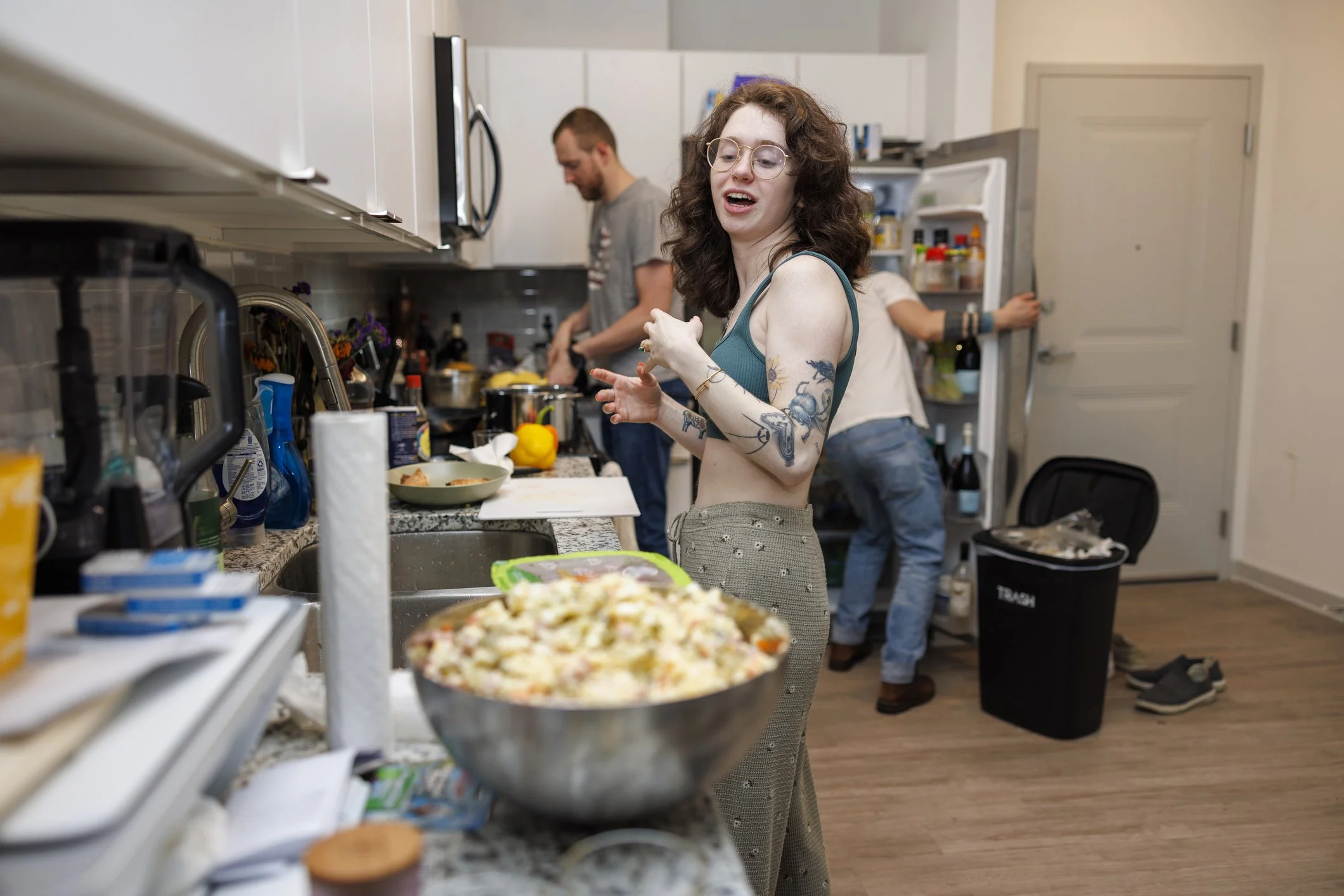
There is an empty chair at the kitchen table.
Every marriage has a kitchen table.
It may be made of oak, laminate, or whatever Scandinavian furniture company has convinced us that happiness arrives with an Allen wrench.
It may be covered with unpaid bills, school permission slips, a lonely avocado, and at least one coffee mug that someone swears they're "still using."
More importantly, it is where couples conduct the ordinary business of intimacy.
Who forgot to call the plumber.
Whether your son really needs another pair of soccer cleats.
Why one person seems unusually quiet.
Who is making dinner.
And, every so often, what exactly was meant by the sentence:
"I just think it's interesting."
No marriage has ever survived without becoming fluent in this strange second language.
Couples rarely argue about words. They argue about meanings.
A spouse says one thing. The other hears another. Somewhere between intention and interpretation, an argument is born.
For most of human history, there was only one way to resolve this problem.

The Hidden Marketplace Inside Love: Why We Compare Ourselves
There are two invisible mirrors in every long-term relationship.
One reflects how desirable you believe your partner is.
The other reflects how desirable you believe you are.
The remarkable thing is that neither mirror is especially accurate.
Both are warped by childhood, attachment history, previous heartbreaks, aging, culture, social media, and the peculiar human habit of comparing ourselves to everyone except our actual partner.
Yet entire relationships are quietly organized around these reflections.
A new study published in the Archives of Sexual Behavior offers an intriguing glimpse into this hidden economy.
Researchers studying 562 women in committed heterosexual relationships in Poland found that women who perceived their partners as having higher "mate value" than themselves reported greater motivation to satisfy those partners sexually.
That increased motivation, in turn, was associated with somewhat more frequent sexual initiation, oral sex, and faking orgasms.
Importantly, the relationship was indirect, the effects were small, and the study cannot establish cause and effect.
That restraint is important.
Because this is not really a story about oral sex.
Nor is it a story about women trying to keep men from wandering.
It is a story about something far older.
It is the story of what happens when love collides with self-doubt.
Can Remote Work Hurt Your Marriage? New Research Says Yes
Remote work was supposed to improve life.
It would eliminate commutes, reduce office politics, give parents more time with their children, and finally allow work to fit around life instead of the other way around.
Much of that happened.
Yet another, quieter revolution occurred behind closed doors.
Millions of couples suddenly found themselves spending more hours together than at any point in modern history.
And many became lonelier.
At first glance, this makes no sense.
For generations, psychologists and marriage researchers worried about couples separated by long workdays, business travel, military deployment, or opposing shifts. The assumption was almost mathematical: more shared time should produce greater intimacy.
Instead, many couples discovered something unsettling.
Presence and connection are not the same thing.
You can spend an entire day in the same house with someone and feel as though you never actually met.
That paradox sits at the center of an elegant new study published in the Journal of Organizational Behavior. The research asks what appears to be a straightforward question: What happens to romantic relationships when work moves into the home?
The answer turns out to have remarkably little to do with geography.
It has everything to do with attention.

NVLD, Couples Therapy, and the Hope That One Person Can Change a Marriage
There is a moment that occurs with surprising frequency in couples therapy.
One partner calls.
The other declines.
"You go if you want," they say.
"I don't need therapy."
For many spouses, this feels like the closing scene of the marriage.
It isn't.
Particularly when Nonverbal Learning Disorder (NVLD) may be shaping the relationship in ways neither partner recognizes.
One of the great misconceptions about couples therapy is that meaningful change requires two motivated people sitting on the same sofa every Tuesday at six o'clock.
It certainly helps.
But it is not always necessary.
In fact, one of the oldest ideas in marriage and family therapy suggests precisely the opposite.
A relationship is not simply two life partners living under one roof.
It is a living system.
And systems reorganize whenever one of their parts begins functioning differently.
That is not optimism.
It is systems theory.

Stable Marriage and Happiness: New Research Shows Why Long-Term Marriages Predict Well-Being in Old Age
There is a peculiar habit in modern culture.
We treat relationships as though they were restaurant reviews.
How was dinner?
Would you recommend it?
Only good, or outstanding?
Five stars or three?
Scientists, fortunately, are far less interested in whether your marriage had a good Friday. They want to know something much more difficult.
What happens if we follow an entire lifetime?
That is exactly what a remarkable new study published in the European Journal of Populationset out to answer.
Instead of asking the familiar question—"Are married people happier?"—the researchers asked a far more ambitious one:
How does the story of your relationships shape your happiness after age sixty?
It's a better question.
And it produced a better answer.
Marriage Isn't a Moment. It's a Biography.