
Welcome to my Blog
Thank you for stopping by. This space is where I share research, reflections, and practical tools drawn from my experience as a marriage and family therapist with an international practice.
I write about what happens to desire, attachment, and meaning once the early myths stop working.
Are you a couple looking for clarity? A professional curious about the science of relationships? Or simply someone interested in how love and resilience work? I'm glad you've found your way here. I can help with that. I'm accepting new clients, and this blog is for the benefit of all my gentle readers.
Each post is written with one goal in mind: to help you better understand yourself, your partner, and the hidden dynamics that shape human connection
Grab a coffee (or a notebook), explore what speaks to you, and take what's useful back into your life and relationships.
And if a post sparks a question, or makes you realize you could use more support, l'd love to hear from you. Let's explore the scope of work you'd like to do together.
Be Well, Stay Kind, and Godspeed.
~ Daniel
P.S.
Feel free to explore the categories below to find past blog posts on the topics that matter most to you. If you're curious about attachment, navigating conflict, or strengthening intimacy, these archives are a great way to dive deeper into the research and insights that l've been sharing for years.
- Attachment Issues
- Coronavirus
- Couples Therapy
- Extramarital Affairs
- Family Life and Parenting
- How to Fight Fair
- Inlaws and Extended Families
- Intercultural Relationships
- Marriage and Mental Health
- Married Life & Intimate Relationships
- Neurodiverse Couples
- Separation & Divorce
- Signs of Trouble
- Social Media and Relationships
- What Happy Couples Know


Who Owns Odysseus?
The Trojan Horse may be the most successful piece of advertising ever created.
Not because it fooled the Trojans.
Because it has been fooling the rest of us for nearly three thousand years.
Ask almost anyone what the horse represents and you'll hear the same answer:
Cleverness, ingenuity, thinking outside the box before there were boxes to think outside of.
We have transformed one of history's most celebrated acts of deception into a compliment. Somewhere along the way,
Odysseus became less a complicated man than a leadership seminar.
Christopher Nolan's The Odyssey arrives at an interesting cultural moment.
We no longer trust our heroes the way our grandparents did.

Ted Lasso Was About More Than Soccer
If you believed Ted Lasso was a show about football, congratulations.
You also believed The Sopranos was a workplace drama.
The soccer was scenery.
It arrived disguised as an underdog comedy—biscuits, locker-room speeches, and improbable optimism.
By the time viewers realized they were watching a meditation on grief, emotional labor, and the quiet cost of always being the strong one, they were already emotionally invested.
For years, we've insisted we wanted authenticity.
What we often rewarded instead was emotional usefulness.
Be encouraging. Be resilient. Read the room. Lift the mood.
Carry the weight.
Enter Ted Lasso.
A man who smiled through divorce.
Smiled through loneliness. Smiled through panic attacks.
Smiled so convincingly that millions of viewers mistook relentless optimism for emotional health.
It wasn't health.
It was survival.
Ted had become exquisitely skilled at making everyone else feel better before anyone noticed he was quietly falling apart.
That's why Ted Lasso was never really about soccer.
It was about what happens when your personality becomes your coping strategy.

The Friction We Lost: How Modern Life Made Other People Optional
There used to be more waiting.
You waited at the bank. You waited at the pharmacy.
You waited for the fellow at the hardware store who knew everything about washers, sump pumps, and marriages, although nobody had asked him about the third item.
You waited because everybody waited.
And while you waited, life slipped in through the side door.
Someone complained about the weather. Someone admired your Red Sox cap. Someone recommended a restaurant that had apparently been “going downhill” since 1987 but remained, mysteriously, open.
Nobody remembers these conversations.
That may have been their purpose.
Relationships are rarely built entirely from dazzling encounters. They are built from the forgettable ones—the tiny exchanges that seem like nothing until they disappear.
In 2026, we have become exceptionally good at making them disappear.

Men's Sexual Submission Fantasies: What New Research Really Says About Desire, Dominance, and Arousal
The oldest story about sex goes something like this.
Men lead.
Women follow.
Men pursue.
Women respond.
Everyone is supposed to stay in their assigned lane.
The trouble is, nobody bothered to ask the imagination.
A new Spanish study of 1,400 heterosexual adults found something that quietly dismantles decades of cultural assumptions.
Men reported more positive thoughts about sexual submission than women did.
Women who enjoyed fantasies of sexual dominance showed an especially strong association with physical arousal.
If your Victorian great-grandmother just fainted, give her a minute.

Naked Dressing Isn't About Nudity. It's About the Attention Economy
Every civilization develops a preferred way of taking its clothes off.
The Victorians called it elegance.
The Roaring Twenties called it liberation.
The 1960s called it revolution.
Fashion in 2026 calls it naked dressing—transparent gowns, illusion fabrics, impossible cutouts, and dresses that appear to have survived a knife fight with a tailor.
The argument arrives right on schedule.
It's empowering.
It's degrading.
It's feminist.
It's anti-feminist.
Everyone has a conclusion.
Almost nobody asks the interesting question.
Why now?
Fashion never happens in isolation.
It reflects the emotional economy of the culture wearing it.
And naked dressing tells us something profound about ours.

The Surprising Difference Between Casual and Compulsive Pornography Use
For years, we've treated pornography the way Americans treat cholesterol.
We assume there's a number.
Below it, you're probably fine.
Above it, you should begin worrying about your future and perhaps schedule an intervention.
We have an almost touching faith that if we can simply count something often enough—calories, steps, drinks, hours on social media, sexual partners—we'll eventually understand it.
Counting is comforting.
Thinking is harder.
Fortunately, Research occasionally ruins a perfectly good stereotype.

Why Heartbroken Men Still Think Schopenhauer Was Right About Women
Arthur Schopenhauer has become the unofficial philosopher of the romantically disillusioned.
Spend enough time in the more aggrieved corners of YouTube, Reddit, or the modern grievance economy and you will encounter the familiar verdict:
Schopenhauer understood women.
He saw through romance.
He predicted modern dating.
He knew what women were really like.
No.
He understood something more unsettling.
He understood what desire can do to judgment.
He understood how humiliation can harden into contempt.
And he demonstrated, perhaps unintentionally, how an intelligent person can turn personal disappointment into a theory about half the human race.
Schopenhauer was not right about women.
But he was disturbingly perceptive about the machinery beneath romantic love.

The Tiny Glowing Vote Against Your Marriage
There was a time when the greatest threat to a marriage was thought to be an affair.
Then it was workaholism.
Then television.
Then the internet.
Today, millions of couples are slowly bleeding intimacy one notification at a time.
The villain isn't the smartphone.
The phone is just glass, aluminum, and enough computing power to land Apollo 11 on the moon.
It has no agenda. It doesn't wake up plotting the demise of your sex life.
You do that all by yourself.
Or, more precisely, you do it every time your spouse begins a sentence and you reflexively glance down because your pocket buzzed.
Every time someone says, "Can I tell you something?" and you answer, "Hang on..." while scrolling through photos of a stranger's Labradoodle.
Every time your partner reaches for connection and loses a fair fight against an algorithm specifically engineered to hijack your attention.
Therapists have a wonderfully awkward word for this behavior: phubbing—snubbing someone you are physically with in favor of your smartphone.
It sounds silly.
It isn't.

The CEO in the Apron: What the Tradwife Internet Is Really Selling
She says this while checking her engagement analytics, negotiating a sponsorship with a cookware company, editing her fifth video of the day, reviewing affiliate sales, answering emails from her manager, and scheduling tomorrow's content across four social media platforms.
If irony burned calories, Tradwife TikTok would disappear overnight.
A fascinating new study published in Psychology of Women Quarterlyexamines one of the internet's fastest-growing subcultures: the "tradwife" influencer.
The researchers weren't interested in judging women who choose to stay home, homeschool their children, or bake sourdough bread. Those are legitimate personal choices that millions of families make happily.
Instead, they asked a far more interesting question:
How do social media influencers package traditional gender roles into a profitable digital business?
Their answer tells us as much about Instagram and TikTok as it does about marriage.
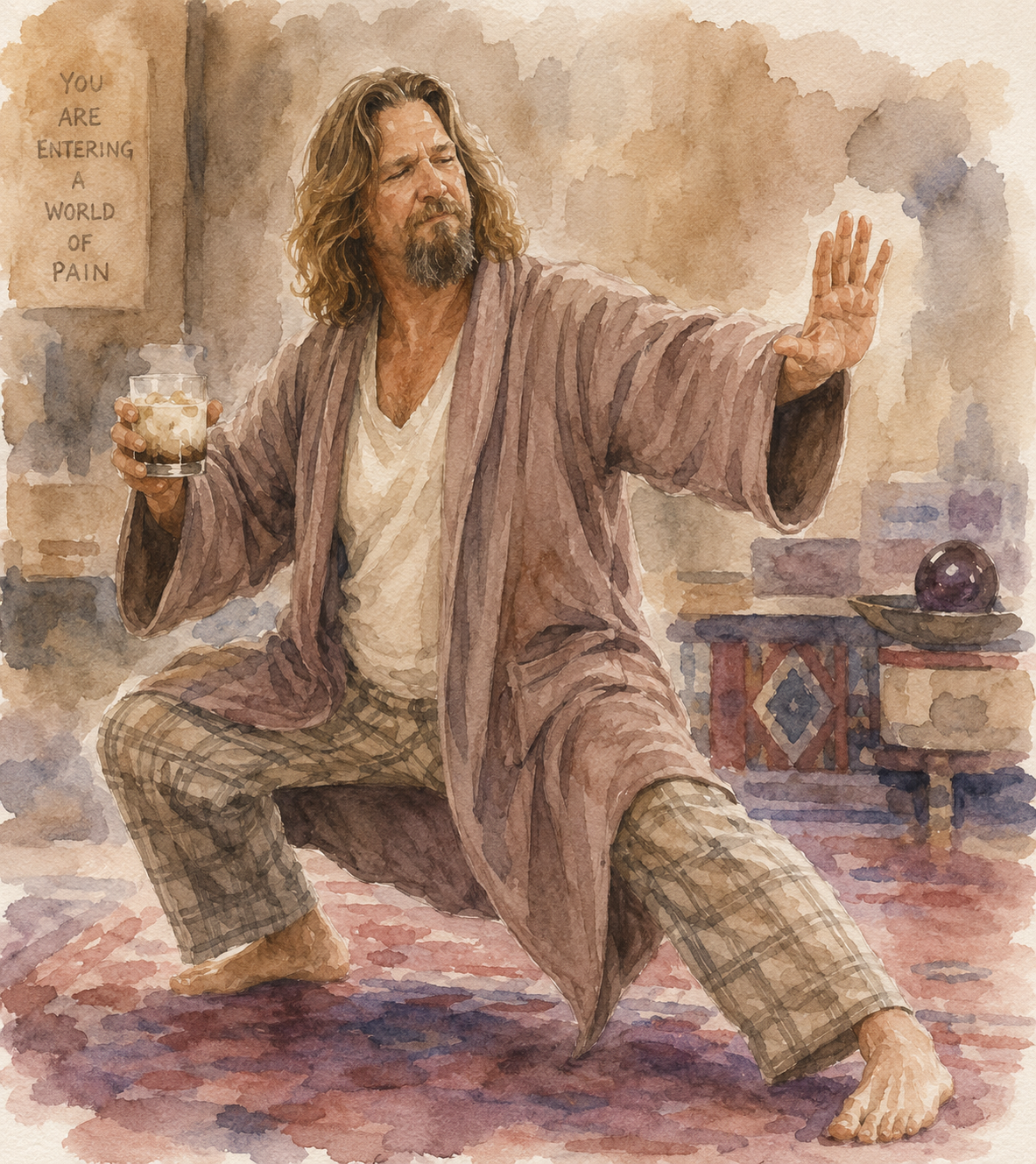
The Dude Abides Because Kali Dances
Most cult films gather fans.
The Big Lebowski gathered pilgrims.
People quote it the way other people quote scripture.
They celebrate "Lebowski Fests."
They wear jelly sandals and Pendleton sweaters with surprising sincerity.
"The Dude abides" has become less of a movie line than a tiny philosophy for surviving modern life.
That is strange.
Because The Big Lebowski is, on its face, an absurd comedy about a soiled rug, fake kidnappers, incompetent criminals, league bowling, and a man who spends an astonishing amount of time drinking White Russians.
It should have disappeared into the VHS bargain bin sometime around 2002.
Instead, it became mythology.
I don't think that's an accident.
I think the Coen brothers made a spiritual film while pretending to make a comedy.
And I think the best key to understanding it isn't Freud, Jung, or Joseph Campbell.
It's Kali.
Not because the Dude is Kali.
But because the movie itself performs Kali's work.

Spock Was Right: "Live Long and Prosper" Is Better Advice Than Most Self-Help Books
Of all the blessings humanity has invented over the past several thousand years, I think one of the finest may have come from an alien.
Which is an odd sentence to write.
Especially when the alien had green blood, pointed ears, and the emotional expressiveness of a particularly thoughtful thermostat.
Yet here we are.
"Live long and prosper."
Four words.
We've heard them so often that they've dissolved into nostalgia—a hand gesture, a convention greeting, a Leonard Nimoy impression at Comic-Con.
We've stopped hearing what they're actually saying.
Which is a shame.
Because hidden inside those four words is a complete philosophy of how to live.
Not how to succeed.
How to live.

Spock Wasn't Cold. He Was Differentiated.
There is perhaps no fictional character who has been more confidently—and more persistently—misunderstood than Commander Spock.
For nearly sixty years, audiences have looked at the raised eyebrow, the measured cadence, the clipped syntax, and the unwavering devotion to logic and arrived at the same diagnosis.
"Emotionally unavailable."
Cold.
Detached.
A brilliant man who, if he ever wandered into a couples therapist's office, would undoubtedly be told to "get in touch with his feelings."
As a marriage and family therapist, I have a different opinion.
Spock wasn't emotionally unavailable.
He was differentiated.