Tuesday, August 4, 2026.
Christopher Nolan's The Odyssey isn't simply another adaptation of Homer.
It's the latest chapter in a three-thousand-year argument about myth, memory, power, and the stories civilizations tell to explain themselves.
Editor's Note: This essay discusses major themes and story elements from Christopher Nolan's The Odyssey and contains spoilers.
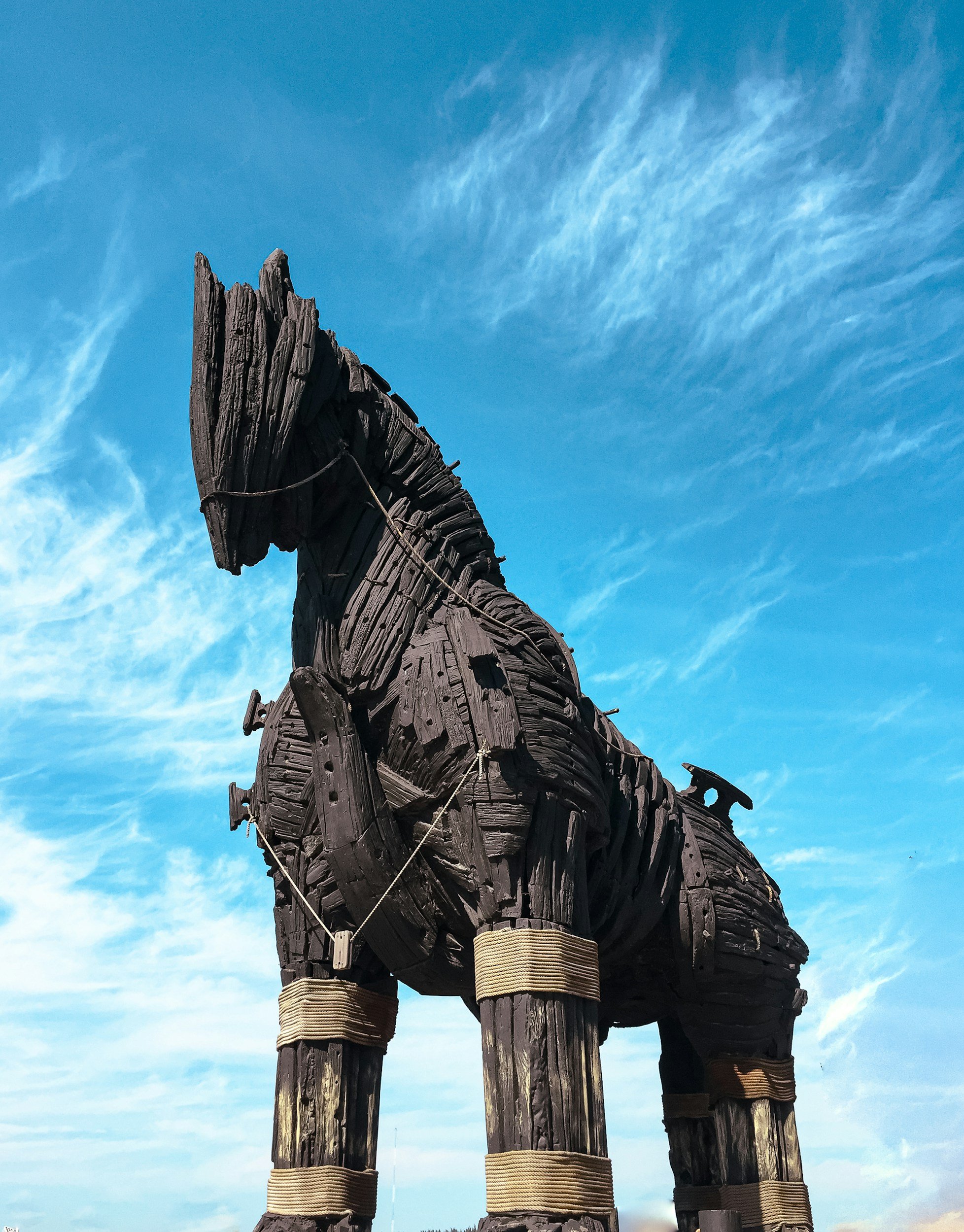
The Trojan Horse may be the most successful piece of advertising ever created.
Not because it fooled the Trojans.
Because it has been fooling the rest of us for nearly three thousand years.
Ask almost anyone what the horse represents and you'll hear the same answer:
Cleverness, ingenuity, thinking outside the box before there were boxes to think outside of.
We have transformed one of history's most celebrated acts of deception into a compliment. Somewhere along the way,
Odysseus became less a complicated man than a leadership seminar.
Christopher Nolan's The Odyssey arrives at an interesting cultural moment.
We no longer trust our heroes the way our grandparents did.
We have learned that explorers owned slaves, philanthropists built monopolies, revolutionaries became tyrants, and nearly every golden age appears to have been financed by someone else's suffering.
We have grown suspicious of monuments because we have finally begun asking who was standing beneath them when they were erected.
Nolan seems less interested in adapting Homer than in cross-examining him.
That distinction matters.
Homer Wrote a Hero. Every Age Wrote Its Own Odysseus.
There has never been one Odysseus.
There is the Odysseus Homer wrote.
Then there is the Odysseus every civilization afterward required.
Those are rarely the same man.
The Greeks admired mētis (μῆτις): a form of cunning, adaptive intelligence that prizes improvisation, strategic deception, resourcefulness, and pragmatic wisdom.
Odysseus survives because he understands that brute force is expensive while persuasion is comparatively cheap.
Achilles can kill a soldier. But Odysseus can persuade an entire city to participate in its own destruction.
The Romans discovered in him the architect of empire.
The medieval world distrusted cleverness.
Dante famously placed him in the Eighth Circle of Hell among the fraudulent, understanding something Homer only hinted at: intelligence detached from conscience eventually develops an appetite of its own.
The Victorians polished Odysseus into character.
The twentieth century reinvented him as psychological resilience.
The twenty-first century has recast him as strategy.
Every age rewrites its heroes until they begin sounding suspiciously like itself.
Nolan Shrinks the Epic Until Only Human Beings Remain
This is why I am less interested in whether Nolan is faithful to Homer than whether he is faithful to our moment.
I think he is.
The film has been praised for its spectacle, yet what struck me most was its relative refusal of spectacle.
The beaches feel oddly empty. Troy feels cramped rather than imperial. The heroes spend an astonishing amount of time looking cold, wet, exhausted, and morally uncertain.
Epic gradually demures to logistics.
It is a brilliant artistic instinct.
Civilizations remember victories.
Individuals remember carrying heavy shit uphill in the rain.
History is always lived at human scale before later generations inflate it into marble.
As the mythology contracts, the humanity expands.
Without grandeur to distract us, we begin noticing the ordinary weight of extraordinary decisions.
The Trojan Horse Was Never About Carpentry
The most revealing sequence is not the battle.
It is the waiting.
The Trojan Horse has usually been filmed as an emblem of military genius.
Nolan quietly transforms it into something else: a cramped wooden container filled with frightened men sweating, pissing, and shitting on one another, whispering, doubting, and waiting for darkness—and for someone else's trust.
The horse ceases to be symbolic.
It becomes physical.
And something remarkable happens.
The less mythical it becomes, the more morally unsettling it grows.
The question shifts from How ingenious! to What kind of people endure this because they believe the slaughter waiting outside is justified?
That is not a classical question.
It is a modern one.
History prefers statues to logistics.
Nolan politely insists on showing us the logistics.
Stories Have Always Been More Dangerous Than Weapons
For centuries we have misunderstood why the horse matters.
It was never primarily a weapon.
Weapons destroy walls.
Stories persuade people to open gates.
Odysseus' masterpiece is not carpentry.
It is narrative.
The horse says:
"The war is over."
"This is a gift."
"Trust what you see."
Every sentence is false.
Every sentence succeeds.
That combination should sound disturbingly familiar.
We flatter ourselves that we inhabit an unprecedented age of misinformation, branding, political messaging, algorithms, and artificial intelligence.
The technology is new.
But the awareness is ancient.
The shortest route into a city has never been through its walls.
It has always been through its imagination.
Every civilization insists it would have recognized the Trojan Horse.
History suggests otherwise.
The Poet Arrives Before the Historian
Here Nolan quietly departs from the myth most of us inherited.
He is less interested in courage than legitimacy.
Every civilization eventually faces the same uncomfortable question:
How do yesterday's victors become tomorrow's rightful rulers?
Not by continuing to fight.
By explaining.
By commemorating.
By educating.
By remembering selectively.
The poet usually arrives before the historian.
Sometimes before the undertaker.
That may be Homer's greatest achievement.
He did not simply preserve memory.
He shaped it.
History has terrible public relations until somebody writes the epic.
Penelope Keeps Civilization Alive
Homer refuses to simplify Odysseus.
He lies.
He manipulates.
He disguises himself repeatedly.
He wins through intelligence, but cunning always exacts a cost.
The journey home is measured less in miles than in moral erosion.
Modern retellings often smooth away those rough Odyssean edges.
Nolan refuses.
His women—especially Penelope—are no longer prizes waiting at the end of male adventure.
She becomes the custodian of continuity.
While men leave to manufacture history, she preserves the possibility that history might someday have a home worth returning to.
That is not passivity.
It is civilization's least celebrated emotional labor.
Empires are built by ambitious men.
Homes are often preserved by women whose history rarely bothers to name.
The Longest Journey Was Never Across the Mediterranean
One reason The Odyssey refuses to disappear is that nearly everyone misremembers it.
People think it is about getting home.
It isn't.
Odysseus reaches Ithaca.
The difficult part begins afterward.
Home is no longer the place he remembers.
He is no longer the man who left.
Penelope has survived twenty years without him.
Telemachus has grown into adulthood in the company of stories rather than a father.
Even the old dog recognizes him before the people do.
That may be Homer's quietest stroke of genius.
The voyage changes less than the voyager.
Every soldier eventually discovers this.
So does every refugee.
Every immigrant.
Every widow.
Every marriage after betrayal.
Every person who survives an illness that quietly divides life into "before" and "after."
We speak casually about "getting our life back," as though time had been patiently waiting for our return.
It never does.
That is why The Odyssey still feels oddly contemporary.
Not because of monsters.
Not because of battles.
Because Homer understood that the longest journeys are measured not in miles but in identity.
We Are Still Building Trojan Horses
Christopher Nolan has not solved Homer.
No serious artist ever solves another.
He has done something more valuable.
He has reminded us that every generation inherits two Odysseuses.
The one Homer wrote.
And the one it needs.
Our age, exhausted by propaganda, suspicious of power, and increasingly aware that reality itself has become contested terrain, has naturally produced an Odysseus who wins less by strength than by mastering narrative.
That should not reassure us.
It should, instead, make us uneasy.
Because myths do not survive because they are literally true.
They survive because each generation discovers, often with some discomfort, that it has been telling the story about itself all along.
We still build Trojan Horses.
Only now we build them from platforms instead of timber.
From algorithms instead of oak.
From stories instead of soldiers.
The materials change.
Human nature rarely does.
Perhaps that is why Homer refuses to become obsolete.
He did not merely write one of civilization's first great adventures.
He wrote one of its first great political questions.
What happens when intelligence discovers that it can accomplish with stories what armies once required swords to achieve?
We have been answering that question for nearly three thousand years.
Christopher Nolan has simply asked us to hear it once again.
The more unsettling question is not what Homer believed.
It is what will our descendants someday believe about us?
Because every civilization rewrites its myths.
And every myth, eventually, becomes evidence.
Be Well, Stay Kind, and Godspeed.