Thursday, July 25, 2024. Revised Sunday, May 17, 2026. This is for Dr. Elizabeth Petroff who showed me the way.
There are moments in history when people begin feeling psychologically abandoned by the age they live in.
Public life becomes unstable.
Attention fragments.
Meaning thins.
Technology accelerates faster than human emotional adaptation.
Folks become flooded with information while starving for orientation.
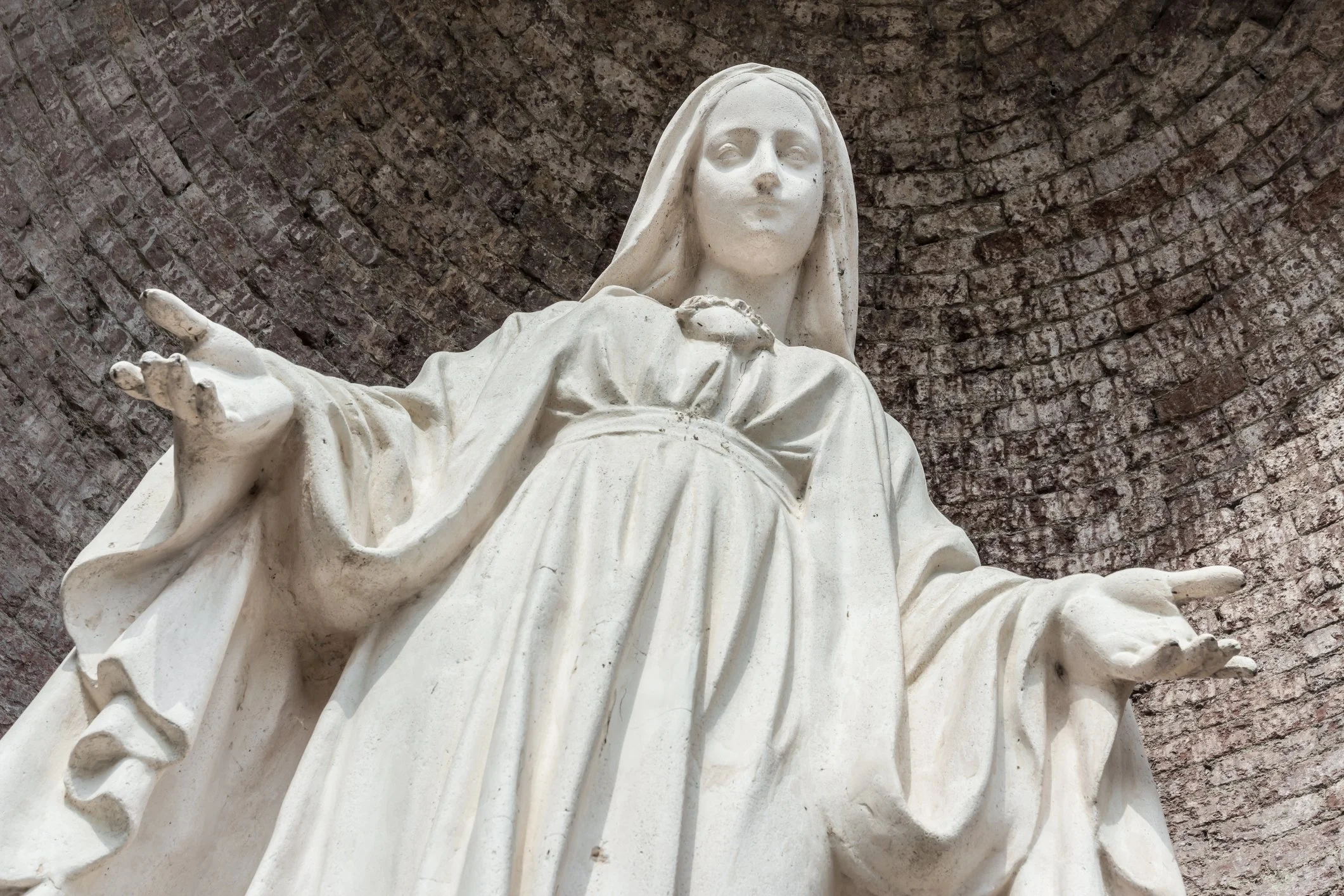
And during these periods, reports of Marian apparitions often emerge with unusual force.
Not during calm.
During rupture.
A maternal figure appears amid war, famine, persecution, political instability, or spiritual exhaustion and delivers remarkably consistent themes: mercy, repentance, prayer, endurance, hope, reconciliation.
Whether these events are understood as supernatural encounters, archetypal experiences, symbolic phenomena, or collective psychological expressions, their historical persistence deserves serious attention.
Because Marian apparitions reveal something important about human beings: what we search for when ordinary emotional structures begin failing.
And increasingly, modern marriages exist under many of those same conditions.
Fragmentation.
Distraction.
Loss of stillness.
Loss of ritual.
Loss of shared symbolic life.
A husband checks financial alerts while his wife describes a frightening medical appointment.
Two spouses lie beside each other while separate algorithms feed them entirely different emotional realities.
A family eats dinner together while nobody fully leaves their phone.
No one appears overtly cruel.
But something essential begins thinning anyway.
Not love exactly.
Attention.
And eventually, reverence itself.
Apparitions During Social Upheaval
One of the most striking patterns surrounding Marian apparitions is timing.
The apparitions almost never emerge during periods of broad cultural confidence.
They appear during instability, fear, collapse, conquest, famine and drought, persecution, or collective uncertainty.
Our Lady of Fatima emerged during World War I.
Our Lady of Kibeho preceded the Rwandan genocide.
Our Lady of Guadalupe emerged amid the spiritual and cultural dislocations following the Spanish conquest of the Aztec Empire.
The pattern matters psychologically.
Human beings appear especially vulnerable to transcendent experience when ordinary social structures stop providing emotional coherence.
And many couples now live inside precisely that kind of emotional atmosphere.
Continuous interruption.
Continuous stimulation.
Continuous partial attention.
The nervous system rarely settles long enough for emotional depth to fully emerge.
Many relationships today are not collapsing dramatically.
They are dissolving incrementally through chronic distraction.
Attention Is Never Neutral
Much of Marian devotion is organized around sustained bestowed attention.
Candles.
Rosaries.
Pilgrimages.
Icons.
Silence.
Ritual repetition.
These practices slow consciousness down.
They interrupt fragmentation.
Late modern life trains the opposite reflex. Couples move through relationships while mentally divided between notifications, work demands, ambient anxiety, political dread, financial stress, streaming media, and algorithmic distraction.
Emotional availability becomes intermittent.
Presence becomes fractured.
Research on attachment and emotional responsiveness repeatedly suggests that intimate bonds stabilize through consistent emotional attunement more than isolated grand gestures.
The work of John Gottman and Sue Johnson both points toward the importance of sustained emotional responsiveness inside long-term relationships.
In therapy, couples rarely say:
“We have lost our shared symbolic life.”
They say instead:
“We feel disconnected.”
“We feel like roommates.”
“Everything feels transactional now.”
“I don’t know where we went.”
A couple spends three hours coordinating schedules, bills, sports practices, and travel plans and never once asks each other an emotionally curious question.
Many couples now share calendars more effectively than inner lives.
Because intimacy is not merely built through affection.
It is built through sustained emotional recognition.
One partner feeling genuinely held in the mind of the other.
And digitally saturated life increasingly destabilizes precisely that capacity.
Why the Figure Is Maternal
It is difficult to ignore that Marian apparitions are essentially maternal. In other words, male saints do not have as well as reliably established a habit of showing up in a crisis.
The symbolic figure emerging during periods of collective fear is not primarily authoritarian, triumphant, or judicial.
It is protective.
Merciful.
Containing.
Maternal.
Psychologically, this is revealing.
During periods of instability, human beings often search less for dominance than for refuge.
The recurring maternal symbolism within Marian apparitions may reflect an enduring psychological need for nurturance, emotional shelter, mercy, and protection during periods of fear and instability.
Carl Jung would likely have recognized this immediately as archetypal material: the repeated emergence of the Great Mother during periods of collective psychic instability.
And marriages often require these same emotional conditions to survive over long periods of time.
Not perfection.
Mercy.
Containment.
The ability to remain emotionally available during illness, disappointment, grief, fear, aging, exhaustion, and uncertainty.
Long-term love depends less on perpetual passion than on sustained forms of compassionate attention.
The Collapse of Symbolic Life
Contemporary emotional life increasingly explains suffering through procedural language:
Attachment style.
Trauma response.
Regulation difficulty.
Cognitive distortion.
Communication deficit.
Some of this language is extraordinarily useful.
But human beings have historically organized emotional life through symbolism, ritual, archetype, prayer, pilgrimage, and transcendence as well.
Marian apparitions endure partly because symbolic language continues speaking to emotional realities that purely procedural frameworks often cannot fully contain.
A maternal figure appears during fragmentation and communicates reassurance, endurance, repentance, mercy, hope.
The symbolic pattern remains remarkably stable across centuries.
And marriages require symbolic structures too.
Not simply schedules.
Shared rituals.
Shared meanings.
Shared forms of reverence.
Shared emotional mythology.
Many couples today possess coordination without transcendence.
They manage calendars together but experience very little awe together.
Without symbolic life, relationships gradually become procedural.
Efficient.
Competent.
Emotionally flattened.
Many marriages are not dying from conflict.
They are dying from prolonged inattentiveness to what once felt sacred.
Pilgrimage and Emotional Transformation
Many Marian apparition sites eventually become places of pilgrimage.
Pilgrimage matters psychologically because it externalizes transformation. People temporarily leave ordinary routines in search of healing, forgiveness, meaning, transcendence, or renewal.
Healthy long-term relationships often function similarly.
Not as static arrangements, but as forms of shared movement.
The strongest couples frequently develop rituals that interrupt emotional automation:
Walking together.
Praying together.
Returning to meaningful places.
Shared silence.
Shared grief rituals.
Shared service.
Shared memory-making.
Anthropological and sociological research, from Émile Durkheim onward, suggests that ritualized collective experience strengthens emotional cohesion and social identity.
Without those structures, couples often drift toward logistical intimacy: relationships organized primarily around errands, schedules, parenting coordination, exhaustion, and task management.
The relationship survives structurally while emotional depth quietly recedes.
Major Marian Apparitions
Our Lady of Guadalupe — Mexico, 1531
Our Lady of Lourdes — France, 1858
Our Lady of Knock — Ireland, 1879
Our Lady of Fatima — Portugal, 1917
Our Lady of Zeitoun — Egypt, 1968–1971
Our Lady of Akita — Japan, 1973–1981
Our Lady of Kibeho — Rwanda, 1981–1989
Medjugorje — Bosnia and Herzegovina, 1981–present
What the Research on Apparitions Actually Helps Us See
The best scholarship on Marian apparitions does not simply ask, “Did this happen?”
That is a theological question, and different readers will answer it differently.
The more useful research question is:
What happens to individual folks, families, and communities when an experience is interpreted as sacred?
William A. Christian Jr.’s historical work shows that apparitions often emerge among ordinary people, especially rural or socially marginal witnesses, and become embedded in local systems of belief, authority, pilgrimage, and devotion.
Ruth Harris’s work on Lourdes shows how apparitions can become cultural battlegrounds where medicine, skepticism, suffering, and faith all compete to define what counts as truth.
Ann Taves gives therapists a crucial conceptual tool: experiences become religious not only because of what occurs internally, but because individuals and communities attribute special meaning to them.
Sandra Zimdars-Swartz helps us see modern Marian apparitions comparatively, as events with repeated patterns: visionary witnesses, messages of warning or hope, communal interpretation, ecclesiastical caution, pilgrimage, controversy, and devotion.
None of this requires the reader to resolve the supernatural status of Marian apparitions.
The psychological and cultural significance of these events exists regardless of whether one interprets them literally, symbolically, archetypally, devotionally, or sociologically.
Taken together, this research suggests that Marian apparitions are not merely isolated visionary claims.
They are meaning-making events.
And marriage, at its best, is also a meaning-making system.
Why This Matters Clinically
Therapists increasingly encounter couples who are not simply conflicted.
They are existentially fatigued.
The presenting problem may sound like resentment, communication difficulty, emotional withdrawal, or sexual disconnection. Beneath those complaints often sits a deeper condition:
The loss of shared transcendence.
Not necessarily religion.
Transcendence.
A felt sense that the relationship participates in something meaningful enough to organize sacrifice, repair, patience, reverence, and sustained emotional presence.
Many couples are searching for emotional experiences digitally mediated life rarely provides:
Stillness.
Mercy.
Containment.
Reverence.
Sacred attention.
And when couples rediscover even modest forms of those experiences together, relational systems sometimes soften in ways purely procedural interventions cannot fully produce.
FAQ
Are Marian apparitions officially recognized by the Catholic Church?
Some Marian apparitions are formally approved by the Catholic Church after extensive investigation. These include Our Lady of Guadalupe, Our Lady of Lourdes, Our Lady of Fatima, Our Lady of Kibeho, and Our Lady of Good Help. Others remain under investigation, disputed, or unapproved.
Why do Marian apparitions often appear during periods of social instability?
Historically, Marian apparitions tend to emerge during war, political upheaval, persecution, famine, or cultural fragmentation. Researchers have noted that periods of collective uncertainty often intensify humanity’s search for protection, meaning, hope, and transcendence.
Why is the apparition figure usually maternal?
The recurring maternal symbolism may reflect enduring psychological needs for nurturance, emotional refuge, continuity, mercy, and protection during periods of fear or instability. Jungian scholars often interpret Marian apparitions through the lens of the “Great Mother” archetype.
What does research on Marian apparitions actually study?
Researchers typically study Marian apparitions as religious, historical, sociological, anthropological, and psychological phenomena. Scholarship often examines visionary experiences, community responses, pilgrimage culture, institutional reactions, symbolic meaning-making, and the social effects of sacred narratives.
Can a relationship survive without shared reverence?
Not easily. Reverence does not necessarily mean religion. It can mean shared awe, gratitude, ritual, emotional curiosity, tenderness, or the feeling that the relationship itself deserves protection and care. Couples often remain functional long after reverence disappears, but the emotional texture of the relationship changes profoundly.
Can nonreligious people still find meaning in Marian apparitions?
Yes. Even outside formal religious belief, Marian apparitions can be understood symbolically or psychologically. Themes such as mercy, hope, ritual, contemplation, emotional attention, and communal meaning-making remain deeply relevant to emotional life.
Why are rituals psychologically important in relationships?
Research in family psychology and sociology consistently suggests that shared rituals strengthen emotional cohesion, predictability, identity formation, resilience, and relational stability. Rituals help couples maintain emotional continuity during periods of stress.
What is “symbolic life” in a marriage?
Symbolic life refers to the shared meanings, rituals, myths, traditions, values, and emotional narratives that help a couple experience the relationship as more than a logistical arrangement. Couples can remain highly functional while gradually losing symbolic depth and emotional reverence.
How does technology affect emotional intimacy?
Continuous digital interruption fragments attention and reduces sustained emotional presence. Many therapists increasingly observe that relationships suffer not only from conflict, but from chronic distraction and attentional erosion.
Are Marian apparitions compatible with science-based therapy?
They can be approached through evidence-based frameworks involving meaning-making, resilience, attachment, ritual, emotional regulation, symbolic identity, forgiveness, and shared spiritual practices.
Final Thoughts
Marian apparitions persist because they continue speaking to enduring human conditions: fear, uncertainty, suffering, longing, hope, and the desire to believe tenderness still matters during periods of collapse.
That persistence deserves reflection.
Especially now.
Because contemporary relationships are not only stressed.
They are interrupted.
Continuously.
And eventually, people become shaped by whatever repeatedly interrupts their attention.
The older religious traditions understood something psychologically sophisticated long before the attention economy emerged:
Attention changes consciousness.
People become what they repeatedly attend to.
Marriages do too.
And in distracted ages, reverence rarely disappears all at once.
It disappears gradually through neglect.
Be Well, Stay Kind, and Godspeed.
REFERENCES:
Anderson, C., & Chávez, E. (2009). Our Lady of Guadalupe: Mother of the civilization of love. Doubleday.
Carroll, M. P. (1992). Madonnas that maim: Popular Catholicism in Italy since the fifteenth century. Johns Hopkins University Press.
Christian, W. A., Jr. (1981). Apparitions in late medieval and Renaissance Spain. Princeton University Press.
Driver, J. L., Tabares, A., Shapiro, A. F., Nahm, E. Y., & Gottman, J. M. (2012). Interactional patterns in happy and unhappy marriages: Gottman laboratory studies. In F. Walsh (Ed.), Normal family processes (4th ed., pp. 57–80). Guilford Press.
Durkheim, É. (1995). The elementary forms of religious life (K. E. Fields, Trans.). Free Press. (Original work published 1912)
Fiese, B. H., Tomcho, T. J., Douglas, M., Josephs, K., Poltrock, S., & Baker, T. (2002). A review of 50 years of research on naturally occurring family routines and rituals: Cause for celebration? Journal of Family Psychology, 16(4), 381–390. https://doi.org/10.1037/0893-3200.16.4.381
Gottman, J. M. (1999). The marriage clinic: A scientifically based marital therapy. W. W. Norton & Company.
Gottman, J. M., & Silver, N. (1999). The seven principles for making marriage work. Crown Publishers.
Harris, R. (1999). Lourdes: Body and spirit in the secular age. Penguin.
Johnson, S. M. (2004). The practice of emotionally focused couple therapy: Creating connection (2nd ed.). Brunner-Routledge.
Johnson, S. M., Hunsley, J., Greenberg, L., & Schindler, D. (1999). Emotionally focused couples therapy: Status and challenges. Clinical Psychology: Science and Practice, 6(1), 67–79. https://doi.org/10.1093/clipsy.6.1.67
Jung, C. G. (1968). The archetypes and the collective unconscious (2nd ed.). Princeton University Press.
Mahoney, A. (2010). Religion in families, 1999–2009: A relational spirituality framework. Journal of Marriage and Family, 72(4), 805–827. https://doi.org/10.1111/j.1741-3737.2010.00732.x
Orsi, R. A. (2010). History and presence. Harvard University Press.
Pargament, K. I. (2007). Spiritually integrated psychotherapy: Understanding and addressing the sacred. Guilford Press.
Repetti, R. L., Wang, S., & Saxbe, D. (2009). Bringing it all back home: How outside stressors shape families’ everyday lives. Current Directions in Psychological Science, 18(2), 106–111. https://doi.org/10.1111/j.1467-8721.2009.01618.x
Sullivan, R. (2004). The miracle detective: An investigation of holy visions. Grove Press.
Taves, A. (1999). Fits, trances, and visions: Experiencing religion and explaining experience from Wesley to James. Princeton University Press.
Taves, A. (2009). Religious experience reconsidered: A building-block approach to the study of religion and other special things. Princeton University Press.
Tronick, E. Z. (2007). The neurobehavioral and social-emotional development of infants and children. W. W. Norton & Company.
Zimdars-Swartz, S. L. (1991). Encountering Mary: From La Salette to Medjugorje. Princeton University Press.