Sunday, November 22, 2026.
Why manifesting took hold now, and what it reveals about where we locate the Godhead.
The universe, it turns out, takes specifications.
In Manon Beliot’s November report for AFP, a Los Angeles photographer describes writing down what she wanted in a husband.
Creative. Curly brown hair. Light eyes.
Then she met Sean. They now make a vision board together every year.
It sounds like a good marriage.
The question I would put to the universe concerns the other applicant. Suppose Sean had written blonde?
The joke is at the expense of the cosmology.
Sean was also looking out of his own eyes. He could have had a list.
He could have changed his mind.
He could have turned out to be the great love of her life with straight hair, which would have presented the universe with a minor administrative problem and the two of them with none at all (AFP’s report on manifesting).
Two loci of the Godhead
“Thy will be done” and “I’m manifesting it” can both be said by someone sitting alone at the kitchen table, waiting for the phone to ring.
Both take the desire seriously enough to address something beyond the room. The difference lies in where each locates the authority to answer.
In prayer, the Thy has a will of its own.
The petitioner can ask with all the particularity of a person who knows exactly what is at stake.
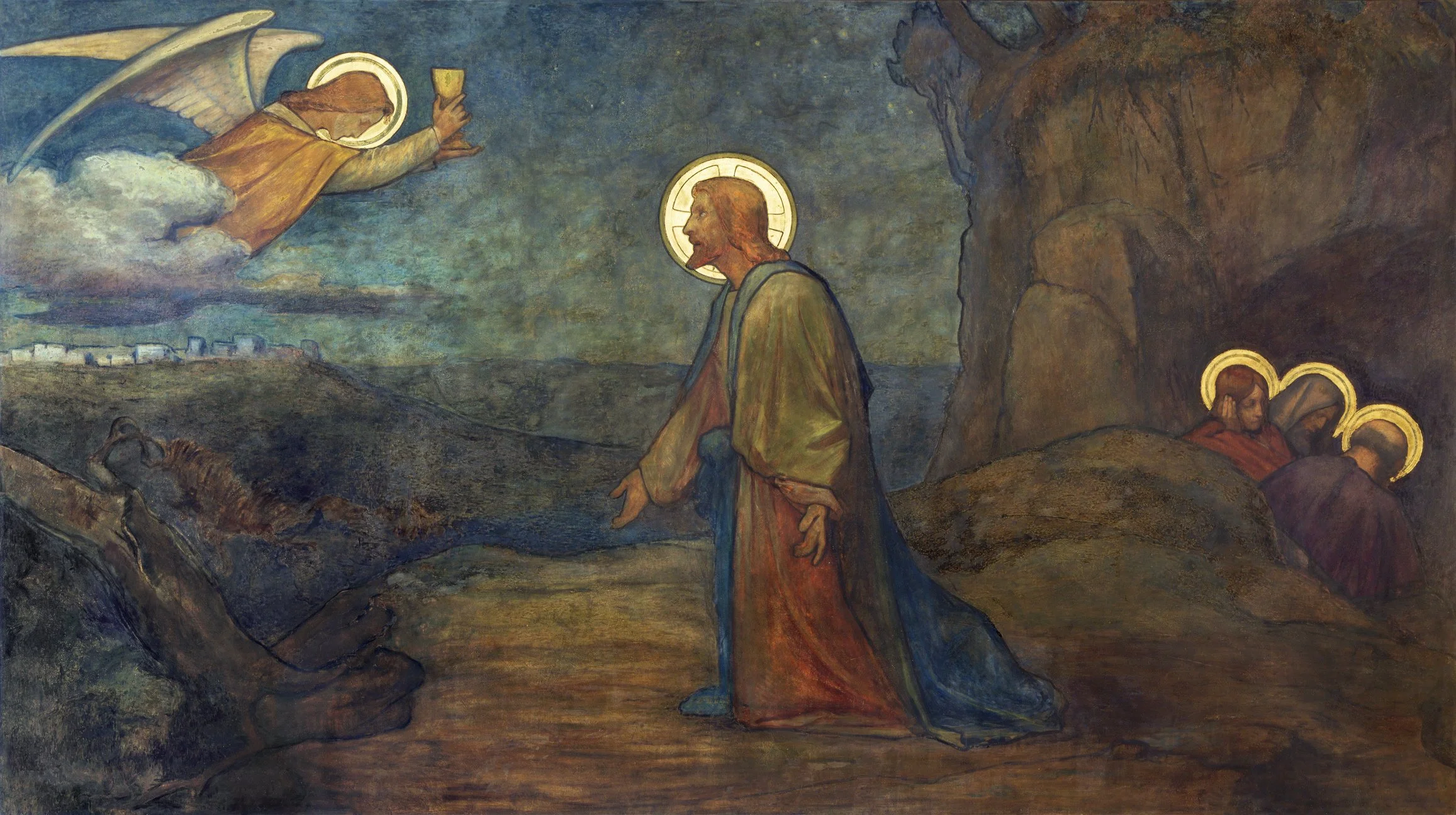
In Gethsemane, Jesus asks for the cup to pass. He makes the request before he yields.
The sequence matters. He has a preference, and it is a desperate one. His words leave room for a will beyond his own, even there (Matthew 26:36–46).
In the stronger version of manifesting, the power still belongs to the universe.
The authority to decide what that power is for has moved indoors.
The universe supplies the force. I supply the specifications.
If there is a discrepancy, I am taught to examine my technique, my doubts, my inability to feel grateful for an event that has yet to occur. I can change practically anything about the request except my conviction that it ought to be granted.
Those are the two loci of the Godhead.
You can hear them in what each practice makes of the word please.
A plea acknowledges that the one addressed can answer freely. Some manifestation teachers advise speaking as if the thing is already yours. Under that instruction, please would only introduce a sense of doubt.
Why this, and why now?
Rituals for securing a future are old.
The interesting question is what makes this one feel so contemporary.
Rhonda Byrne’s The Secret gave the law of attraction a mass audience in 2006. The pandemic gave it a fresh setting.
Millions of people were waiting for decisions about their lives that would be made somewhere they couldn’t go.
The job, the wedding, the visit to an aging parent all had to wait. Here was a practice you could begin immediately, at home, using the very instrument on which the bad news arrived.
Cambridge Dictionary made manifest its 2024 word of the year after the term spread from self-help and social media into ordinary speech (University of Cambridge).
The phone had already given us an education in apparent magic.
It serves up an advertisement for the shoes you were thinking about.
You know there are commercial explanations involving what you clicked, what people like you clicked, and how many shoes you forgot you looked at.
Still, there’s that little shiver of recognition. The machine can feel uncannily attentive at precisely the moment the institutions with actual power over your life are hardest to reach.
As a candidate for bestowed divine attention, the feed has the advantage of getting back to you.
There’s a religious opening, too.
In Pew’s 2023–24 Religious Landscape Study, 29% of American adults identified as religiously unaffiliated, with younger adults more likely than older adults to say so.
That figure tells us nothing about which of them keep vision boards.
It does help explain the setting in which a private spiritual practice can make sense to people who have little reason to call a minister.
You can have a morning ritual, a testimony, and a theory of providence without acquiring a congregation.
You can also try a new theory of providence on Thursday (Pew Research Center)
And if a down payment for your first home is slipping away faster than you can save for it, an evening spent imagining your future front door has an appeal that a lecture on building your credit score will never match.
The ritual gives you something to do with a wish that has otherwise has nowhere obvious to go.
The business opportunity begins when someone offers to tell you what you did wrong.
When magic looks like discipline
Here is where we start to teeter.
A woman wakes early, writes in a journal, keeps her appointments and does her best to govern her attention.
These are recognizable forms of discipline.
A manifesting coach can sell her the same routine with one additional premise. If she performs it faithfully, someone who left her will come back.
That premise is where the old language of black magic has something to say.
The phrase sounds lurid next to a woman with a notebook. The temptation it names is quieter.
You seek spiritual leverage over something you have no right to command.
In love, that something is a potential partner. But their capacity to refuse is part of the very freedom that would make their return worth having.
Psychology can help us tell what the notebook is doing.
In four experiments, Heather Barry Kappes and Gabriele Oettingen found that dwelling on idealized futures could reduce the energy people brought to pursuing them.
It matters what you picture. Rehearsing how you’ll get through a job interview leaves the interview ahead of you.
Spending twenty minutes basking in the admiration of your future colleagues can give you some of the pleasure of a job you still have to apply for.
It’s a problem of deciding where to exert control, complicated by the fact that imagining success is often the nicest part of the work (Kappes & Oettingen, 2011).
Lucas Dixon and colleagues found that stronger manifestation beliefs went with greater perceived success and confidence about future success.
They also went with attraction to riskier investments and a greater likelihood of reporting past bankruptcy. Those associations leave the direction of cause open.
They do make it worth asking what happens when a coach teaches a person to treat the feeling of certainty as evidence.
In Beliot’s reporting, former coach Danielle Ryan noticed that some of the people teaching clients how to manifest money had made theirs selling the lesson. Their clients were already part of somebody’s success story (Dixon et al., 2025 · AFP’s report).
What happens when the answer is no?
Churches have their own history of making a transaction out of prayer.
Any preacher who ties the size of the blessing to the size of the check has already grasped the commercial possibilities.
Conversely, there are people who use manifestingto mean they finally dared to say out loud that they wanted to leave a bad job.
The word can do some good there.
The difference becomes clear at the point of disappointment.
Who has to explain the refusal?
What do you owe the person whose outcome you found inconvenient?
Consider a woman who wants her marriage back. There are things to do. She can make a plain apology for the cruelty she used to call honesty.
She can listen to the answer without correcting the chronology.
If her partner is willing, they can see whether a life together is still possible.
His answer may be no. By then, she may have done more honest work than at any other time in her marriage. It would be a second cruelty to tell her that the result reveals how little she believed.
That’s the moral cost of putting the Godhead inside the self. It sounds, at first, like a promotion.
Eventually somebody has to be responsible for everything.
I keep coming back to the detail in Matthew that Jesus asked his friends to stay awake with him.
They fell asleep.
He preferred that the cup would pass, and he wanted a little company while he waited.
There’s room in that scene for the things we can actually do for each other.
You can sit with somebody through the last hour before the call.
You can make coffee.
When the call comes, you can still be there.
Be Well, Stay Kind, and Godspeed.
REFERENCES:
Dixon, L. J., Hornsey, M. J., & Hartley, N. (2025). “The secret” to success? The psychology of belief in manifestation. Personality and Social Psychology Bulletin, 51(1), 49–65. https://doi.org/10.1177/01461672231181162
Kappes, H. B., & Oettingen, G. (2011). Positive fantasies about idealized futures sap energy. Journal of Experimental Social Psychology, 47(4), 719–729. https://doi.org/10.1016/j.jesp.2011.02.003
If you and your partner are facing a future you want different things from, explore my couples therapy services or get in touch for a free introductory call.