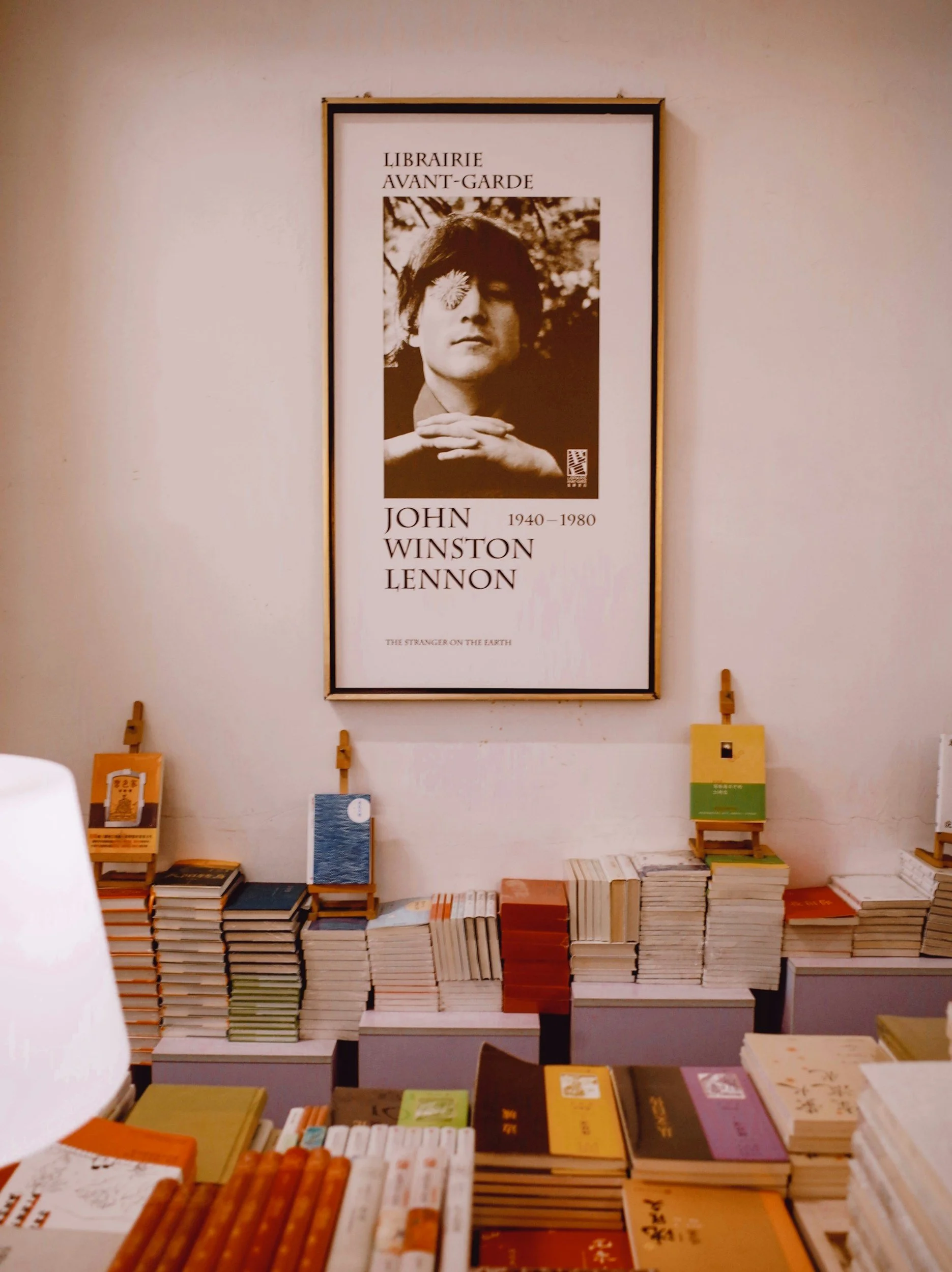
December 10, 2025.
John Lennon was killed on December 8, 1980—shot outside the home he shared with the woman this song was written for.
He was forty. He has now been dead longer than he lived.
Most of us can accept tragedy, but not this kind of math: the idea that someone who shaped us never got the years he was singing toward.
So when we listen to “(Just Like) Starting Over,” we’re hearing a man imagining a future he believed he still had. It makes the song tender; it also makes it unbearable.
By this point, Lennon had stepped out of the spectacle and into the ordinariness he’d once mocked. He was raising a child, burning bread, trying to remember who he was when nobody asked him to be iconic.
He just had to let it go.
It’s often in these quiet domestic stretches that we finally hear ourselves think—and don’t entirely like what we hear.
He was at the age when people begin taking stock of their lives, and their loves, and the distances they swore they’d never allow to grow.
He was not a rock star writing a love song.
He was a highly accomplished middle-aged man realizing repair might require more honesty than he had practiced up to that point.
The Opening Gesture: Hope in a Careful Voice
When he suggests they “start over,” the line slides past quickly, but only because he wants it to. Brightness can be a kind of apology.
People speak this way when they want something they’re not sure they deserve.
Hope, expressed too directly, sounds like begging.
This is how people talk when they sense something slipping and aren’t quite ready to admit how badly they want it back.
Why Nostalgia Makes Us Cry: A Collision With Who We Once Were
When Lennon gestures toward their beginning, nostalgia hits the listener like an unexpected wave.
This is the part that breaks people.
Not the memory itself—
but the self inside the memory.
We cry because nostalgia shows us the distance between who we were and who we have become.
Between what we believed about love and what we’ve learned it actually demands.
Between the softness we once carried and the caution that replaced it.
Neuroscience can map this as reconsolidation.
But emotionally, it’s something simpler: an ache for a version of ourselves we can’t return to without cost.
The Drift: What Love Sounds Like When It Starts to Thin
Lennon admits something has changed. It’s understated, almost shy. That’s how people tell the truth when they’re trying not to make a scene.
Relationships don’t unravel dramatically.
They fade in increments so small no single moment feels worthy of alarm.
You stop reaching out.
You stop listening for their footsteps.
You stop believing the small things matter because you’re too tired to give them meaning.
The quiet becomes a kind of weather—persistent, unremarkable, corrosive.
This is the drift.
And it breaks more marriages than betrayal ever will.
The Escape Fantasy: Love Asking for a Room of Its Own
Then he dreams of leaving everything behind.
Folks frame this as romance.
It’s actually the oldest survival instinct love has: the plea for fewer obstacles, fewer competing demands, fewer ways to lose each other in the noise.
Couples aren’t tired of each other.
They’re just tired of their lives pressing in on them.
Lennon wasn’t asking for adventure.
He was asking for space—
the one resource an accomplished life never seems to afford.
The Return of Playfulness: A Small, Impossible Lifting
Later, his voice turns playful, almost boyish. You can hear the man he once was and the man he hoped to be again.
Play is intimacy’s truest signal.
It appears only when fear loosens its grip.
This is often where readers cry—not from joy but from recognition.
Because they remember a time when love required no choreography, when laughter came unforced, when closeness didn’t feel like work.
Play is the canary in a marriage.
When it returns, something inside you stands up to listen.
Erotic Memory: What the Body Refuses to Forget
Then comes the soft invocation of their physical life together.
Not explicit. Not even descriptive.
Just enough to remind them both of who they were when desire felt like certainty.
Erotic memory works like this:
it holds the truth long after the relationship starts protecting itself from it.
We do not cry because the sex was better.
We cry because the vulnerability was easier.
Because we were once willing to be seen without flinching.
The body remembers joys the mind has long since intellectually explained away.
Repetition: Hope Practicing Its Own Survival
Lennon circles back to the idea of beginning again.
Not insistently—rhythmically, almost as if he’s rehearsing a feeling he wants to believe.
Hope requires repetition.
The nervous system needs evidence before it relaxes.
The refrain doesn’t say “trust me.”
It says “I’m still here and still trying.”
Which, for many couples, is the most honest love language they ever speak.
This is the part that feels like someone standing in their doorway, unable to articulate the fear that time might be running out.
The Song Beneath the Song: Our Private Grief For Who We Were
Strip away the retro shine and you find something simple and devastating:
A man trying to come home to himself,
and to the marriage he hopes still has room for him.
Every lyric line carries within it a small instruction for repair:
Remember our origin story without idolizing it.
Clear the noise so tenderness has a place to land.
Let the body whisper what the mind refuses to hear.
Let ease return, even briefly.
Let hope repeat until it stops sounding ridiculous.
This is not a song about starting over.
It is a song about wanting the beginning not because it was perfect,
but because we were someone in it we now quietly miss.
That is why we cry.
Not for the relationship.
But for the selves that we lost along the way.
Therapist’s Note
If this stirred something—if you felt the sting of recognition, the warmth of nostalgia, or the small panic of seeing yourself in the drift—that isn’t sentiment.
It’s recognition..
Relationships don’t collapse from lack of love.
They collapse from lack of repair.
If you want to find your way back—to your partner, to yourself, to the version of your love that still lives somewhere beneath the noise—please reach out.
Schedule a free consultation with me.
Let’s begin again, with clarity and care.
Be Well, Stay Kind, and Godspeed.
REFERENCES:
McEwen, B. S. (1998). Stress, adaptation, and disease: Allostasis and allostatic load. Annals of the New York Academy of Sciences, 840, 33–44. https://doi.org/10.1111/j.1749-6632.1998.tb09546.x
Panksepp, J. (1998). Affective neuroscience: The foundations of human and animal emotions. Oxford University Press.
Friston, K. (2010). The free-energy principle: A unified brain theory? Nature Reviews Neuroscience, 11(2), 127–138. https://doi.org/10.1038/nrn2787
Mikulincer, M., & Shaver, P. R. (2007). Attachment in adulthood: Structure, dynamics, and change. Guilford Press.