The Three Hares Motif: Why Three Rabbits Running in a Circle Still Haunt Human Imagination
Thursday, May 14, 2026.
There are symbols that belong to history, and then there are symbols that seem to move underneath history like underground rivers.
The three hares motif belongs to the second category.
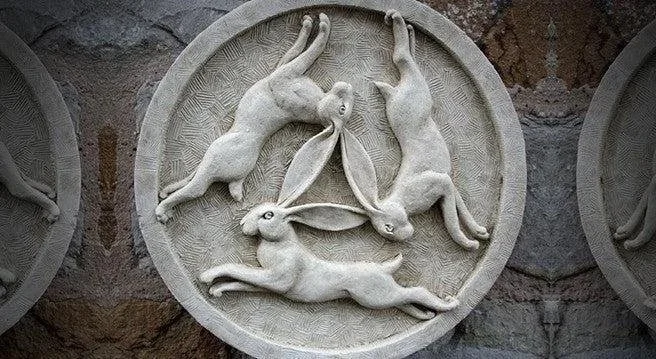
Three hares chase one another in a circle.
Each shares an ear with the next so that there are only three ears total, though each animal appears to possess two.
The image is mathematically elegant and psychologically strange.
It looks less designed than discovered, as though someone stumbled upon it while half-dreaming beside a fire eight hundred years ago and immediately understood it mattered.
Then it began appearing everywhere.
In Buddhist cave temples in China.
In Islamic decorative art.
In medieval churches in England.
In synagogues.
In manuscripts.
In carved ceilings and hidden architectural corners across civilizations that supposedly should not have been speaking to one another with quite this degree of symbolic intimacy.
Nobody entirely agrees on what it means.
That is precisely why it survived.
The Symbol Above Your Head
The placement matters.
The three hares often appear overhead, carved into ceiling bosses where the ribs of medieval churches intersect.
You walk into a stone building built by people who lived with plague, famine, religious terror, and winters capable of psychologically flattening entire villages. You look upward expecting saints, angels, theological warnings.
Instead, you get rabbits.
This informs medieval Christianity enormously.
The famous version at Widecombe-in-the-Moor Church became associated with Devon tin miners and acquired the nickname “Tinners’ Rabbits.”
The mining connection feels symbolically right even if historians debate the details.
Mining cultures become intimate with cycles: descent, darkness, return. Men disappear underground each day and emerge again at dusk like exhausted resurrections.
The hares do not appear to be running toward something.
They appear to be sustaining something.
I think this is the first clue.
The Ancient Knowledge of Recurrence
Modern culture worships novelty. Ancient culture understood repetition.
The modern world promises progress:
better technology.
better optimization.
better identities.
stressless chairs designed by emotionally unavailable Scandinavians.
Ancient people were less convinced that human beings changed quite so dramatically.
They watched seasons repeat. Empires repeat. Wars repeat. Family patterns repeat.
The same emotional catastrophes appearing in different clothing century after century.
The three hares motif feels strangely modern because we remain trapped inside recurrence while pretending we are moving in straight lines.
Relationships loop.
Politics loop.
Loneliness loops.
Attention loops.
People still ruin marriages for reasons medieval monks would have recognized immediately: vanity, secrecy, hunger for admiration, boredom, power, resentment, fear.
Only now they also have Bluetooth.
The hares are not moving toward resolution.
I believe they are illustrating continuity.
Why Hares?
Because hares have always unnerved human beings slightly.
They move unpredictably. They appear at dusk. They freeze, then explode into motion. Ancient cultures associated them with the moon, fertility, resurrection, witchcraft, intuition, and immortality.
In Chinese mythology, the moon rabbit uses a mortar and pestle to grind the elixir of eternal life.
In European folklore, witches transformed into hares.
In Christian symbolism, hares became linked in some contexts to resurrection and virginity because medieval biology occasionally wandered into what can only be described as aggressively imaginative territory.
The hare became symbolically overloaded because human beings sensed something uncanny in it: nervousness, speed, hidden awareness.
The animal seemed connected to rhythms people could feel but not fully explain.
This is often how symbols begin.
Not through logic.
Through emotional recognition.
The Silk Road and the Movement of Meaning
Many scholars believe the motif originated near the Mogao Caves and spread westward along Silk Road trade routes.
The Silk Road did not merely transport goods.
It also transported meaning.
Religions moved along it.
Mathematics moved along it.
Symbols moved along it.
The modern world likes imagining globalization as a recent invention because modernity constantly enjoys taking credit for ancient human behavior.
But civilizations have always leaked into one another.
Stories migrate. Images migrate. Anxiety migrates.
So does hope.
The three hares motif survived because it was symbolically flexible enough to enter multiple cultures without losing emotional force.
That is rare.
Most symbols become local.
The three hares became migratory.
Why The Shared Ears?
Without the shared ears, the image would probably not have endured.
It would merely depict animals chasing one another in a circle — pleasant enough, suitable perhaps for expensive ceramics.
The shared ears create paradox.
Your eye keeps recounting them:
Three?
Six?
Separate?
Shared?
The brain cannot fully stabilize the image.
This produces fascination because the human mind is drawn toward unresolved patterns. This is called the Zeigarnik Effect.
Complete chaos repels us. Complete predictability bores us. Structured ambiguity captures our attention.
The three hares remain alive because perception never entirely finishes with them.
So do certain memories.
So do certain losses.
So do certain loves.
In other words, human beings become attached not only to what they understand, but to what continues to unfold inside them over time.
FAQ
What is the three hares motif?
The three hares motif is a circular image of three hares or rabbits sharing three ears while chasing one another. It appears in sacred and decorative art across Europe and Asia.
Where did the symbol originate?
Its exact origin is unknown, but many scholars believe it began in Buddhist cave art in China and spread westward through Silk Road trade networks.
What does the three hares motif symbolize?
That’s up for grabs. Interpretations include:
eternity.
interconnectedness.
fertility.
resurrection.
continuity.
cyclical time.
spiritual unity.
Its ambiguity is part of its enduring appeal.
Why are hares symbolically important?
Across cultures, hares have been associated with fertility, the moon, intuition, resurrection, magic, and mystery because of their unusual behavior and reproductive symbolism.
Why does the motif still fascinate people?
The image combines visual paradox, sacred geometry, historical mystery, and emotional depth. It feels ancient while remaining psychologically contemporary.
Why the Symbol Still Matters
The renewed fascination with ancient symbols reflects a modern hunger people rarely discuss openly.
Modern foks are symbol-starved.
We possess staggering amounts of information alongside astonishing levels of existential confusion.
Modern life explains more and means less. Entire days disappear into algorithmic distraction without producing anything remotely resembling transcendence.
The three hares motif offers several things contemporary life struggles to provide:
mystery.
continuity.
beauty.
recurrence.
symbolic depth.
The image does not scream for attention.
It waits.
That patience now feels almost supernatural.
Final Thoughts
The three hares motif survives because it refuses simplification.
It cannot be collapsed into one religion, one doctrine, one explanation, or one civilization.
It remains psychologically vibrant because it continues generating meaning without exhausting itself.
Three rabbits run endlessly through ceilings while civilizations rise, fracture, industrialize, digitize, optimize, monetize attention, and slowly rediscover that information alone cannot nourish the human nervous system.
And still the hares run.
Not toward conclusion.
Toward recurrence.
Which may be the most honest thing human beings have ever carved into stone.
Be Well, Stay Kind, and Godspeed.
REFERENCES:
Andrew, S., Chapman, C., & Greeves, T. (2016). The three hares: A curiosity worth regarding. Skerryvore Productions.
Cirlot, J. E. (1971). A dictionary of symbols (J. Sage, Trans.; 2nd ed.). Philosophical Library.
Eliade, M. (1959). The sacred and the profane: The nature of religion (W. R. Trask, Trans.). Harcourt.
Jung, C. G. (1968). Man and his symbols. Dell.
Whitfield, R. (1982–1985). The art of Central Asia: The Stein collection in the British Museum (Vols. 1–3). Kodansha International in cooperation with the Trustees of the British Museum.