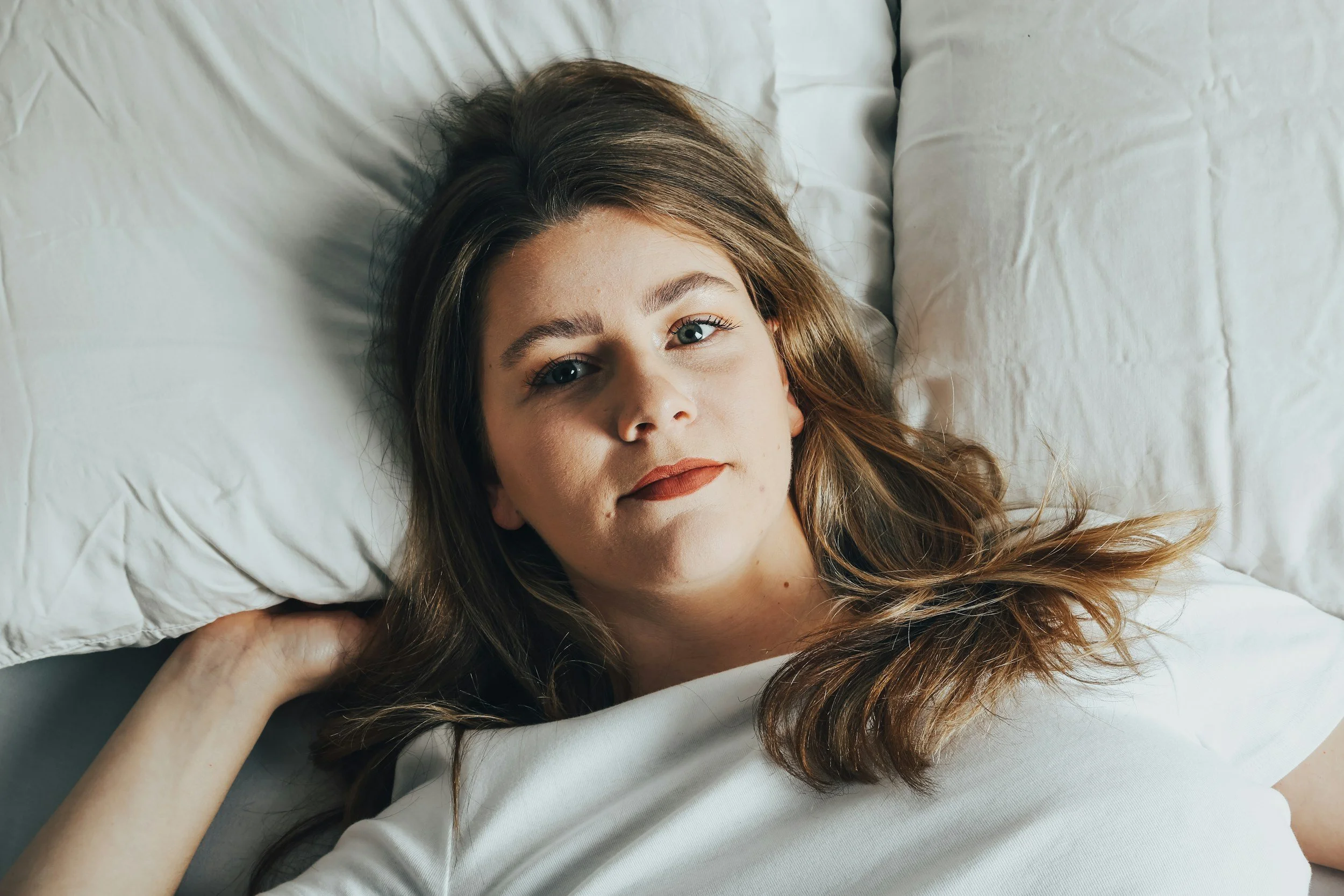
Saturday, November 1, 2025.
The sheets have cooled twice. The clock ticks like a leaky faucet. Somewhere, a refrigerator hums with moral judgment.
She’s already tried everything—no caffeine, no screens, no scrolling apocalypse.
Still awake.
The body’s horizontal, but the mind is on the night shift.
Outside, the world dreams. Inside, her cortex hosts a symposium on regret. This is what researchers call pre-sleep cognitive arousal.
It’s the mind that won’t shut up.
When Stress Meets a Racing Brain
A new study in the Journal of Sleep Research has confirmed what every overthinker knows: some brains treat bedtime as a planning session.
Researchers Ju Lynn Ong and Stijn Massar at the National University of Singapore followed sixty university students for two weeks. Half were low-reactivity sleepers—the kind who can snooze after breakups or tax audits.
The other half were high-reactivity types, whose nervous systems interpret a full inbox as mortal danger.
Each night, participants logged stress levels, tracked heart rate with ŌURA rings, and wore motion sensors to record sleep.
Everyone slept worse on stressful days, but the high-reactivity group had it worst. They took longer to fall asleep, woke more often, and stared at the ceiling longer afterward.
The body could relax. The mind refused.
Cognitive Arousal: The Brain’s Night Shift
This wasn’t about pounding hearts or twitching muscles. Physiological arousal wasn’t the true saboteur.
The real culprit was cognitive arousal—racing thoughts, endless analysis, and that absurd mental PowerPoint of “what ifs.”
The researchers found that high-reactivity sleepers had stronger links between stress, mental noise, and poor sleep quality. They weren’t lying awake from fear; they were lying awake from management.
Their minds weren’t anxious—they were dutiful.
That’s the tragedy of insomnia: a nervous system trying too hard to help.
Sleep researchers call it “trait-level vulnerability.”
Sleep Reactivity: A Nervous System’s Personality
Sleep reactivity is the difference between people who sleep through chaos and people who can hear disappointment from another room.
It’s not weakness—it’s wiring. Some brains simply don’t forgive easily.
The same vigilance that once helped our ancestors hear predators now reacts to push notifications.
Stress reactivity becomes a personal climate: the same weather, just hotter under your skin.
Over time, that difference becomes destiny. The vigilant stop sleeping. The serene never notice.
The Culture That Can’t Sleep
We built an economy on alertness and called it ambition. Every ping, every update, another sermon on productivity.
Sleep is for people who trust the world to keep turning without them.
So we track our rest, grade it, shame ourselves when it fails to perform. Insomnia becomes a kind of unpaid overtime.
The modern brain doesn’t clock out—it just switches tabs.
The exhausted mind doesn’t need more advice. It needs amnesty.
When Empathy Becomes Hypervigilance
As a therapist, I’ve seen this same stress pattern play out in couples therapy.
The person who can’t sleep is often the one who notices everything—the family seismograph, the emotional weather station.
They anticipate moods before they happen, apologize before they’re asked.
Daylight vigilance becomes nocturnal rehearsal.
Sometimes the same brain that can’t rest at night can’t rest in love either. It keeps scanning for tone, solving feelings that weren’t problems.
It’s empathy turned into surveillance.
The Science, in Miniature
At the daily level, everyone’s sleep suffers when stress spikes.
But for high-reactivity folks, the damage compounds. A ten-point increase in perceived stress cost them a minute of sleep—small, but cumulative.
Insomnia doesn’t arrive like catastrophe; it erodes like tidewater.
As Ong and Massar put it, this might not be a malfunction at all but an overexpression of an adaptive trait.
Your brain is trying to protect you—even if it keeps you awake to do it.
The Anti-Advice
If you’re the kind who lies awake drafting tomorrow’s crises, your problem isn’t willpower—it’s loyalty.
Your mind won’t rest because it refuses to abandon you.
The best remedy remains Cognitive Behavioral Therapy for Insomnia (CBT-I)—not spa playlists or herbal teas.
CBT-I trains the mind to file its reports during daylight hours.
Some therapists even assign “worry appointments,” giving the brain a schedule so it stops freelancing at night.
Mindfulness helps too, though not the curated kind.
Real mindfulness is boring. It’s learning to let a thought pass without shaking its hand.
It’s not serenity. It’s containment.
Grace for the Sleepless
She tries it all: the breathing, the writing, the daily surrender. Some nights it even works.
Other nights, she simply forgives herself for being awake.
If you can’t sleep, you’re not broken. You’re just too awake in a world that rewards vigilance.
The mind keeps watch because the body no longer trusts the world to do it.
Sleep isn’t a moral test. It’s biology negotiating with memory.
Some nights you win. Some nights you simply attend the meeting.
2:17 A.M., Again
The same ceiling, but softer now. The thoughts still come, but slower—like rain after thunder.
Her brain still wants to keep watch.
She thanks it.
And bids it rest.
That’s the only command the body obeys: kindness, not control.
Sleep arrives like trust sometimes when you stop trying to earn it.
Be Well, Stay Kind, and Godspeed.
REFERENCES:
Buysse, D. J. (2014). Sleep health: Can we define it? Does it matter? Sleep, 37(1), 9–17. https://doi.org/10.5665/sleep.3298
Feldman, R. (2017). The neurobiology of human attachments. Trends in Cognitive Sciences, 21(2), 80–99. https://doi.org/10.1016/j.tics.2016.11.007
Harvey, A. G. (2002). A cognitive model of insomnia. Behaviour Research and Therapy, 40(8), 869–893. https://doi.org/10.1016/S0005-7967(01)00061-4
Kalmbach, D. A., Arnedt, J. T., Swanson, L. M., Rapier, J. L., & Drake, C. L. (2018). Genetic and environmental influences on sleep reactivity. Sleep, 41(4), zsy034. https://doi.org/10.1093/sleep/zsy034
Ong, J. L., & Massar, S. A. A. (2025). Sleep reactivity amplifies the impact of pre-sleep cognitive arousal on sleep disturbances. Journal of Sleep Research.