Sunday, July 26, 2026. This is for Nick again.
David Crosby never called it Blue Space Therapy.
In fact, I doubt he would have.
Sailors rarely describe what the sea gives them in therapeutic language. They simply say they need to get back on the water. They need to hear the wind. They need to sail.
Therapists, on the other hand, reach for words like emotional regulation, differentiation, secure attachment, attention restoration, and environmental psychology.
Often, we're describing the same experience.
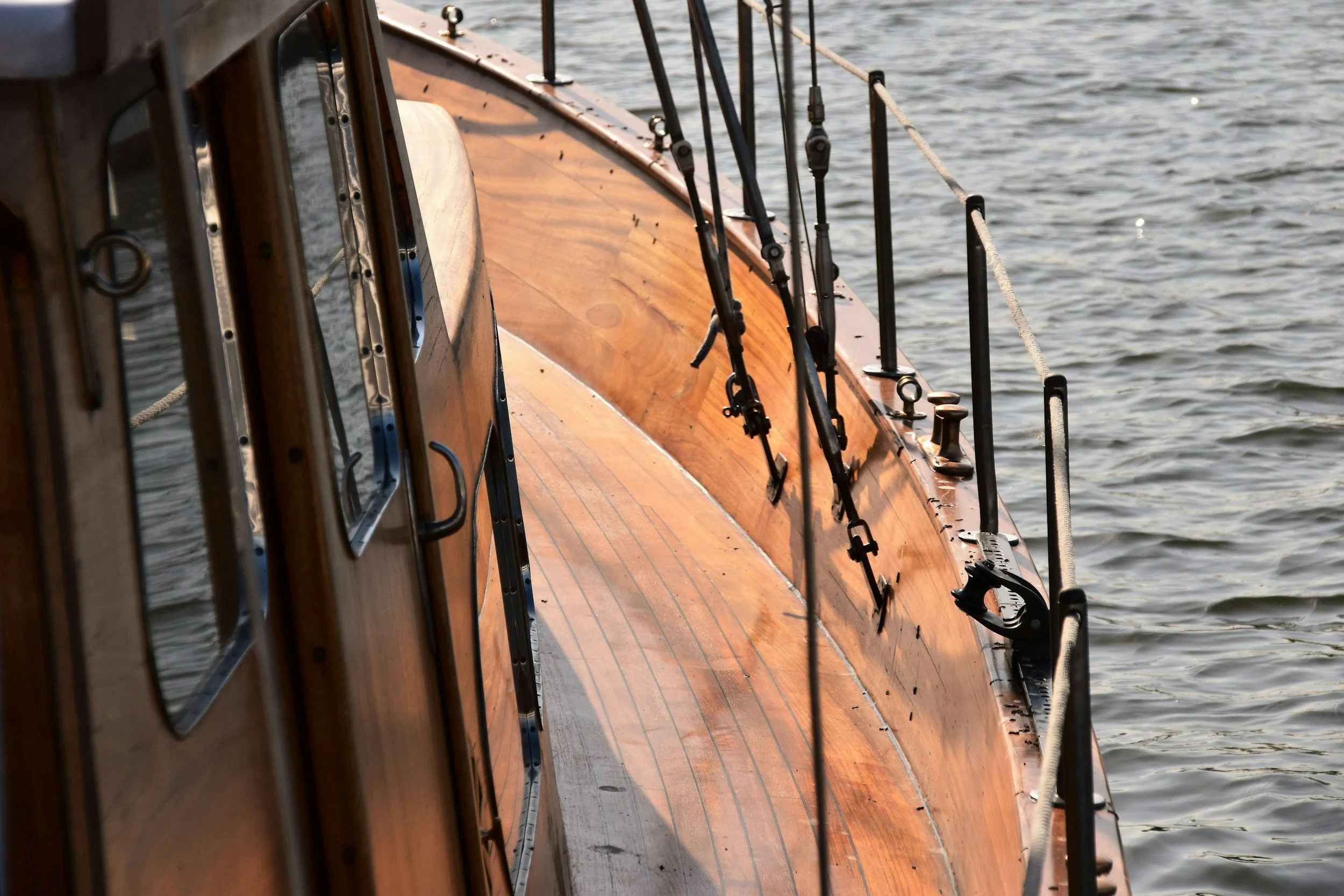
For nearly forty-five years, David Crosby returned to the same wooden schooner whenever his life became too loud.
Through extraordinary musical success, devastating addiction, prison, recovery, illness, and redemption, one constant remained: Mayan.
The story isn't really about a famous musician who owned a beautiful boat.
It's about why one human being kept returning to the same place to become himself again.
A Sailor Before He Was a Rock Star
Long before he became one of the defining voices of the 1960s, Crosby fell in love with sailing. He began as a boy, discovering that wind, tide, weather, and craftsmanship made a kind of sense that people often did not.
In 1969, fresh from the success of Crosby, Stills & Nash, he found a weathered 59-foot Alden-designed schooner named the Mayan. Built in British Honduras (now Belize) in 1947, she had spent years as a charter vessel before falling into neglect.
Crosby saw something different.
Unable to purchase her outright, he borrowed money from his friend Peter Tork of the Monkees and bought the boat that would become the emotional center of for much of his adult life.
Rather than shipping the Mayan to California, Crosby sailed her himself through the Panama Canal and up the Pacific Coast.
That voyage wasn't simply transportation.
It was the beginning of one of the longest and deepest relationships of his life.
A Floating Home—and a Floating Studio
During the 1970s, the Mayan became far more than a sailboat.
She became home.
Friends gathered aboard. Musicians came and went. Songs were written there. Among the works associated with Mayan are "Wooden Ships," "The Lee Shore," "Carry Me," and other compositions that reflected Crosby's fascination with both the sea and the human condition.
The schooner even appeared on the cover of Crosby, Stills & Nash's 1977 album CSN.
People often assume artists create because of chaos.
Sometimes they create because they've finally escaped it.
The Years Everything Fell Apart
By the early 1980s, Crosby's life had become dominated by addiction.
Cocaine, freebase, and heroin consumed nearly everything.
Relationships deteriorated.
His health declined.
Arrests accumulated.
In 1985, Crosby entered a Texas prison after convictions on drug and weapons charges.
He remained incarcerated until 1986.
Years later, Crosby reflected on that experience with striking honesty. Before prison, he had entered hospitals and treatment programs repeatedly, only to leave before recovery could take hold.
Prison was different.
For the first time, there was nowhere to run.
He later acknowledged that incarceration probably saved his life—not because prison was therapeutic, but because it finally interrupted the momentum of addiction long enough for recovery to begin.
That distinction matters.
Recovery often begins not because life becomes easier, but because denial becomes impossible.
Returning to Reality
Following prison, Crosby rebuilt his life piece by piece.
He underwent a life-saving liver transplant.
He resumed recording. In my opinion, some of his most enduring work.
He toured successfully well into his seventies.
And throughout those decades, the Mayan remained one of the constants that connected him to himself.
One of Crosby's most revealing observations came late in life:
"The ocean doesn't really care who you are... it kept me in touch with some part of the real world through a time that was very difficult."
That sentence deserves careful attention.
The ocean didn't rescue him.
It reminded him that reality still existed.
Those are profoundly different things.
What Neuroscience Now Calls Blue Space
Today, neuroscientists and environmental psychologists are beginning to describe what sailors have intuitively understood for centuries.
Marine biologist Wallace J. Nichols popularized the concept of Blue Mind—the calm, mildly meditative state many people experience around oceans, lakes, rivers, and other natural bodies of water.
Research suggests that blue spaces can reduce stress, quiet mental rumination, broaden attention, improve creativity, and help regulate the nervous system.
Water doesn't solve our problems.
It changes the state from which we confront them.
That's a subtle distinction.
And it's an important one.
Boats Teach Differentiation
As a marriage and family therapist, I've always been struck by how much sailing resembles healthy relationships.
A sailor never controls the wind.
He collaborates with it.
That is differentiation.
Edwin Friedman and David Schnarch both argued that emotional maturity doesn't come from controlling other people.
It comes from regulating ourselves while remaining emotionally connected.
Every sailor understands this instinctively.
You don't yell at the weather.
You adjust your sails.
You don't demand a different tide.
You learn to read the current.
The healthiest couples eventually discover the same truth.
Stop trying to control your partner.
Learn to steer yourself.
Mayan as a Secure Base
Attachment Theory describes a secure base as the place from which exploration becomes possible.
Usually, we think of another human being.
Sometimes it is a place.
For Crosby, the Mayan appears to have functioned exactly that way.
After tours...
After addiction...
After prison...
After illness...
After triumph...
He returned to the same deck.
The same rigging.
The same companionway.
The same horizon.
Predictability calms the nervous system.
Consistency restores identity.
Not because life suddenly becomes easier, but because something dependable still exists.
Letting Go
In 2014, after approximately forty-five years of ownership, Crosby sold the Mayan.
He later described the decision as "very painful."
He also expressed gratitude that the schooner had gone to owners committed to preserving her rather than turning her into a floating trophy.
Anyone who has loved a family cottage, a favorite dog, an old pickup truck, or a weathered porch understands this kind of loss.
Sometimes we don't just lose an object.
Because we also lose a geography of memory.
The Sea Doesn't Care Who You Pretend to Be
One of David Crosby's simplest observations may also be his wisest:
"The ocean doesn't really care who you are."
At first glance, that sounds almost cruel.
I hear something else.
I hear freedom.
The ocean doesn't care whether you're famous or forgotten.
It doesn't care about your résumé.
It doesn't care how many followers you have.
It doesn't care if your last argument with your spouse ended badly.
It asks only one thing:
Bestow Attention.
The tide is either rising or it's falling.
The wind is either shifting or it's steady.
Your sail is either trimmed correctly or it isn't.
Reality has an extraordinary way of simplifying us.
I've noticed something similar in couples therapy.
Many couples aren't exhausted simply because they're fighting.
They're exhausted because they're performing.
Performing competence.
Performing certainty.
Performing happiness.
Performing the version of themselves they think their partner wants.
Performance is exhausting.
Authenticity is surprisingly quiet.
Water has an uncanny ability to strip away performance. Perhaps it's because our brains evolved beside rivers and coastlines rather than conference rooms and glowing screens. Perhaps it's because horizons widen our attention instead of fragmenting it.
Whatever the mechanism, conversations beside the ocean often become less about winning and more about understanding.
David Crosby never claimed sailing cured his addiction.
He never suggested the sea erased his mistakes.
He simply said it kept him connected to "some part of the real world."
As therapists, that's a phrase worth lingering over.
Healing rarely begins by becoming someone new.
It usually begins by finding our way back to what is authentic and real.
Sometimes that happens in a therapy office.
And sometimes it happens while walking beside the Atlantic Ocean, listening to waves that have been saying the same thing for thousands of years.
The sea doesn't solve our problems.
But it has an extraordinary way of reminding us which problems are the ones that actually matter.
Pondering the wine-dark sea may be one of humanity's oldest forms of therapy.
A Different Kind of Couples Therapy
Clients occasionally ask me why I've recently become so passionate about Blue Space Couples Therapy.
David Crosby helps explain the answer.
Not because he practiced psychotherapy aboard the Mayan.
Not because sailing cured his addiction.
Neither claim would be remotely true.
Instead, Crosby instinctively kept returning to an environment that grounded him in reality.
I've watched couples who could barely tolerate sitting across from one another in an office begin talking naturally while walking beside the Atlantic.
Defensiveness softens. Silence becomes less threatening. Curiosity returns.
The office remains a wonderful place to do therapy.
But I suspect we've underestimated the healing power of place.
The environment itself can become a quiet member of the therapeutic team.
David Crosby probably would have rolled his eyes at that sentence.
Then he would have untied the dock lines, hoisted the sails, and pointed the Mayan toward open water.
Sometimes wisdom arrives wearing a cardigan sweater
And sometimes it arrives on a wooden schooner carried by the wind.
Final Thoughts
If you and your partner feel caught in the same painful conversations, emotionally disconnected, or simply overwhelmed by the pace of modern life, perhaps you don't need a louder argument.
Perhaps you need a different horizon.
My Blue Space Couples Therapy approach combines intensive evidence-based relationship therapy with the restorative effects of the coastal environment of Cape Cod Massachusetts..
Whether we meet in a traditional office or walk together beside the Atlantic, the goal is the same: to help you slow down, think more clearly, reconnect emotionally, and build a relationship that is resilient rather than reactive.
David Crosby spent decades searching for open water whenever life lost its bearings.
You don't need to own a schooner to discover what he found.
Sometimes all it takes is a willingness to leave the harbor.
If you're ready to chart a new course together, I'd be honored to help. Schedule a complimentary consultation and discover how changing your environment can change your conversation—and perhaps your relationship.
Be Well, Stay Kind, and Godspeed.
REFERENCES:
Nichols, W. J. (2014). Blue mind: The surprising science that shows how being near, in, on, or under water can make you happier, healthier, more connected, and better at what you do. Little, Brown and Company.
Crosby, D., & Gottlieb, C. (1988). Long time gone. Doubleday.
Friedman, E. H. (2007). A failure of nerve: Leadership in the age of the quick fix. Church Publishing.
Schnarch, D. (2009). Intimacy & desire: Awaken the passion in your relationship. Beaufort Books.