Monday, July 1, 2026. This is for Nick.
The Ocean Doesn't Heal You. It Changes What Your Brain Has to Do.
Some folks collect watches.
Some collect wine.
Some disappear into woodworking, fly-fishing, or marathon training.
And then there are the boat folks.
You know who they are.
They study weather forecasts with the seriousness of military strategists.
They know what the tide is doing before they know what day it is.
They have strong opinions about anchor chain, hull design, and whether ten knots of wind is "perfect" or "a little sporty."
Ask them why they keep returning to the water and you'll rarely hear a technical answer.
Instead, they'll say things like:
"It's the only place my mind gets quiet."
"Everything slows down."
"It's where I do my best thinking."
Or perhaps the most revealing sentence of all:
"I feel like myself out there."
Most of us smile politely when we hear comments like these. We assume they're talking about recreation, vacation, or the simple pleasure of escaping work.
But I don't think that's what's happening.
After more than a decade of working with couples, I've become convinced that environments quietly shape our psychology in ways we scarcely notice.
Change the room, and you often change the conversation. Change the landscape, and you sometimes change the life partner who walks through it.
I've seen couples argue bitterly in kitchens and reconcile unexpectedly on walks.
I've watched life partners struggle to find words in an office chair only to discover them while driving.
The environment is never just the background.
It always participates.
And few environments participate as profoundly as the open water.
The remarkable thing about the ocean is that it doesn't solve your problems.
It simply changes what your brain has to do.
That turns out to be more therapeutic than many of us realize.
The Modern Brain Lives Under Continuous Siege
Imagine an ordinary Tuesday.
Your alarm sounds.
Before your feet reach the floor you've checked the weather, scanned overnight email, read a headline about a political crisis, responded to a text, and glanced at the stock market.
The day hasn't even begun.
Your nervous system already has.
As the hours unfold, your attention is pulled in dozens of directions.
Traffic.
Meetings.
Notifications.
Conversations.
Advertisements.
Passwords.
Calendar reminders.
That peculiar anxiety that perhaps you've forgotten something important.
None of these experiences is catastrophic.
The problem is cumulative.
The human brain did not evolve inside an environment that demanded hundreds of tiny decisions every hour.
It evolved in landscapes where attention served a different purpose.
Our ancestors scanned the horizon for movement.
They noticed changes in weather.
They watched rivers, forests, and one another.
Their attention was directed toward survival.
Ours is directed toward interruption.
Neuroscientists often describe attention as one of the brain's most valuable currencies.
Like money, it can be spent wisely.
Or squandered.
Modern life excels at spending it for us.
Every vibration in your pocket carries the same silent message:
"Pay attention."
The email asks.
The phone asks.
The billboard asks.
The breaking news asks.
Even the grocery store asks.
By evening, most people don't merely feel physically tired.
They feel mentally crowded.
Not because they have thought deeply.
Because they have thought shallowly about hundreds of different things.
That distinction matters.
A crowded mind isn't necessarily an engaged mind.
More often, it's an exhausted one.
Why Your Brain Never Quite Gets to Finish a Thought
There's an illusion that multitasking makes us efficient.
Neuroscience has spent years dismantling that illusion.
The human brain has never been especially good at doing multiple demanding tasks simultaneously.
Instead, it rapidly switches between them.
Every switch carries a cost.
Attention leaves one task.
Reorients itself.
Finds the new task.
Then reconstructs the mental context necessary to continue.
Therapists sometimes refer to these lingering mental remnants as attention residue.
Part of your mind stays attached to what you were just doing while another part attempts to engage with what comes next.
Imagine trying to leave a dinner party while twenty different people each grab your sleeve to tell you "one last thing."
Eventually you leave.
But you don't arrive anywhere mentally intact.
Much of contemporary life feels exactly like that.
One unfinished thought after another.
One partial conversation after another.
One tiny demand layered atop the next.
The result is subtle but profound.
The nervous system begins to expect interruption.
Not occasionally.
Continuously.
Over time, constant vigilance stops feeling unusual.
It becomes normal.
Some of my clients tell me they can't relax anymore.
I don't think that's entirely accurate.
I think many of us have simply forgotten what relaxation actually feels like.
Then Something Peculiar Happens When the Dock Disappears
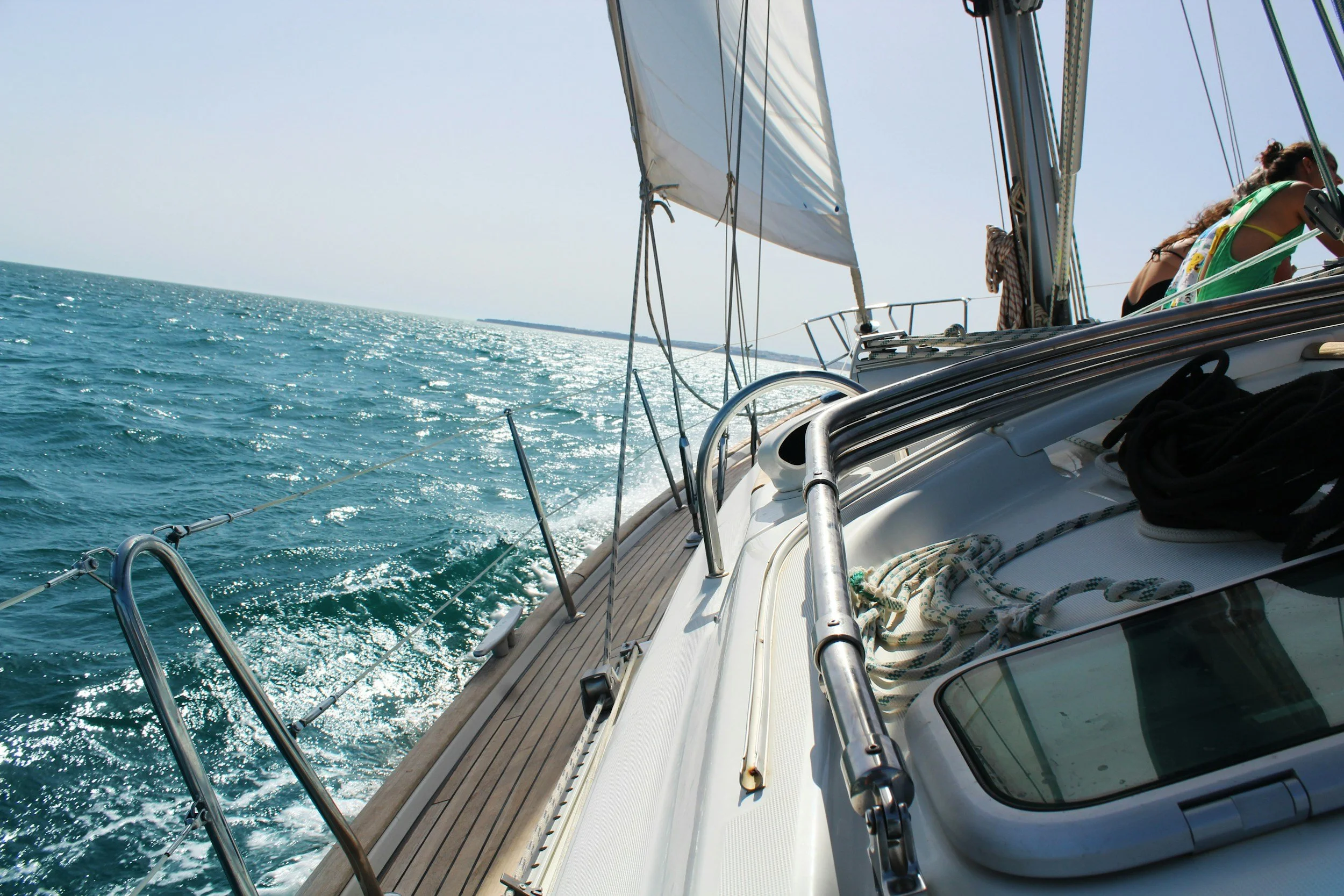
Five minutes after leaving shore, something changes.
Nobody announces it.
There is no dramatic moment.
The boat simply continues moving.
The shoreline slowly shrinks.
The engine quiets.
The wind becomes easier to hear.
Conversation slows almost without anyone deciding it should.
Silence appears.
Not the uncomfortable silence that makes people reach for their phones.
The other kind.
The kind that's so complete it almost feels like another passenger aboard the boat.
You notice things.
The movement of sunlight across the water.
A gull suspended effortlessly in the wind.
The rhythm of waves meeting the hull.
The changing color of the horizon.
None of these observations demands anything from you.
They simply exist.
That difference is psychologically enormous.
Modern environments are designed to recruit your attention.
The ocean is not.
It remains magnificently indifferent.
It has nothing to sell.
Nothing to notify.
Nothing to persuade.
Nothing to optimize.
It asks for no password.
It doesn't congratulate you for productivity.
It doesn't remind you of your unread messages.
It simply keeps being the ocean.
In a world where nearly everything competes for your attention, that indifference is strangely healing.
The Most Restorative Places Don't Demand Your Mind—They Hold It Gently
Environmental psychologists Stephen and Rachel Kaplan spent decades studying why certain landscapes consistently leave people feeling mentally refreshed.
Their explanation became known as Attention Restoration Theory, and it remains one of the most profoundly influential ideas in environmental psychology.
The theory begins with a simple observation.
There are two very different ways of paying attention.
The first requires effort.
Balancing your checkbook.
Writing a report.
Driving through heavy traffic.
Trying to remember someone's name at a crowded party.
This is directed attention.
It is immensely useful.
It is also mentally expensive.
The second kind of attention is almost effortless.
Watching a campfire.
Listening to rainfall.
Following clouds across the sky.
Watching waves roll toward shore.
These experiences hold attention without demanding work.
The Kaplans called this soft fascination.
It may be one of the most important psychological concepts you've never heard of.
Soft fascination occupies the mind just enough to prevent rumination, but not so much that it becomes mentally taxing.
It's attention without strain.
Interest without urgency.
Awareness without exhaustion.
The ocean may be one of the purest examples of soft fascination on Earth.
No two waves are identical.
Yet no wave insists that you evaluate it.
The sea keeps changing.
Your brain finally stops chasing change.
The Sea Is Almost Aggressively Uninterested in Your Productivity
There's another reason boats feel therapeutic.
The modern economy depends upon convincing you that every idle moment should become useful.
Learn something.
Optimize something.
Track something.
Measure something.
Improve something.
Even leisure has become productive.
We don't merely hike.
We count our steps.
We don't simply read.
We measure reading goals.
We don't enjoy dinner.
We photograph it.
The sea quietly refuses this arrangement.
It doesn't care how many emails you've answered.
It has no interest in your résumé.
It isn't impressed by your title.
The horizon has never once asked anyone about quarterly earnings.
That may sound poetic.
It is also psychologically significant.
For a few hours, your value stops being measured by output.
You become, once again, a human being instead of a human doing.
Philosophers have wrestled with this distinction for centuries.
The ancient Greeks distinguished between activity aimed at production and activity aimed simply at living well.
Later thinkers like Josef Pieper argued that genuine leisure is not idleness but a condition in which we become fully present to reality rather than consumed by utility.
The ocean seems to understand this instinctively.
It offers no productivity hacks.
Only presence.
And perhaps that is why so many people describe returning from a day on the water by saying something that initially sounds odd:
"I finally felt like myself again."
Maybe they didn't discover a different self.
Maybe they simply encountered the version of themselves that isn't constantly fragmented by demands on attention.
The sea didn't change who they were.
It removed, for a little while, everything that kept interrupting them.
And sometimes that is enough for the mind to remember what quiet feels like.
The Horizon, the Nervous System, and the Strange Experience of Becoming Small
There is a moment that almost everyone misses.
It doesn't happen when the boat leaves the dock.
It doesn't happen when the sails fill or the engine settles into its rhythm.
It happens later.
Usually without announcement.
You realize you've stopped thinking in paragraphs.
Your mind has become...quieter.
Not empty.
Quieter.
The constant narrator inside your head—the one composing emails, replaying arguments, anticipating tomorrow's meeting, remembering that you forgot to buy cat food—has somehow wandered off.
Nothing dramatic replaced it.
There is simply less noise.
If you've experienced this, you know exactly what I'm talking about.
If you haven't, it may sound suspiciously romantic.
It isn't.
Something measurable is happening.
The environment has begun reorganizing your nervous system.
The Horizon Is Doing More Work Than You Think
Most of modern life happens within three feet of our faces.
Phones.
Laptops.
Steering wheels.
Kitchen counters.
Cash registers.
Television screens.
Our visual world has become remarkably small.
Our eyes spend hours making tiny adjustments as they move from one nearby object to another.
Then we step onto open water.
Suddenly the visual field stretches for miles.
Nothing blocks the distance.
Nothing requires close inspection.
Your eyes stop darting.
They begin resting.
Vision scientists have long known that sustained near work places different demands on the visual system than viewing distant landscapes. Looking toward the horizon requires less constant accommodation and encourages broader patterns of visual scanning.
That may sound like a small physiological detail.
It isn't.
Vision isn't separate from the brain.
Vision is the brain.
Nearly one-third of the cerebral cortex participates in processing visual information. Change what the eyes are doing, and you inevitably change what the brain is doing.
Therapists notice this in quieter ways.
Clients often think differently while walking than while sitting.
They remember differently while driving than while staring across a desk.
Some discover difficult truths while gazing through a window.
The direction of attention influences the direction of thought.
The horizon doesn't merely give us something beautiful to look at.
It changes the way we look.
And sometimes that changes the way we think.
The Brain Is Constantly Asking One Question
Am I safe?
Not consciously.
Continuously.
Deep inside the nervous system, millions of years of evolution are conducting a silent interview with the environment.
Is there danger?
Should I prepare?
Can I relax?
The pioneering neuroscientist Stephen Porges introduced the concept of neuroception to describe this unconscious evaluation of safety and threat.
Before we're aware of feeling anxious—or calm—our nervous system has already been gathering evidence.
The tone of another person's voice.
Facial expressions.
Unexpected sounds.
Crowded spaces.
Confined rooms.
Conflict.
Chaos.
The body is always listening.
Often before the mind catches up.
Now consider the ocean.
Predictable sounds.
Rhythmic movement.
Open visibility.
Fresh air.
Natural light.
No blaring televisions.
No flashing advertisements.
No sudden demands from dozens of strangers.
For many people, these conditions provide the nervous system with repeated signals that immediate danger is low.
The body begins to release its grip.
Shoulders lower.
Breathing deepens.
Conversation slows.
Thought becomes less defensive.
You don't decide to relax.
Your nervous system reaches that conclusion first.
Your conscious mind merely receives the memo.
Why Rocking Feels So Good
One of the most overlooked features of being on a boat isn't what you see.
It's what you feel.
Forward.
Back.
Forward.
Back.
The motion is subtle enough that you stop noticing it.
Which is precisely why it matters.
Hidden inside the inner ear is the vestibular system, a remarkable network responsible for balance, spatial orientation, and movement.
Although most folks think of it as simply helping us stay upright, its influence extends much further.
Vestibular signals communicate constantly with regions involved in attention, emotional regulation, posture, and autonomic nervous system activity.
In other words...
Movement changes mood.
We've known this intuitively forever.
We rock babies.
We sit in rocking chairs.
Children seek swings.
People nap in hammocks.
The body has always found comfort in gentle, predictable rhythm.
Boats provide exactly that.
Not enough movement to alarm the nervous system.
Just enough to reassure it.
Like a heartbeat you can feel beneath your feet.
The Philosophy of Rhythm
Long before neuroscience existed, philosophers noticed something curious.
Human beings seem healthiest when they move with rhythms larger than themselves.
Day and night.
The changing seasons.
The tides.
Breathing.
Walking.
Music.
Even conversation can have a rhythm.
Healthy relationships breathe.
One life partner speaks.
The other listens.
Then they exchange roles.
Conflict often destroys rhythm before it destroys love.
Partners interrupt.
Defend.
Accelerate.
The emotional tempo becomes frantic.
Now imagine two partners sitting quietly on a boat.
Neither one is forcing conversation.
The waves establish the rhythm.
The wind establishes the pace.
Without realizing it, two nervous systems begin synchronizing to the same external environment.
This isn't mysticism.
Biologists call it entrainment.
Independent systems naturally begin coordinating their timing when exposed to shared rhythms.
Heartbeats.
Breathing.
Walking pace.
Even conversation.
The ocean supplies rhythm without asking anyone to create it.
Sometimes the environment does part of the relationship's work.
Why Time Feels Different at Sea
One of the first things people notice after spending several hours on the water is how strangely time behaves.
An afternoon feels longer.
Yet somehow passes more quickly.
This apparent contradiction has fascinated philosophers for centuries.
Clock time measures minutes.
Human experience measures moments.
Those are not the same thing.
The philosopher Henri Bergson argued that lived time cannot be understood simply by looking at clocks.
Real time expands and contracts depending on consciousness itself.
We've all experienced this.
Ten minutes in a dentist's waiting room can feel endless.
Three hours with someone you love disappear almost instantly.
Time is psychological before it is mathematical.
The ocean quietly restores this forgotten truth.
There are few schedules.
Few deadlines.
Few artificial markers dividing experience into productive units.
Instead, time becomes organized by wind.
By weather.
By sunlight.
By tides.
You stop asking,
"What time is it?"
You begin asking,
"Where is the sun?"
That shift sounds quaint.
It is actually profound.
Modern civilization teaches us to experience time as something scarce.
The ocean invites us to experience it as something inhabited.
Becoming Smaller Can Be Surprisingly Liberating
Perhaps the most therapeutic thing about open water has nothing to do with relaxation.
It has to do with perspective.
Stand on the deck of a small boat several miles offshore.
Look in every direction.
Water.
Sky.
Horizon.
Nothing else.
For a brief moment you encounter something our ancestors probably knew far better than we do.
You are very small.
Strangely...
this often feels wonderful.
This is the experience of awe.
Awe occurs when we encounter something so vast that our ordinary mental categories become temporarily inadequate.
Cathedrals.
The night sky.
The ocean.
Research suggests that awe does something remarkable.
It reduces what therapists call the small self.
That phrase sounds negative, but it isn't.
It simply means our relentless self-focus begins to loosen.
The mortgage still exists.
The difficult conversation still needs to happen.
The uncertainty hasn't disappeared.
But for a few moments...
it no longer occupies the entire universe.
The horizon has reminded us that reality is larger than our immediate concerns.
That's one reason people often make important life decisions on boats.
Not because the ocean whispers answers.
Because it restores proportion.
Problems become visible without becoming all-consuming.
Perspective returns.
And perspective is one of psychology's most underrated forms of healing.
The Ocean Doesn't Remove Reality
It removes distortion.
By the time most people return to the dock, their lives are objectively unchanged.
The difficult coworker still exists.
The diagnosis hasn't disappeared.
The bills remain unpaid.
Nothing external has been solved.
Yet many describe feeling profoundly different.
How is that possible?
Because the brain doesn't merely react to reality.
It reacts to the version of reality presented by the nervous system.
When the nervous system is overwhelmed, every problem appears larger.
When it is regulated, the same problems become thinkable.
That's an important distinction.
Therapy often aims to help people see more clearly.
The ocean appears to accomplish something similar—not by offering insight directly, but by creating the biological conditions under which insight becomes possible.
Perhaps that's why generations of sailors have insisted that the sea clears the mind.
Not because the water contains answers.
Because it removes, for a little while, the noise that keeps us from hearing our own.
What the Ocean Teaches Us About Love, Attention, and Being Human
There is a reason therapists have offices instead of roller coasters.
Healing requires a nervous system that feels sufficiently safe to become curious.
That sentence may be the entire secret.
Not just of psychotherapy.
Of good conversations.
Of good marriages.
Perhaps even of wisdom itself.
We like to imagine that insight arrives because we think harder.
Much of the time, the opposite is true.
Insight arrives because the brain finally stops defending itself long enough to notice something it has been trying not to see.
The ocean, oddly enough, is remarkably good at creating those conditions.
Every Environment Has a Psychology
We often speak as though our thoughts originate entirely inside our heads.
They don't.
The room matters.
The lighting matters.
The chair matters.
The noise matters.
The weather matters.
The presence of another person matters.
Environment shapes emotion.
Cities shape attention.
Churches invite a different kind of silence than airports.
Libraries feel different from casinos because they ask different things of the nervous system.
The philosopher Martin Heidegger argued that human beings are never simply isolated minds floating through the world. We are always being-in-the-world. Consciousness is inseparable from the environments in which it unfolds.
Modern neuroscience reaches a remarkably similar conclusion through different language.
The brain is not a detached computer.
It is constantly regulating itself in conversation with its surroundings.
We don't simply inhabit environments.
They inhabit us.
The question is not whether your surroundings are shaping your mind.
They are.
The question is whether they are shaping it wisely.
Why Couples Often Become Kinder on the Water
One of the quiet mysteries I've noticed over the years is that some couples seem incapable of having productive conversations in their own homes.
The same two life partners.
The same marriage.
The same disagreement.
Move the conversation to a long walk, a quiet drive, or a boat, and something unexpected happens.
Nobody has become more intelligent.
Nobody has suddenly acquired superior communication skills.
Yet they listen differently.
Why?
Part of the answer is physiological.
When our nervous system perceives threat—even subtle threat—we become less curious and more certain.
Certainty feels protective.
Curiosity feels risky.
Under stress, partners stop asking,
"Help me understand."
They begin asking,
"How do I prove I'm right?"
The goal quietly changes.
Understanding gives way to victory.
That's rarely good for a relationship.
On a boat, however, something shifts.
Both partners are facing the same horizon.
Neither occupies the traditional "opposite side" of the conversation.
Long silences stop feeling like failures.
They become part of the experience.
The rhythm of the water slows the rhythm of speech.
Life partners interrupt less.
They defend less.
They wonder more.
Sometimes the environment succeeds where advice could not.
Side-by-Side Is Different from Face-to-Face
This may sound like a small detail.
It isn't.
Many emotionally important conversations occur while partners are walking, driving, gardening, fishing, or sitting beside one another.
Developmental psychologists have long observed that direct eye contact can increase emotional intensity.
Sometimes that's exactly what's needed.
Sometimes it isn't.
Side-by-side conversation changes the emotional geometry.
Neither partner feels quite so examined.
The nervous system experiences less interpersonal pressure.
Words arrive more naturally.
This is one reason fathers and adolescent sons often have their deepest conversations while driving.
It's one reason old friends sometimes reconnect while walking rather than sitting across a table.
And it's one reason boats create surprisingly intimate conversations.
The horizon absorbs some of the emotional intensity.
The silence carries part of the burden.
The relationship breathes.
The Ocean Is an Antidote to the Illusion of Control
Perhaps the greatest therapeutic lesson the sea offers has nothing to do with relaxation.
It concerns humility.
On land, we gradually develop the comforting illusion that we control far more than we actually do.
Climate-controlled homes.
Navigation apps.
Instant communication.
Online banking.
Food delivered to our doors.
Every convenience quietly reinforces the same message:
You are in charge.
The ocean politely disagrees.
Wind changes.
Weather changes.
Currents change.
Visibility changes.
No amount of confidence persuades a storm to reconsider.
Far from being discouraging, this recognition often becomes deeply liberating.
The Stoic philosophers distinguished between what belongs within our control and what does not.
Much human suffering, they argued, comes from confusing the two.
The sea offers that lesson without ever speaking a word.
You learn quickly that cooperation is wiser than domination.
Adjustment is wiser than resistance.
Respect is wiser than arrogance.
Oddly enough...
Those are excellent principles for marriage, too.
Attention Is Becoming Our Most Precious Resource
If the twentieth century was shaped by industry, the twenty-first is increasingly shaped by attention.
Companies compete for it.
Algorithms optimize for it.
Entire business models depend upon capturing it.
In many ways, attention has become the modern economy's most valuable currency.
Which makes the ocean increasingly unusual.
It does not compete for your attention.
It returns it.
That distinction is profound.
When you spend several hours looking at water, your attention gradually shifts from fragmented to sustained.
You stop reacting.
You begin observing.
You stop consuming.
You begin noticing.
You stop performing.
You begin existing.
Philosopher Simone Weil once wrote that attention is the rarest and purest form of generosity.
I suspect she was right.
And perhaps nowhere is that generosity easier to rediscover than on open water.
The Ocean Doesn't Cure Anxiety
Let's be careful here.
Being on a boat is not psychotherapy.
It does not treat major depression.
It does not cure trauma.
It does not replace medication when medication is needed.
It is not a substitute for evidence-based mental health care.
Romanticizing nature helps no one.
But dismissing its influence would be equally mistaken.
Environmental psychology has repeatedly demonstrated that natural settings reduce physiological stress, restore directed attention, decrease rumination, and improve subjective well-being.
Blue spaces appear particularly powerful.
The ocean doesn't replace therapy.
It often prepares the mind to benefit from it.
Sometimes the most important intervention isn't discovering a brilliant insight.
It's arriving with a nervous system capable of hearing one.
The Real Gift Isn't Calm
When people describe a day on the water, they usually say they felt peaceful.
I don't think peace is the deepest gift.
I think clarity is.
Calm eventually fades.
The weather changes.
The dock returns.
The phone lights up.
Traffic resumes.
Life, stubbornly, becomes life again.
But clarity has a way of lingering.
You remember which worries mattered.
Which ones didn't.
You remember that silence is not the enemy.
You remember that conversation doesn't have to be rushed.
You remember that your marriage is larger than yesterday's argument.
You remember that your identity is larger than your job title.
You remember that attention is finite and therefore sacred.
Most importantly, you remember something modern life works very hard to make us forget.
You are not a machine designed for uninterrupted productivity.
You are a biological creature whose nervous system evolved beneath open skies, beside moving water, among rhythms older than civilization itself.
Perhaps that's why the sea feels strangely familiar.
It is one of the few places left that still speaks the language your brain evolved to understand.
Frequently Asked Questions
Is there scientific evidence that being on the ocean improves mental health?
Yes. Research on blue spaces—natural environments dominated by water—suggests they are associated with reduced stress, improved mood, enhanced subjective well-being, and better cognitive restoration. While many studies are observational and don't prove causation, the overall evidence points in a consistent direction.
Why does the ocean feel different from watching television?
Television and social media are engineered to capture and hold your attention through novelty, emotional salience, and rapid changes. The ocean captures attention through what psychologists call soft fascination—it is engaging without being demanding. This allows directed attention to recover instead of becoming depleted.
What is "soft fascination"?
Coined by environmental psychologists Stephen and Rachel Kaplan, soft fascination describes experiences that effortlessly engage attention without requiring intense mental effort. Watching waves, clouds, rain, or a campfire are classic examples.
Why do I think more clearly on a boat?
Because your brain has fewer competing demands. With fewer interruptions and decisions, cognitive resources can shift away from constant task-switching and toward reflection, problem-solving, and creativity.
Does the horizon really affect the brain?
Indirectly, yes. Looking into the distance changes visual demands and encourages broader attentional patterns. Wide, open vistas may also reduce feelings of confinement and support psychological restoration.
Why does the rocking motion feel calming?
Gentle, rhythmic movement stimulates the vestibular system, which communicates with brain regions involved in balance, arousal, and emotional regulation. Humans appear naturally responsive to slow, predictable movement.
Why do couples often have more satisfying conversations on boats?
The environment reduces competing distractions, lowers physiological arousal, and encourages side-by-side rather than face-to-face communication. Shared attention toward the same landscape often reduces defensiveness and increases openness.
Is this why some folks like fishing?
Partly. Fishing combines blue space, rhythmic movement, sustained attention, quiet, and a simple task requiring moderate engagement. These ingredients together may produce a restorative psychological experience.
Does being near water reduce anxiety?
For many people, yes, but it is not a cure. Water can lower stress and improve mood, but persistent anxiety disorders require appropriate assessment and treatment.
Is this the same as mindfulness?
Not exactly. Mindfulness intentionally trains awareness. The ocean often evokes mindful attention naturally, without formal practice.
Can this help burnout?
Potentially. Natural environments appear to restore directed attention and reduce mental fatigue. They should be viewed as one component of recovery rather than a complete solution.
Why does time seem slower on the water?
Without constant interruptions and clock-driven demands, the brain processes experience differently. Philosophers and psychologists alike have noted that subjective time depends on attention, novelty, and emotional engagement—not simply the passage of minutes.
Is there an evolutionary explanation?
Probably. Human beings evolved in natural environments for hundreds of thousands of years. Urban, digitally saturated settings are evolutionarily recent. Many researchers believe our brains remain especially responsive to natural landscapes.
Can simply looking at the ocean help?
Research suggests even viewing water from shore or through windows may provide psychological benefits, though direct immersion in natural settings generally has stronger effects.
Why do I feel "smaller" at sea?
That experience is known as awe. Vast natural environments can reduce excessive self-focus and increase feelings of connection, perspective, and humility.
Is this why I solve problems while boating?
Possibly. Restored attention, reduced cognitive overload, improved mood, and increased psychological distance from daily stressors all support creative thinking.
Can boating replace couples therapy?
Not really. But think of it as an environment that supports psychological regulation. It complements—not replaces—science-based couples threrapy.
What is the biggest lesson the ocean teaches?
That attention is precious. Wherever you consistently place it, you gradually become.
Coming Back to Shore
Eventually every voyage ends.
The boat is tied to the dock.
The gear is put away.
Shoes replace bare feet.
Phones come back to life with a small avalanche of notifications, as if the world had been impatiently waiting for your return.
Nothing has changed.
Except you.
Or perhaps not even that.
Perhaps the better way to say it is this:
For a few precious hours, everything that wasn't truly you fell silent.
The urgency.
The performance.
The comparison.
The endless demands for one more click, one more purchase, one more opinion, one more response.
The sea stripped away the noise until only attention remained.
And attention, when freed from constant interruption, has an extraordinary habit of becoming awareness.
Awareness becomes perspective.
Perspective becomes wisdom.
That may be the closest thing psychology has to grace.
So perhaps the therapeutic power of a boat has never really been about boats.
It has been about remembering what kind of mind we were designed to have before the modern world taught us to scatter it in a thousand different directions.
The ocean cannot make us whole.
But every now and then, it reminds us where to begin.
Be Well, Stay Kind, and Godspeed.
REFERENCES:
Berto, R. (2005). Exposure to restorative environments helps restore attentional capacity. Journal of Environmental Psychology, 25(3), 249–259. https://doi.org/10.1016/j.jenvp.2005.07.001
Bratman, G. N., Daily, G. C., Levy, B. J., & Gross, J. J. (2015). The benefits of nature experience: Improved affect and cognition. In J. D. Wright (Ed.), International encyclopedia of the social & behavioral sciences (2nd ed., pp. 619–624). Elsevier. (Excellent overview chapter.)
Bratman, G. N., Hamilton, J. P., Hahn, K. S., Daily, G. C., & Gross, J. J. (2015). Nature experience reduces rumination and subgenual prefrontal cortex activation. Proceedings of the National Academy of Sciences, 112(28), 8567–8572. https://doi.org/10.1073/pnas.1510459112
Kaplan, S. (1995). The restorative benefits of nature: Toward an integrative framework. Journal of Environmental Psychology, 15(3), 169–182. https://doi.org/10.1016/0272-4944(95)90001-2
Kaplan, R., & Kaplan, S. (1989). The experience of nature: A psychological perspective. Cambridge University Press.
Keltner, D., & Haidt, J. (2003). Approaching awe, a moral, spiritual, and aesthetic emotion. Cognition & Emotion, 17(2), 297–314. https://doi.org/10.1080/02699930302297
Nichols, W. J. (2014). Blue mind: The surprising science that shows how being near, in, on, or under water can make you happier, healthier, more connected, and better at what you do. Little, Brown Spark.
Porges, S. W. (2011). The polyvagal theory: Neurophysiological foundations of emotions, attachment, communication, and self-regulation. W. W. Norton.
Sternberg, E. M. (2009). Healing spaces: The science of place and well-being. Belknap Press of Harvard University Press.
White, M. P., Alcock, I., Grellier, J., Wheeler, B. W., Hartig, T., Warber, S. L., Bone, A., Depledge, M. H., & Fleming, L. E. (2019). Spending at least 120 minutes a week in nature is associated with good health and well-being. Scientific Reports, 9, 7730. https://doi.org/10.1038/s41598-019-44097-3
White, M. P., Elliott, L. R., Grellier, J., Economou, T., Bell, S., Bratman, G. N., Cirach, M., Gascon, M., Lima, M. L., Lõhmus, M., Nieuwenhuijsen, M., Ojala, A., Roiko, A., Korpela, K., & Fleming, L. E. (2020). Associations between green/blue spaces and mental health across 18 countries. Scientific Reports, 10, 8903. https://doi.org/10.1038/s41598-020-66094-w
White, M. P., Pahl, S., Wheeler, B. W., Fleming, L. E., & Depledge, M. H. (2017). The Blue Gym: What can blue space do for you and what can you do for blue space? Journal of the Marine Biological Association of the United Kingdom, 96(1), 5–12. https://doi.org/10.1017/S0025315415002209
Wilson, E. O. (1984). Biophilia. Harvard University Press.