Tuesday, May 26, 2026.
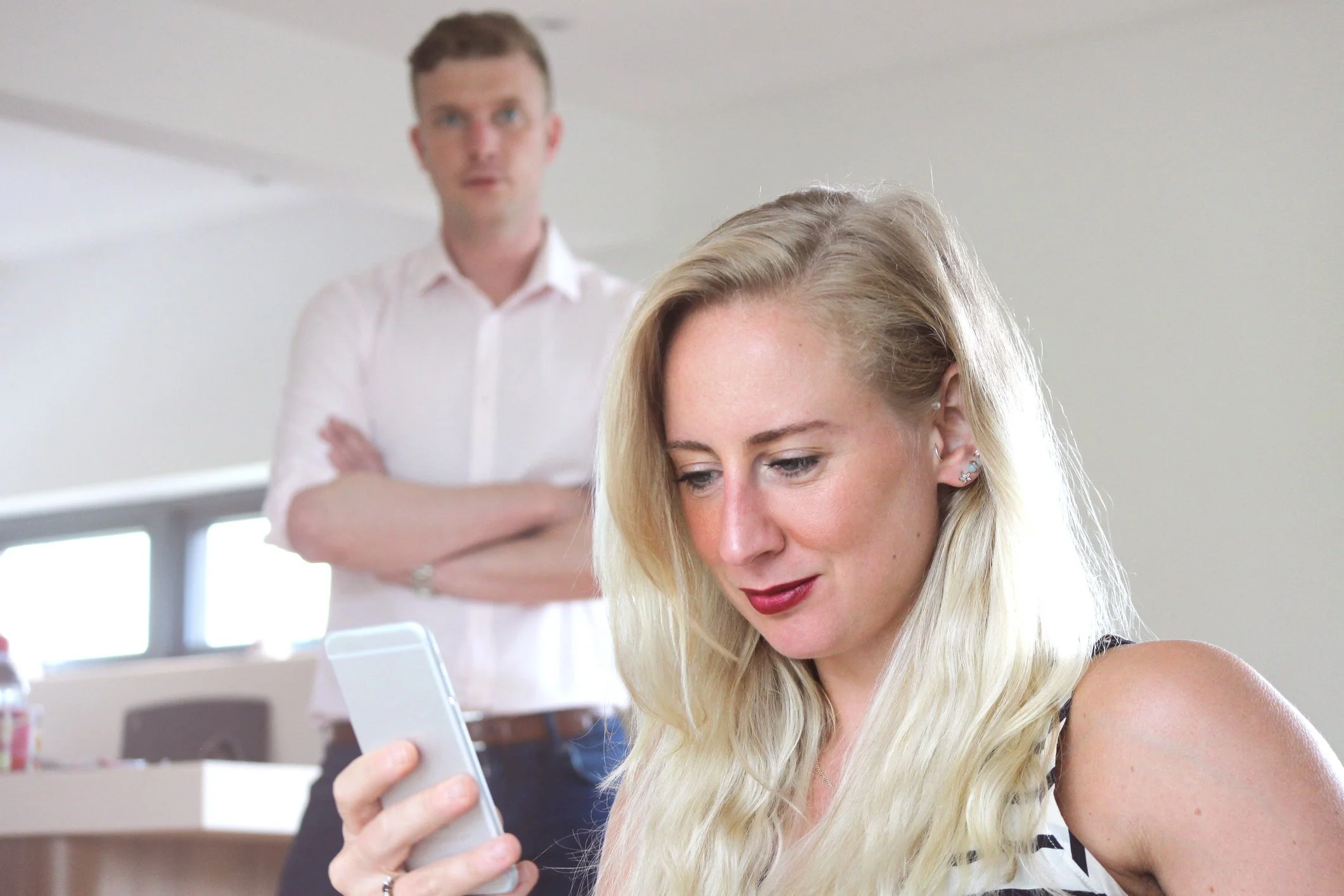
The laugh arrives instantly for strangers and three seconds late for him.
Not occasionally.
Reliably.
She smiles at her phone before breakfast.
Reacts to texts with animation. Replies to people she has never met with a kind of reflexive psychological immediacy that used to belong to the marriage.
At first he tells himself not to become dramatic.
Nobody is cheating. Nobody is sneaking into hotels wearing baseball caps and a look of exhausted moral confusion. There are no mysterious credit card charges.
No suspicious “work conferences” involving suspiciously tropical weather.
And yet something in the relationship has clearly migrated.
She seems more emotionally alive elsewhere.
More attentive.
More anticipatory.
More psychologically available to invisible worlds that he cannot fully access.
He complains to his brother. It gets passed on to his younger sister. Then his mom.
A feed.
A Discord server.
A group chat.
An audience.
A low-grade emotional ecosystem organized around novelty, affirmation, stimulation, and endless micro-doses of anticipation.
Nothing exploded.
But something leaked.
Modern couples increasingly struggle to describe this experience because the old language of infidelity was built for closed systems.
Traditional betrayal was concrete:
secrecy.
sex.
deception.
physical intimacy.
romantic exclusivity violations.
But modern relationships increasingly fracture through something more ambient.
More distributed.
More psychologically porous.
Ambient infidelity is the gradual redistribution of attachment energy outside the primary relationship through sustained attentional, emotional, or psychological investment that falls below the traditional threshold of an affair.
And once you see it, you begin noticing it everywhere.
Marriage Was Never Just About Two People
One of the stranger fantasies of modern Western culture is the idea that marriage is a completely private arrangement between two autonomous life partners floating heroically outside social influence.
People say things like:
“It’s nobody else’s business.”
Which sounds wonderfully enlightened until Thanksgiving dinner turns into a low-budget hostage negotiation because someone’s mother just referred to your spouse as “that woman” while passing cranberry sauce with the emotional precision of a Mafia warning.
Then suddenly everyone rediscovers systems theory.
Because marriages do not merely join two souls.
They join:
nervous systems.
attachment histories.
conflict styles.
kinship loyalties.
family myths.
class assumptions.
rituals.
emotional inheritances.
and entire ecosystems of belonging.
Older traditions understood this intuitively.
Modern relationship research is slowly rediscovering it empirically.
If you are reading this because your relationship already feels emotionally crowded, psychologically fragmented, or strangely lonely despite constant digital contact, pay attention to what comes next. This pattern can sometimes escalate.
The New Research on Parents and Mate Selection Is Surprisingly Nuanced
A 2026 study by Lu Ran Zhang and Wei-Wen Chen published in the Journal of Social and Personal Relationships examined 299 Chinese parent-child pairs and found something deeply inconvenient for modern stereotypes about endless intergenerational warfare.
The researchers found that parents and adult children often agreed substantially about what mattered in a future spouse, especially around stability, reliability, character, and long-term resource security.
The study also found that warm, authoritative parenting was associated with healthier and more flexible patterns of agreement between generations, while highly authoritarian parenting was associated with lower relationship quality and more rigid conflict patterns. The study can be accessed through SAGE Journals.
This matters because the findings challenge two simplistic assumptions simultaneously:
Healthy adults do not emerge through total emotional separation from family influence.
Family influence becomes destructive when it turns coercive rather than relational.
That is a much subtler insight than:
“Ignore your parents and follow your heart.”
Or:
“Parents always know best.”
The reality appears more complicated.
Relational wisdom often develops socially.
And frankly, this should not be shocking. Human beings evolved in kinship systems, not emotionally detached apartments with Wi-Fi and fourteen active identity platforms.
The Baháʼí Tradition Understood Something Modern Culture Forgot. As my regular readers already know, I like to consider spiritual as well as cultural perspectives. I am intrigued that The Baháʼí Faith firmly requires parental consent before marriage from all living parents.
Modern people sometimes hear this and immediately imagine:
arranged marriages.
Victorian emotional repression.
and a deeply tense father polishing silverware while evaluating a suitor’s wrist strength.
But the underlying logic is psychologically sophisticated.
The Baháʼí principle is not primarily about parental domination.
It is about family unity.
The assumption is profoundly humane:
love survives more easily when surrounded by goodwill.
A marriage stands a better chance of enduring when the life partners who raised the couple are not quietly hoping the relationship implodes by Easter.
Because unresolved hostility between families rarely stays outside the marriage.
It enters through:
divided loyalties.
triangulation.
subtle contempt.
emotional sabotage.
childcare conflict.
financial conflict.
and chronic relational stress.
Family systems theory has spent decades describing precisely this dynamic.
The foundational work of Murray Bowen and Salvador Minuchin emphasized that couples cannot be understood apart from the emotional systems surrounding them.
The marriage inherits the emotional climate around it.
Which is why the fantasy of “just us against the world” often ages poorly.
Usually around the second holiday season.
The Research on In-Laws Is Much More Serious Than People Think
For decades, family researchers have quietly found that supportive in-law relationships strongly predict marital stability and satisfaction.
A longitudinal study by Chalandra Bryant, Rand Conger, and Jennifer Meehan found that ongoing conflict with in-laws predicted declines in marital success over time.
Their work demonstrated that marriages are shaped not only by what happens inside the couple, but also by the emotional stability of the surrounding kinship network.
The study is available through JSTOR.
Supportive in-laws often function as:
emotional stabilizers.
stress absorbers.
sources of continuity.
practical support systems.
and protectors of long-term commitment.
Hostile in-laws often function as chronic stress multipliers.
This sounds obvious once stated aloud, but modern relationship culture frequently behaves as though marriages exist in sealed emotional containers.
They do not.
Human beings regulate emotionally through systems.
Which means marriages do not merely require love.
They require infrastructure.
Ambient Infidelity and the Collapse of Relational Infrastructure
This is where the newer digital realities become important.
Historically, marriage existed inside relatively dense social ecosystems:
extended family.
neighborhood continuity.
religious communities.
communal rituals.
intergenerational support.
Modern marriages increasingly exist inside:
algorithmic attention economies.
fragmented social life.
digital isolation.
identity performance platforms.
and infinite comparison environments.
This changes attachment itself.
Because once stable relational ecosystems weaken, people begin sourcing emotional regulation elsewhere.
Not always through affairs in the traditional sense.
But through:
feeds.
parasocial relationships.
emotionally charged group chats.
audience attention.
hidden digital selves.
ambient flirtation.
AI companionship.
or psychologically customized ecosystems that continuously reward attention outside the marriage.
The rival is often no longer another person.
The rival is distributed attention itself.
Modern partners increasingly track vitality rather than fidelity.
Who gets the fastest replies.
Who receives emotional immediacy.
Who still evokes curiosity.
Who gets the best stories.
Who receives the version of someone that still feels psychologically awake.
The nervous system notices these redistributions long before the intellect can explain them.
Therapists increasingly hear bewildered versions of the same sentence:
“I don’t think they’re cheating, but I feel emotionally abandoned anyway.”
That sentence captures the modern condition almost perfectly.
Because many contemporary spouses are not losing partners to lovers.
They are losing them to invisible systems optimized to absorb psychological investment continuously.
This pattern usually escalates.
Most couples wait too long because the system temporarily stabilizes.
Insight is not interruption.
FAQ
What is ambient infidelity?
Ambient infidelity refers to the gradual redistribution of emotional, attentional, or psychological investment outside the primary relationship in ways that fall below the traditional threshold of an affair. It often involves emotional preoccupation, parasocial attachment, hidden digital ecosystems, audience-driven validation, or chronic attentional outsourcing.
Is ambient infidelity the same thing as cheating?
Not exactly. Traditional cheating usually involves explicit sexual or romantic betrayal. Ambient infidelity focuses more on attachment migration, emotional vitality outside the relationship, and the gradual erosion of attentional intimacy.
Why do in-laws matter so much in marriage?
Research consistently shows that supportive family systems reduce stress and stabilize relationships, while hostile or intrusive family dynamics increase marital distress. Couples do not exist in isolation; they are affected by the emotional systems around them.
What did the Chinese mate selection study find?
The 2026 study by Zhang and Chen found that parents and adult children often shared similar preferences regarding future spouses, especially around stability, character, and resources. Warm parenting styles were associated with healthier relational flexibility and better parent-child relationship quality.
Why does the Baháʼí Faith require parental consent before marriage?
The Baháʼí Faith teaches that marriage joins families as well as individuals. The parental consent requirement is intended to foster long-term family unity and reduce chronic relational conflict between kinship systems.
Why do modern relationships feel more psychologically crowded?
Modern technology exposes people to continuous comparison, endless stimulation, algorithmic attention competition, and emotionally immersive digital ecosystems. This creates conditions where attachment energy can become fragmented across multiple invisible environments.
Can a relationship recover from ambient infidelity?
Sometimes, yes. But recovery usually requires more than insight alone. Couples often need structured interruption of entrenched attentional patterns, restoration of emotional curiosity, and rebuilding of relational infrastructure.
Marriage Was Built for Closed Systems. Technology Created Open Systems.
This may be the deeper historical shift underneath everything.
Marriage evolved under conditions of limited attentional competition.
Partners had:
fewer comparison environments.
fewer identity platforms.
fewer alternative attachment ecosystems.
and fewer opportunities for endless romanticized projection.
Now every partner carries a portal to:
infinite novelty.
ambient validation.
erotic comparison.
frictionless stimulation.
and emotionally responsive digital environments.
inside their pocket.
Modern platforms profit directly from interrupted attention.
Stable attachment, by contrast, requires sustained attention.
Which means many marriages now exist inside technological systems economically incentivized to fragment the very psychological continuity long-term intimacy depends upon.
At the exact same historical moment, many couples have become increasingly disconnected from:
extended family support.
intergenerational continuity.
communal rituals.
and durable local belonging.
Which means modern relationships are attempting to sustain lifelong attachment inside environments specifically engineered to fragment attention.
That is not a small technological development.
That is a civilizational transformation in how attachment gets organized.
The danger is not simply temptation.
The danger is continuous attentional redistribution slowly normalized by the surrounding culture until emotional migration begins feeling ordinary.
Many couples do not realize the relationship is starving until curiosity disappears.
By then, the marriage often still looks intact from the outside.
Which is precisely what makes ambient infidelity so difficult to recognize.
Nothing dramatic happened.
Attention left first.
Be Well, Stay Kind, and Godspeed.
REFERENCES:
Bowen, M. (1978). Family therapy in clinical practice. Jason Aronson.
Bryant, C. M., Conger, R. D., & Meehan, J. M. (2001). The influence of in-laws on change in marital success. Journal of Marriage and Family, 63(3), 614–626. DOI record
Fingerman, K. L., Gilligan, M., VanderDrift, L. E., & Pitzer, L. (2012). In-law relationships before and after marriage. Research in Human Development, 9(2), 106–119. Taylor & Francis DOI page
Hari, J. (2022). Stolen focus: Why you can’t pay attention—and how to think deeply again. Crown.
Minuchin, S. (1974). Families and family therapy. Harvard University Press.
Turkle, S. (2011). Alone together: Why we expect more from technology and less from each other. Basic Books.
Wilcox, W. B., & Dew, J. (2016). The social and cultural predictors of marital quality and stability. In J. F. Cheadle & P. Amato (Eds.), Families in an era of increasing inequality (pp. 93–118). Springer. Springer chapter page
Zhang, L. R., & Chen, W.-W. (2026). Mate preference profiles in parent-child dyads: Implications of parenting styles and parent-child relationship. Journal of Social and Personal Relationships. Advance online publication. DOI landing page