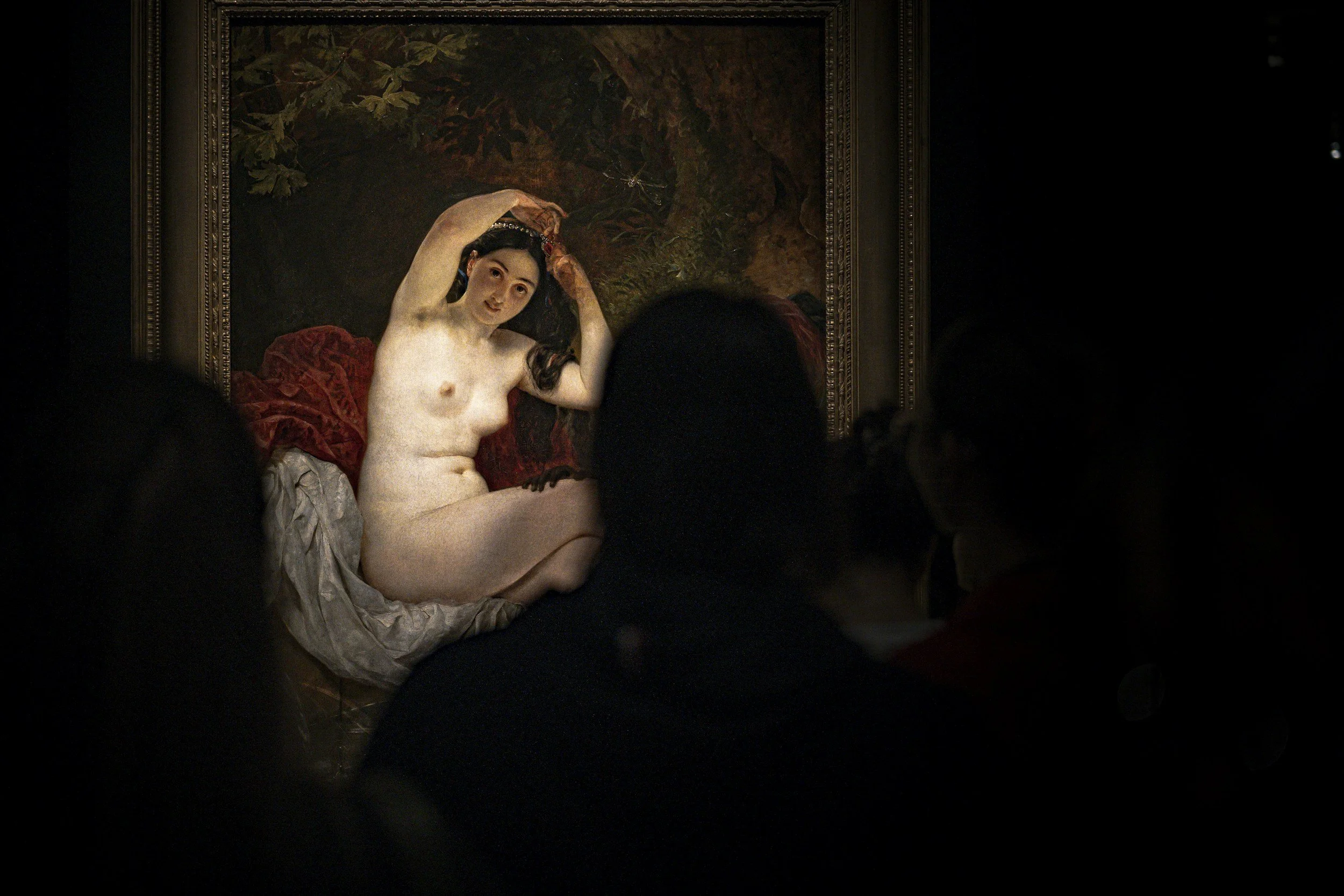
Sunday, May 31, 2026.
A civilization can survive disagreement about politics.
It can survive disagreement about religion.
It can survive disagreement about economics.
What becomes more difficult is surviving disagreement about what deserves reverence.
That may be one of the defining cultural facts of the twenty-first century.
We no longer agree on what is sacred.
And because we no longer agree on what is sacred, we increasingly struggle to agree on what is beautiful.
A recent study found that some viewers see nude paintings as beautiful while others experience the same paintings as uncomfortable, pornographic, or morally troubling.
Interesting.
But the study may be measuring something much larger than reactions to art.
It may be measuring the consequences of a civilization that has lost a common understanding of beauty itself.
The painting remains unchanged.
The meaning does not.
And meaning is where civilizations either cohere or come apart.
When Beauty Carried Authority
For most of Western history, beauty was not merely decorative.
Beauty was evidence.
A cathedral was beautiful because it reflected divine order.
A symphony was beautiful because it reflected harmony.
A sculpture was beautiful because it revealed something about human excellence.
Beauty pointed beyond itself. It suggested that reality possessed structure. It implied that existence contained meaning. It hinted that the world was more than a random collection of accidents.
People disagreed about kings, wars, theology, and power. Yet they often shared a basic intuition that beauty mattered and that beauty revealed something worth knowing.
Today that consensus feels increasingly fragile.
Beauty no longer arrives carrying authority.
Beauty arrives carrying questions.
Who defines it?
Who benefits from it?
Who was excluded from it?
What values does it reinforce?
What power structures does it conceal?
Some of these questions are valuable. Some expose genuine blind spots and hypocrisies. But their cumulative effect has been profound.
Beauty no longer settles arguments.
Beauty becomes the argument.
That may be one of the most important cultural shifts of the modern era.
The study found that some viewers experienced nude paintings as beautiful while others experienced them as uncomfortable or pornographic.
That disagreement may reveal something larger than differences in taste.
It may reveal a civilization that no longer agrees on whether beauty itself possesses authority.
Yet the suspicion toward beauty did not emerge from nowhere. Beautiful things can seduce.
Beautiful ideas can conceal brutality. Beautiful propaganda can recruit entire populations into catastrophe. The twentieth century gave intellectuals plenty of reasons to distrust beauty's authority, and not without justification.
The challenge is that a civilization incapable of trusting beauty at all may become just as lost as one that trusts it blindly.
The Body's Long Journey
The history of Western art is, in many ways, the history of changing ideas about the human body.
For the Greeks, the body represented excellence.
For Christians, the body represented incarnation.
For Renaissance artists, the body represented beauty.
The human form was never merely flesh.
It was meaning.
It was aspiration.
It was philosophy rendered visible.
Michelangelo's David is not simply a naked man.
It is a claim about courage.
A claim about dignity.
A claim about what human beings might become.
The sculpture argues before it depicts.
Then something changed.
The body became increasingly detached from transcendence.
It became desire.
Consumption.
Identity.
Politics.
Marketing.
Branding.
Performance.
Content.
The flesh remained remarkably consistent.
The stories attached to it multiplied.
And once the stories multiplied, agreement became difficult.
Folks were no longer looking at the same thing.
They were looking through different stories.
The study's findings may reflect exactly that process.
Viewers who prioritized autonomy and individual expression tended to respond positively to nude artwork, while viewers who prioritized purity, authority, and social cohesion were more likely to experience discomfort or see the artwork as pornographic.
The painting remained unchanged.
The worldview supplied the meaning.
The Museum and the Algorithm
The internet did something remarkable.
It flattened distinctions that civilizations spent centuries creating.
Art.
Advertising.
Erotica.
Self-expression.
Performance.
Marketing.
Beauty.
Pornography.
Influence.
Content.
These categories increasingly occupy the same screen.
The museum asks:
"What is this trying to reveal?"
The algorithm asks:
"Will this keep someone scrolling?"
Civilizations are often shaped by whichever question they decide to reward.
The Renaissance produced Michelangelo.
The internet produced engagement metrics.
Future historians may have opinions about this trade.
The result is not merely that people see more images.
The result is that they learn to see images differently.
A Renaissance nude and an influencer's thirst trap increasingly arrive through the same psychological pipeline.
Meaning gives way to engagement.
Contemplation gives way to reaction.
Beauty becomes content.
And once beauty becomes content, it loses much of its authority.
There was a time when a visitor could walk into a cathedral, a museum, and a concert hall and encounter very different expressions of roughly the same aspiration.
Human beings were attempting to reach upward—toward God, toward beauty, toward excellence, toward transcendence.
The forms differed.
The direction was similar.
Today the forms remain.
The direction is a bit harder to identify.
The Sacred Never Disappears
This is where the conversation becomes truly interesting.
Because beneath arguments about art lies a deeper question:
What deserves reverence?
Modern culture often imagines itself as less religious than previous eras.
I am not convinced.
The sacred rarely disappears.
It changes addresses.
A society that abandons one sacred object usually replaces it with another.
Human beings seem incapable of living without investing something with ultimate significance.
For centuries sacred energy flowed toward God, truth, beauty, family, community, and nation.
Today it often flows toward identity, politics, self-expression, technology, lifestyle, wellness, and personal autonomy.
The language changes.
The intensity does not.
People once feared heresy.
Now they fear social exile.
People once performed public acts of piety.
Now they perform public acts of virtue.
People once argued about blasphemy.
Now they argue about offense.
The technologies differ.
The emotional architecture feels strangely familiar.
This may explain why arguments about nude art become so emotionally charged.
The painting is not merely touching aesthetic values.
It is touching sacred values.
For one viewer, artistic freedom is sacred.
For another, moral order is sacred.
For another, bodily autonomy is sacred.
For another, cultural continuity is sacred.
The painting becomes a collision point between competing sacred commitments.
And sacred conflicts rarely remain small.
The Real Argument
One of the enduring mistakes in cultural commentary is assuming people are arguing about what they appear to be arguing about.
They usually are not.
The disagreement over nude art is not really about nudity.
The disagreement is about what human beings are.
What beauty is.
What freedom is.
What dignity is.
What deserves reverence.
The painting becomes the battlefield because the underlying disagreement is too abstract to hang on a wall.
People believe they are debating art.
More often they are debating reality itself.
Frequently Asked Questions
Why do some people see nude art as beautiful while others find it offensive?
Research suggests that moral values influence aesthetic judgments. Folks who prioritize autonomy, fairness, and personal expression tend to evaluate nude artwork more positively, while those who prioritize purity, authority, and social order are more likely to experience discomfort and view the artwork as pornographic.
Does this study suggest that political ideology determines artistic taste?
Not necessarily. The study examined moral foundations rather than political party affiliation. The findings suggest that viewers bring different moral priorities to the experience of viewing art, which influences how they interpret what they see.
Why has nude art played such an important role in Western civilization?
For much of Western history, the nude body symbolized beauty, heroism, mortality, divinity, and human potential. Artists often used the human form to explore philosophical, religious, and cultural ideas rather than merely depicting physical appearance.
Is nude art the same thing as pornography?
Historically, most cultures treated fine art and pornography as distinct categories. However, where viewers draw that boundary varies considerably, and moral values appear to influence those judgments.
What is the larger cultural question raised by this research?
The deeper question is whether modern societies still share common standards for beauty, meaning, and reverence. The study suggests that viewers may approach the same artwork with fundamentally different assumptions about morality, freedom, and the purpose of art itself.
Final Thoughts
The body has not changed.
The painting has not changed.
The marble has not changed.
What has changed is the story surrounding them.
And stories matter.
Because civilizations are held together less by laws than by shared acts of attention.
By common objects of admiration.
By agreed-upon forms of beauty.
By things considered worthy of reverence.
When those agreements disappear, the arguments begin multiplying.
The painting becomes political.
The statue becomes controversial.
The museum becomes ideological.
The body becomes a battlefield.
The researchers asked why some viewers find nude paintings beautiful while others find them troubling.
The more unsettling possibility is that they may no longer inhabit the same symbolic universe.
People believe they are arguing about paintings.
More often they are arguing about human nature.
About beauty.
About freedom.
About dignity.
About the sacred itself.
The painting simply happens to be hanging on the wall while the argument unfolds.
The study appears to be about nude art.
It may actually be measuring what happens when a civilization loses confidence in beauty's ability to tell the truth.
And once that confidence disappears, disagreement spreads outward.
The painting becomes political.
The museum becomes ideological.
The body becomes contested.
Eventually reality itself begins to fracture into competing interpretations.
When a civilization loses agreement about beauty, it often discovers that it has lost agreement about reality itself.
Be Well, Stay Kind, and Godspeed.
Note to my gentle readers: This essay are my comments on a recent piece of research concerning changing cultural notions of art and nudity. I intended this piece to be a modest exploration of the broader clinical and cultural questions raised by the research findings, rather than a simple summary of the research findings. You can read that elsewhere.
REFERENCES:
Awa, K. N., Brown, M., & Zabelina, D. L. Individualizing and Binding Moral Values as a Function of Evaluations of Artwork Depicting Nudity. Psychology of Aesthetics, Creativity, & the Arts.