Thursday, December 11, 2025. This is for Mika.
A Eulogy for a Civilization in Ruins
The modern West has always loved its own slogans.
They roll off the tongue with the ease of a creed and the hollowness of a television jingle:
God is dead. The lone wolf lives. We live in free markets.
Three sentences that were never entirely true, then became increasingly false, and now survive only as the flickering neon above a civilization that no longer believes in its own mythology.
What follows is not an argument.
Arguments require an audience with hope.
This is a eulogy.
A ruined-beautiful lament for a world that still stands but no longer shelters.
And like all eulogies, it begins with the cause of death.
The House Built on Three Lies
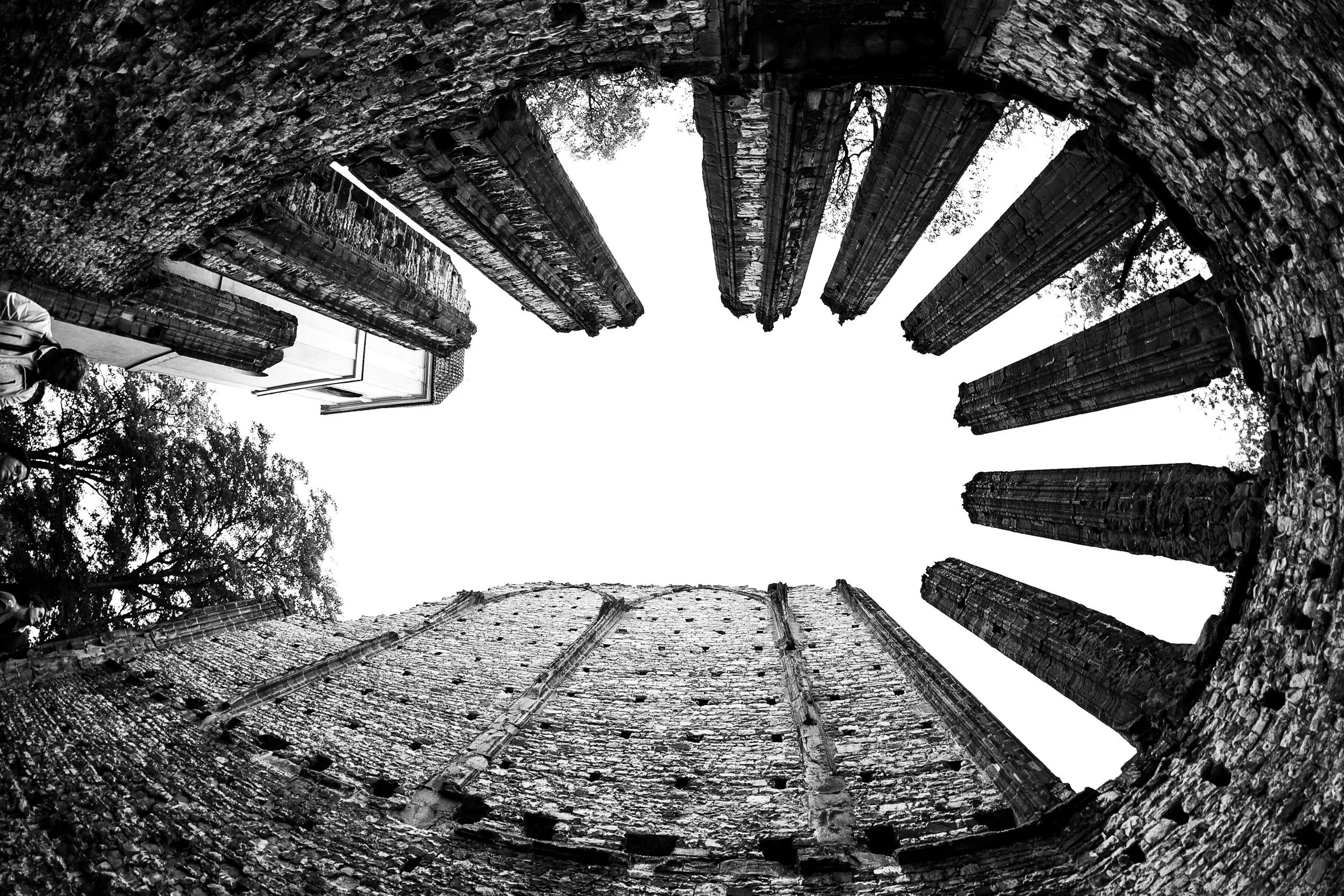
Imagine the West as a great house—cathedral ceilings, stone foundations, centuries of ambition set into the mortar. A structure built to last but maintained with increasing negligence.
Inside this house, three pillars carried the weight:
The sovereign individual.
The sacred market.
The evacuation of the divine.
Each pillar was a lie.
Beautiful lies, yes—powerful enough to erect a world order, fragile enough to let it crumble.
Together, they created a civilization too proud to admit it needed what it destroyed.
The First Lie: The Sovereign Individual
Once, the West told a story in which human beings were threads in a tapestry—held by kin, craft guild, village, faith. Then came the Enlightenment, which admired the thread so much it cut it loose.
We celebrated this severing.
We called it freedom.
The self-made man was born—an ideal stitched from philosophers, industrialists, and advertisers who all shared the same fantasy:
the human being as a self-contained miracle, unburdened by history, community, obligation, or need.
We admired him for standing alone.
We failed to notice he stood in a vacuum.
A vacuum is quiet at first.
Then it begins to howl.
Modern loneliness is not a psychological mystery.
It is structural.
It is the draft that enters when you remove the walls that once held a society upright.
People were never meant to be lone wolves.
The animal itself is a myth. No wolf survives alone.
But humans tried—and mistook the resulting anguish for adulthood.
The West raised a generation that can manage an inbox but not a grief.
A generation fluent in self-analysis but incapable of self-forgiveness.
A generation that believes intimacy is optional and independence is oxygen.
And so the house groans.
The Second Lie: The Sacred Market
The second pillar was built when the first began to wobble.
Human beings, newly isolated, needed a map to navigate their severed lives. Into this vacuum stepped the market—efficient, amoral, endlessly expanding—offering an organizing principle that required no gods and no neighbors.
The market told us:
You do not need meaning. You need metrics.
You do not need community. You need competition.
You do not need dignity. You need demand.
It was a small god, but reliable.
It could not bless, but it could determine the price of everything, but the value of nothing..
And so we let it in.
The tragedy was not that markets existed.
It was that we mistook them for a new metaphysics.
We asked prices to tell us what is valuable.
We asked wages to tell us what we are worth.
We asked productivity to tell us who we must become.
And when the answers disappointed, we blamed ourselves.
Loneliness became a branding problem.
Exhaustion became a time-management flaw.
Grief became a failure of mindset.
The sacred market spreads fastest in rooms where the cathedral roof has collapsed.
It thrives in the ruins.
The Third Lie: The Death of God Meant the End of Transcendence
When Nietzsche declared the death of God, he was not celebrating. He was warning: the sky has broken; brace yourself.
But the West misread the warning as permission.
We removed the divine, dismantled the rituals, mocked the moral vocabulary, and assumed nothing essential would be lost.
But transcendence is not decorative.
It is load-bearing.
You can remove a god, but you cannot remove the human longing for scale, continuity, witness, and mercy. Something must inhabit that sacred space.
In the ruins of religion, the West installed:
Self-improvement.
Identity politics.
Consumerism.
Therapy-speak.
Productivity gospel.
Romantic idealism.
The cult of personal branding.
And the spiritualized worship of one’s own nervous system (if I feel it, it must be true).
None of these were designed to hold transcendence.
All of them cracked under its weight.
A civilization without the sacred becomes sentimental, then hysterical, then numb.
People today do not lack belief.
They lack a larger, containing story in which belief can live.
The Daily Life Inside This Ruined House
Enter the house at dusk.
You will see a couple lying side by side in bed, the glow of two separate universes lighting their faces.
You will see a child performing achievements for a camera phone that has replaced the village.
You will see a man whose job title confers prestige but whose life confers nothing.
You will see a woman scrolling for comfort, for meaning, for distraction, for anything resembling presence.
In this broken house, meals are swallowed rather than shared.
Grief is outsourced to strangers.
Friendship is scheduled like a dental cleaning.
Love is attempted but rarely trusted.
Religion is gone, but superstition flourishes.
Community is gone, but content is abundant.
The roof is gone, but the architecture haunts the air.
This is what ruined-beautiful looks like:
a civilization still standing, but no longer inhabitable.
How the Lies Interlocked Into Fate
The sovereign individual created isolation.
The sacred market monetized it.
The hollowed sky left nothing to answer the resulting ache.
Structure became destiny.
Destiny became despair.
People wander through the house—successful, efficient, self-sufficient—carrying the quiet suspicion that they were meant for something larger than a life that feels so small.
The West did not collapse.
It evaporated.
One belief at a time.
And Yet—The Light Through the Broken Roof
Ruins are not failures.
Ruins are what remain when illusions fall away.
Through the broken roof pours light the builders never imagined.
It illuminates truths we were too proud to see:
that independence is a technical skill, not a virtue.
that markets can price everything except what matters.
that humans require meaning the way lungs require air.
that no life is bearable alone.
Ruins expose what the intact house concealed:
the shape of the sky.
the scale of our hunger.
the fragility of our myths.
the fact that we are not finished.
We were never meant to live as lone wolves in marketplaces under a sky emptied of gods.
We simply didn’t realize it until the roof collapsed.
Now we stand in the ruins, blinking, unguarded, almost tender—
and for the first time in generations,
we can see the horizon.
Final thoughts
The West is not dead.
It is waiting.
Civilizations do not die when their lies fail.
They die when they refuse to imagine a story truer than the ruins.
The next story begins when someone looks up
through the fractured ceiling of the house we broke
and finally says, softly and without performance:
“I was never meant to be alone.”
Be Well, Stay Kind, and Godspeed.