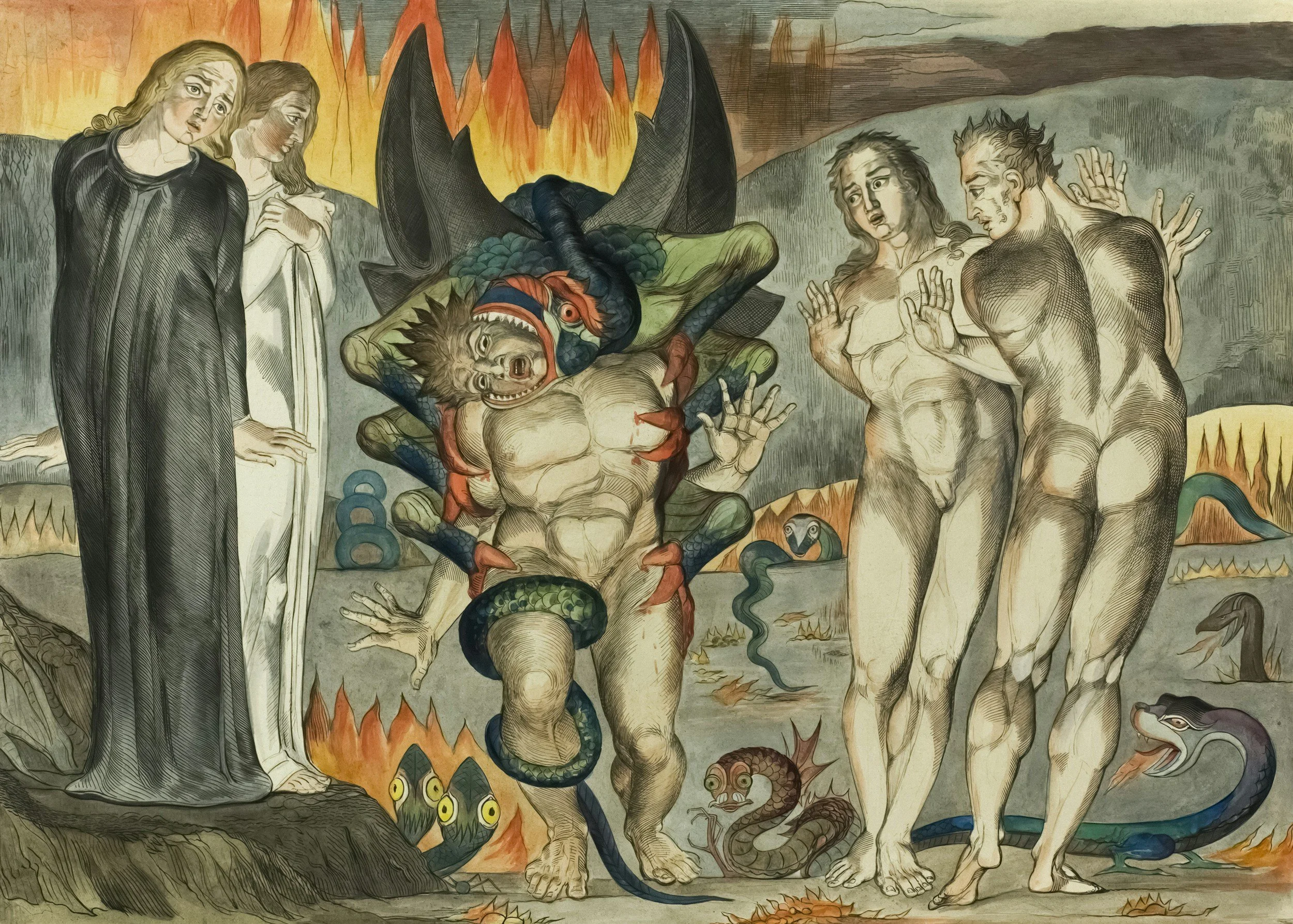
Sunday, September 6, 2026.
There is a particular kind of hell reserved for people who are right.
Not legally right. Not merely factually right. Morally right.
They were betrayed. Neglected. Left carrying more than their share.
They apologized first, stayed longer, tried harder, remembered the birthday, scheduled the therapist, and kept the family functioning while their life partner wandered through life protected by charm, incompetence, addiction, self-pity, or selective amnesia.
Their account of what happened is substantially accurate.
That is what makes the place so difficult to escape.
Ordinary guilt contains a door. You can confess, make restitution, ask forgiveness, and change your behavior.
But what is the exit from innocence?
What do you do when the terrible thing was done to you?
This is the hell of the just.
The Old Meaning of the Phrase
In traditional Christian theology, “the hell of the just” did not mean the place of damnation.
It referred to the limbo of the fathers: the condition of the righteous who died before Christ. They were the faithful dead—Abraham, Moses, David, the prophets—waiting for a heaven that had not yet been opened.
They were good.
They were loved.
They were still not free.
The distinction matters. The hell of the just was not understood as psychological torment or resentment. It was a condition of deprivation and delay: a place where innocence could not, by itself, complete the journey.
Then comes one of Christianity’s strangest and most beautiful images: the Harrowing of Hell. Christ descends into the realm of the dead, breaks its gates, and leads the waiting captives out.
The just do not escape because they finally argue their case successfully.
They are liberated by something that enters from beyond the closed moral system in which they have been waiting.
That old theological image contains an unexpectedly modern psychological truth.
Sometimes being right is not enough to save you.
The Marriage in Which One Person Is Right
Couples therapists regularly meet couples living in the domestic version of this place.
One spouse had the affair.
The other did not.
One drank, lied, raged, disappeared, overspent, withheld affection, or left their counterpart to manage the children, mortgage payments, aging parents, and emotional weather of the household.
The injured partner is not imagining the asymmetry. There are marriages in which responsibility is not divided neatly down the middle. “It takes two” becomes cruel when applied indiscriminately.
Sometimes one partner really did commit the larger wrong.
But after the facts have been established, another question appears:
What must happen now?
This is where justice and healing begin to separate.
Justice wants an accurate accounting. Healing wants a future.
Justice asks who caused the wound. Healing asks what the wound is becoming.
Justice wants the guilty party to understand. Healing eventually asks whether the injured person can build a life that no longer depends upon being understood by the person who injured them.
Justice matters. Truth matters. Accountability matters. Cheap forgiveness is often another name for coerced silence.
But justice can describe the prison without opening it.
A life partner can win every argument about the past and still lose the rest of their life to it.
The Secret Burden of Remaining Injured
Suffering is not chosen because it offers benefits. Most wounded partners would surrender every supposed “secondary gain” in exchange for having never been wounded.
Still, injury can acquire a moral function.
It can become proof.
Proof that the betrayal mattered. Proof that the offender has not adequately repaired it. Proof that the injured person was not foolish to trust. Proof that the moral balance has not been restored.
To relinquish the suffering may begin to feel like relinquishing the verdict.
If I stop being angry, perhaps what you did was not so terrible.
If I become happy without your apology, perhaps you have escaped accountability.
If I no longer tell the story, perhaps no one will remember who was innocent.
So the wound is kept open as evidence.
Pain becomes the last reliable witness for the prosecution. The injured person cannot dismiss it because the case has not been properly heard. Their misery becomes an exhibit entered into evidence every morning.
Look what you did to me.
The tragedy is that the offender may have moved on years ago. The court remains in session, but the defendant no longer attends.
Resentment Is Justice Without Resurrection
Resentment is not merely anger that has overstayed its welcome.
Resentment is moral memory organized around an unpaid debt.
It says, “Something remains owed.”
An apology. A confession. Remorse proportionate to the damage. Restored years. A childhood returned. A faithful marriage. A parent who finally understands. A public correction from the people who believed the lie.
Sometimes the debt is real.
It is simply uncollectible.
That is one of adulthood’s most brutal discoveries: a debt can be legitimate and still never be paid.
The parent may die without apologizing. The former spouse may remain committed to a flattering revision of history. The sibling may never concede what the family required you to carry. The institution may preserve its reputation by quietly sacrificing yours.
The psyche continues sending invoices.
No one answers.
This is how justice becomes hell—not because justice is wrong, but because a legitimate demand has been attached to an unavailable source.
Resentment is justice waiting for a resurrection it cannot produce.
The Fantasy of the Sufficient Apology
In distressed marriages, injured partners often imagine that freedom lies on the other side of a perfect apology.
Not the apology already offered. That one was defensive, incomplete, badly timed, or contaminated by explanation.
They are waiting for the apology in which the offender finally experiences the wound from the inside. The precise moral magnitude is grasped. The guilty partner feels—perhaps even suffers—enough.
Then the injured partner will be released.
Occasionally something close to this happens. Deep remorse can be transformative. A person who caused harm must learn to remain present before pain without hurrying the injured person toward forgiveness.
But no apology can reverse time.
Even the perfect apology arrives in a world in which the terrible thing still happened.
At some point, healing requires an act justice cannot compel: the injured person must decide whether the offender’s limitations will continue to govern the architecture of their inner life.
That decision is not acquittal.
It is emancipation.
When the Wound Becomes an Identity
After enough years, the question “What happened to you?” can quietly become “Who are you?”
The betrayed wife.
The discarded husband.
The unchosen child.
The responsible sibling.
The employee who told the truth.
The good parent whose children sided with the other one.
The identity is not false. But a true description can become a small room.
Trauma freezes identity at the scene of the crime. The self becomes the person to whom the event occurred.
This is why recovery can feel frightening. If I am no longer organizing my life around what happened, who am I? If vigilance relaxes, will I become vulnerable again? If I surrender my role as the morally serious one, will the family return me to the position of scapegoat?
The hell of the just is not merely suffering.
It is the fear that leaving suffering will require betraying the self who survived it.
The Righteous Marriage
There is also a quieter version of this hell.
No affair occurred. No one committed an obvious atrocity. But over twenty years, one spouse became the marriage’s moral adult.
They initiate every difficult conversation. Read the relationship books. Arrange the date nights. Monitor the children’s emotional lives. Remember what the therapist said. Make the repair attempts.
The other spouse becomes the defendant.
Every conflict confirms the established arrangement: one person is emotionally evolved; the other is the problem.
The righteous spouse may be correct about nearly everything and curious about almost nothing.
This is where virtue hardens into superiority.
Superiority feels cleaner than grief. It protects against the humiliation of wanting love from someone who does not know how to give it. It is easier to diagnose a spouse than to admit, once again, I cannot make you come toward me.
Contempt is often grief wearing judicial robes.
The righteous partner says, “I need you to take responsibility.”
Sometimes what they mean is, “I need you to become a different person so my years of waiting will make sense.”
No spouse, unfortunately, has that power.
Therapy Cannot Conduct a Trial Forever
Good couples therapy must establish reality.
It must name betrayal as betrayal, cruelty as cruelty, coercion as coercion, and neglect as neglect. A therapist who hides every asymmetry beneath “both sides” may preserve neutrality by abandoning truth.
But therapy cannot remain a courtroom indefinitely.
A courtroom asks: Who is responsible?
A consulting room must eventually ask: What is possible?
Can trust be rebuilt? Is remorse genuine? Has behavior changed? Can the injured partner risk living again? Is the marriage capable of becoming more than a site of adjudication? If not, can the couple end it without requiring one person to become a monster and the other a saint?
Clinical mediocrity rushes forgiveness.
But another kind of clinical mediocrity endlessly validates grievance without helping the client metabolize it. It mistakes agreement for treatment. The client leaves each session more certain of the verdict and no closer to freedom.
A therapist should be able to say two things at once:
What happened to you was wrong.
You cannot build your remaining life inside that sentence.
The Harrowing
In the old Christian story, the just do not reason their way out of the underworld.
The gates must be broken.
Psychologically, this breaking may arrive as grief. Not anger, which still imagines that the past can be negotiated, but grief—the recognition that what should have happened will not happen.
The childhood will not be rerun.
The faithful years will not be restored.
The parent will not become capable of seeing.
The apology may never be adequate.
The marriage may survive, but it will never again be the marriage in which the betrayal did not occur.
Grief sounds like surrender because it relinquishes the demand that reality become retroactively different.
But grief is not surrender to the offender.
It is surrender to time.
And time, unlike the offender, cannot apologize.
The gate begins to open when a life partner says:
I will no longer make my freedom contingent upon your comprehension.
I will remember without building an altar to the injury.
I will tell the truth without requiring it to be the only truth about me.
I will not call evil good.
I will also not permit evil to remain the organizing intelligence of my life.
This is forgiveness at its most serious.
It may include reconciliation, but it does not require it. It may coexist with divorce, estrangement, testimony, boundaries, prosecution, or permanent refusal of trust.
Forgiveness is not necessarily the restoration of a relationship.
Sometimes it is the restoration of authorship.
When Innocence Becomes an Idol
The identity of the innocent person can become morally intoxicating. It absolves us from examining the cruelties that emerged after the original cruelty.
We may not have caused the first wound, but we remain responsible for what we build around it.
We can be betrayed and then become punitive.
Neglected and then become contemptuous.
Abandoned and then become controlling.
Falsely accused and then become incapable of correction.
Our later sins do not retroactively justify what was done to us. But neither does what was done to us consecrate everything we do afterward.
Innocence is not the same as goodness.
Innocence describes our relationship to a particular offense. Goodness describes what we choose to become.
The first may be established by evidence.
The second can only be established with practice.
There Is a Life Beyond the Verdict
The deepest lesson of the hell of the just is not that justice matters too much.
It is that justice cannot do everything.
Justice can name the wrong, assign responsibility, impose consequences, protect the vulnerable, and restrain the dangerous.
But it cannot return the dead, restore the untouched childhood, erase the affair, or make another person capable of the remorse we deserve.
For that, human beings need something beyond verdicts.
Grace, perhaps.
Grief.
Meaning.
Love that arrives from somewhere the injury did not control.
A future not awarded by the offender.
The goal is not to become less right.
It is to become more free.
There are partners who have done wrong and cannot admit it. There are also partners who have been wronged and cannot seem to leave the courtroom.
Both remain bound to the offense.
The gates of the hell of the just are not locked because the injured person secretly wants to suffer.
They are locked because innocence contains no natural instructions for what comes next.
Someone must descend into that place and announce:
Vindication is not resurrection.
You may have been right.
You may still be right.
But you were not placed on earth merely to be proved right.
There is a life beyond the verdict.
If your marriage has become a courtroom—one partner prosecuting and the other defending—the problem may no longer be establishing what happened. The problem may be discovering what remains possible.
Why Work with Daniel?
Betrayal does not create equal responsibility, and healing does not require pretending that it did. Skilled couples therapy can hold the truth of what happened while helping you decide whether trust, intimacy, and a shared future remain possible.
If your marriage is trapped between an unpaid moral debt and an uncertain future, schedule a Free Introductory Call.
Be Well, Stay Kind, and Godspeed.