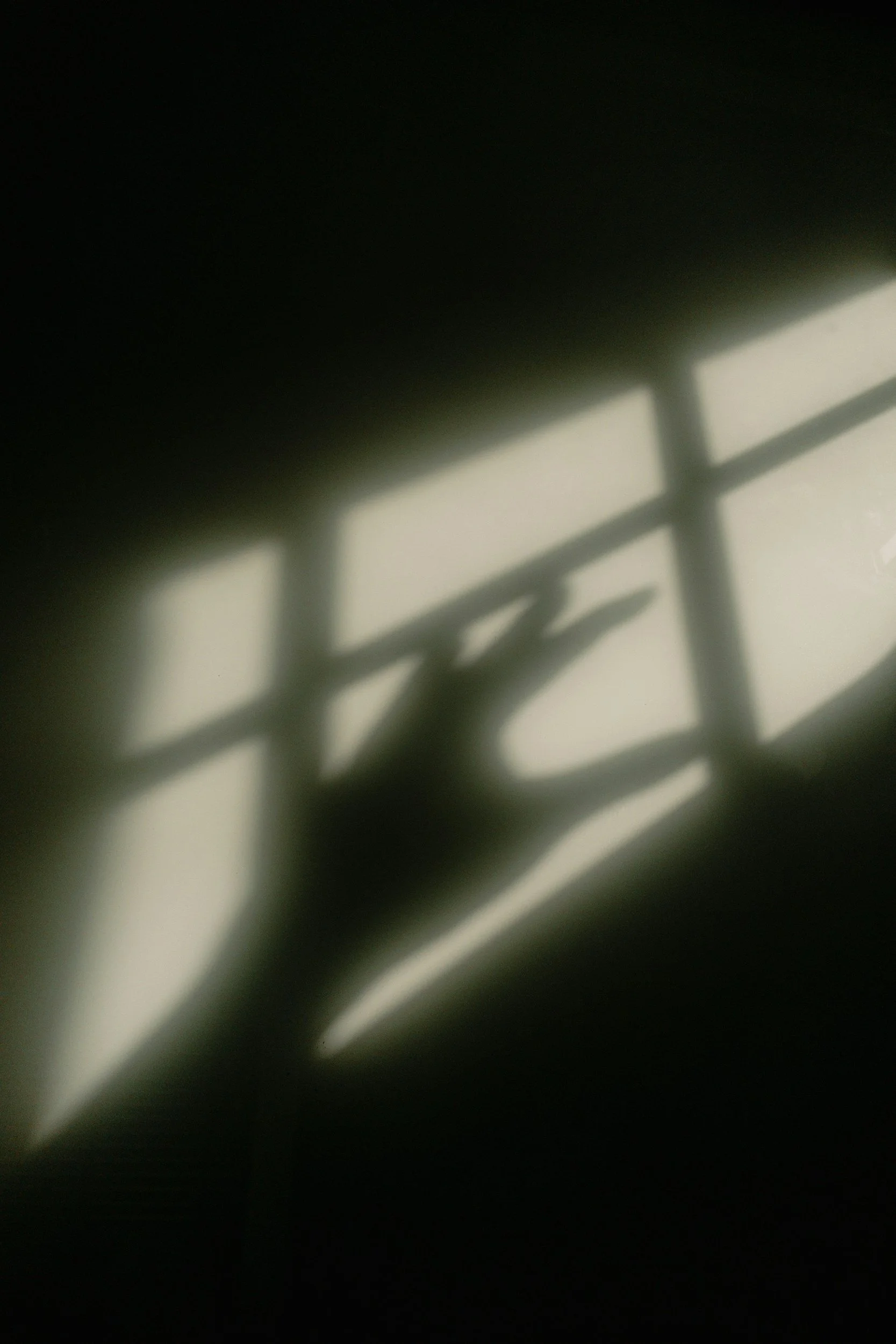
Tuesday, October 14, 2025. I wrote this about the death of my son, whose final gesture — one hand reaching toward what waited beyond him — became the center of this reflection on light, loss, and the human need to make meaning of what cannot be explained. This is for Daniel Gordon Hamilton 1973-2025.
There are moments that stop time.
They hover, soundless, ungoverned by sequence or clock.
I was sitting beside my son when one of those moments arrived.
He had been still for hours. The machines were steady, counting what was left to count. The nurses whispered on her phone near the door.
His skin had taken on that pale transparency that warns you the body is almost done with its work.
And then, without warning, he shot his arm up, fingers outstretched.
Not a twitch. Not a reflex.
A movement with intention in it.
He raised his arm straight into the air — fingers spread wide, palm open — as if he had just recognized something above him and was trying to touch it before it disappeared.
For a moment, the hand stayed there, trembling slightly. The air changed.
I thought: he sees it!
Then his arm fell back to the bed, and he was gone.
Later I learned there’s a name for what happens after such moments for those who come back from near-death experiences and return to this mortal coil — reentry problems.
Researchers at the University of Virginia call it that when people come back from near-death experiences.
Here’s the data. One in five lose marriages. One in five lose friends. They say the world they return to no longer fits.
They’ve seen the light, and, for some, the ordinary now feels utterly unbearable.
Bills. Small talk. The grocery line.
The sharpness of trivial life against what they’ve glimpsed.
They call it “the dark aftermath.” But darkness is only what follows an illumination beyond words..
I kept looking at the air above my son’s bed for the space where his hand had reached.
I wanted to believe the air remembered him, that something unseen still rippled there.
The doctor said it was reflex.
The hospice nurse assured me that it was quite common.
They meant to be kind, but language often fails at the border between science and faith.
What I know is this: I saw him reach for something I could not see. And ever since, I’ve been reaching too — into the empty air he left behind.
Life goes on, though it leans now, slightly off-center. I move through it the way a ghost might: answering messages, caring for my clients, remembering to buy coffee, pretending the world hasn’t slipped.
But sometimes, when the light drifts across the room just right, everything stops. The air stills. A sound catches before silence. And there he is — my son — eyes wide, caught between here and somewhere kinder.
The awe that lifted him still hovers. I can feel it, faint as breath on glass. And in those moments, I understand how grief’s painful throb can be so stubborn and unyielding.
My only child, Dan was always reaching toward the light.
And I am still learning how to live, without him, in its shadow.
Be Well. Stay Kind. Godspeed.
REFERENCES:
Greyson, B., & Holden, J. M. (2025). Psychological aftermath of near-death experiences: Relationship and integration outcomes in experiencers. Psychology of Consciousness: Theory, Research, and Practice. University of Virginia School of Medicine.
Holden, J. M., & Greyson, B. (2023). Near-death experiences: Problems of reentry and integration. Journal of Humanistic Psychology, 63(2), 143–165.