Thursday, December 4, 2025.
If you want to understand the fragile beauty of human psychology, don’t look at brain scans or meditation retreats.
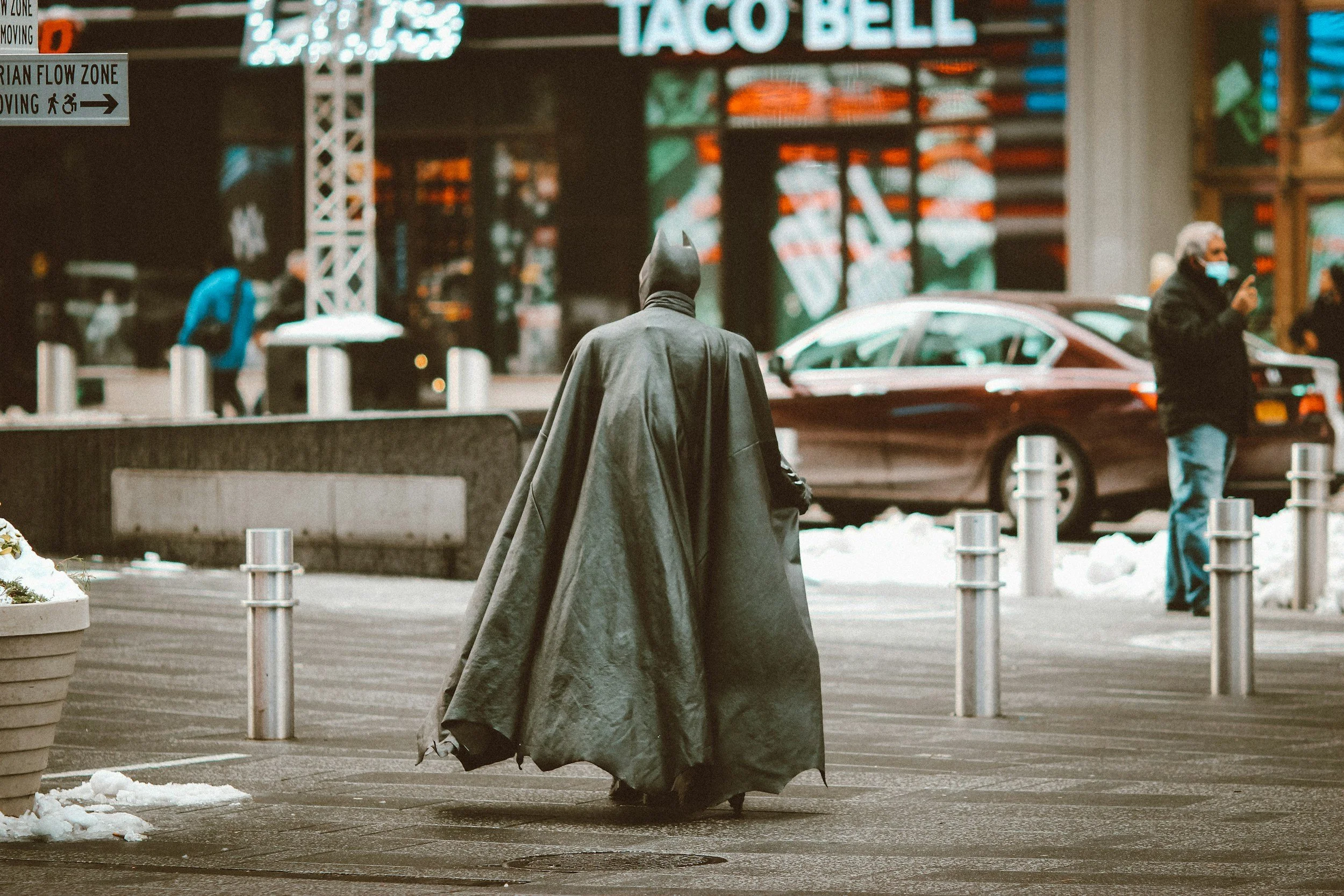
Instead, consider the Milan, Italy subway, where a man dressed as Batman recently doubled the rate at which commuters offered their seat to a pregnant woman.
It is one of the most charming, rigorous, and quietly revolutionary demonstrations of the Batman Effect—a phenomenon where unexpected events disrupt the commuter autopilot trance and trigger prosocial behavior.
Let’s go deeper, because the effect is not just funny or heartwarming.
It’s a rare, real-world glimpse into how the human brain manages attention, how novelty triggers present-moment awareness, and how social contagion spreads prosocial cues through a crowd without anyone realizing what’s happening.
This is not comic-book morality. This is neuroscience, urban psychology, and the exquisitely delicate machinery of human perception—disguised in a cape.
How the Human Brain Slips Into “Commuter Autopilot”
Neuroscientists call it perceptual decoupling—the moment your internal world pulls you so far inward that the environment blurs into irrelevance.
During routine tasks, like commuting, the default mode network (DMN) becomes dominant, the mind drifts, and attention collapses into private rumination.
This is efficient, but it creates a social side effect:
autopilot weakens empathy, reduces situational awareness, and lowers the likelihood of prosocial behavior.
If you've ever ignored a crying toddler on a train because you were “lost in thought,” congratulations—your DMN was performing beautifully.
But the Milan team suspected this mental cocoon could be cracked open.
The question was how.
Enter the Batman Effect: Novelty as a Neural Interruptor
Novelty is kryptonite to the default mode network.
A sudden, vivid, unexpected stimulus—say, Batman boarding the subway—activates the salience network, a distributed system that tells the brain:
“Stop drifting. Something is happening right now.”
This shift from internal to external attention is measurable across domains:
– increased noradrenergic arousal,
– heightened visual scanning,
– stronger situational monitoring,
– and, crucially, improved social cue detection.
The Milan researchers found that this attentional shift, even when subtle, dramatically increased helping behavior. In fact, the Batman Effect nearly doubled prosocial action, raising seat-offering behavior from 37.66% to 67.21%.
That bump isn’t randomness. That’s essentially a cognitive reboot.
But Here’s the Twist: Almost Half the Helpers Never Saw Batman!
This is where the study moves from delightful to profound.
44% of the helpful passengers did not consciously register Batman at all.
Which means:
– The Batman Effect is not simply a hero-priming effect.
– It is not just a moral-symbol activation phenomenon.
– It is not about capes, cows, or cinematic nostalgia.
It is about ambient attention disruption.
When even a fraction of people in a contained space shift into heightened awareness, behavioral cues—like someone standing up—become social contagion, spreading through the group in milliseconds.
No one needs to even see Batman.
They only need to feel the atmosphere change.
Why Novelty Can Increase Prosocial Behavior (Even Without Conscious Awareness)
Psychologists studying prosocial priming, the pique technique, and environmental novelty all converge on a similar idea:
When attention is disrupted, empathy becomes easier to access.
This aligns with mindfulness research showing that:
– present-moment awareness increases altruism,
– attention to external cues increases social attunement,
– and interrupting habitual scripts can override automatic non-helping behaviors.
The brilliance of the Batman experiment is that it demonstrates:
Mindfulness can be externally induced without meditation, without intention, and without awareness.
A caped man steps into a subway car.
The atmosphere shifts.
The brain reopens its perceptual field.
A pregnant woman becomes visible again.
People act.
This is urban enlightenment, delivered through costume rental.
The Batman Effect as Urban-Design Insight: Why Cities Need Curated Disruption
Cities are obsessed with smoothing the commuter experience—predictable schedules, frictionless ticketing, silent escalators, minimalist signage. The holy grail is efficiency.
But psychological research increasingly suggests efficiency is socially expensive.
A perfectly optimized commute encourages:
– social withdrawal,
– attentional disengagement,
– and the collapse of prosocial behavior.
The Batman Effect raises an uncomfortable possibility for city planners:
Perhaps public spaces need intentional whimsy.
Just enough novelty to interrupt autopilot—
without tipping into chaos.
Imagine urban spaces where:
– A pop-up installation invites commuters to look up.
– A shifting mural resets attentional fatigue.
– A performer disrupts perceptual monotony.
– A gentle anomaly re-humanizes the crowd.
If Batman can do this accidentally, imagine what design could do deliberately.
The Batman Effect and the Psychology of Social Scripts
One of the most fascinating implications is how novelty breaks social scripts.
On subways, the script is:
Sit.
Ignore.
Endure.
Repeat.
Novelty—especially prosocial or ambiguous novelty—interrupts the script, forcing the brain to re-evaluate incoming cues.
This aligns with research on:
– norm activation (the situational triggering of social norms),
– moral salience,
– visual cue amplification,
– and micro-context shifts in crowded environments.
When Batman walks in, the script collapses.
A new one emerges.
People act according to latent social norms, not autopilot habits.
The Batman Effect Is Not About Heroism—It’s About Neurobiology
Let’s be unromantic for a moment.
The Batman Effect is not evidence that people long to be heroic.
It is evidence that people can be prosocial once their brain stops drowning in routine.
The real mechanism is:
Attention → Awareness → Social Cue Detection → Prosocial Action
Or, more elegantly:
Disrupt → Notice → Care → Act
Batman is simply the delivery system.
Why This Research Matters (Beyond the Fun of It)
This study sits at the intersection of several important fields:
– prosocial behavior research,
– urban psychology,
– environmental psychology,
– mindfulness science,
– social contagion theory,
– the neuroscience of attention,
– behavioral nudging in public spaces,
– unexpected stimuli and moral decision-making.
It shows how environmental novelty—even subtle novelty—can:
– increase kindness,
– reduce social inertia,
– enhance group awareness,
– and reawaken communal responsibility.
We’ve spent decades studying how environments degrade social behavior.
Here, finally, is evidence for how they might improve it.
The Cultural Question: Would This Work Anywhere?
Maybe not.
Milan’s commuter culture, social norms, and public-transit etiquette aren’t universal. What sparks prosocial behavior in Lombardy may spark YouTube chaos in New York.
And then there’s the symbolism problem:
Batman is a positive moral archetype.
If you repeat the experiment with the Joker, Pennywise, or even someone dressed in a giant pigeon costume, you might not get the same prosocial effect.
Or you might get a different one entirely.
Future research will have a field day.
But Here’s the Real Takeaway: Surprise Makes Us Better
If you strip the costumes, remove the mythology, and ignore Gotham entirely, you end up with a simple principle:
We are kinder when we are awake.
We are awake when something surprises us.
That is the true Batman Effect.
And the next time someone says psychology never studies anything useful, remind them that a peer-reviewed journal just proved that wearing a Batman costume on the subway may be the most effective behavioral public mental health intervention of the decade.
Be Well, Stay Kind, and Godspeed.
REFERENCES:
Bastian, B., & Haslam, N. (2006). Psychological essentialism and stereotype endorsement. Journal of Experimental Social Psychology, 42(2), 228–235. https://doi.org/10.1016/j.jesp.2005.03.003
Cialdini, R. B. (2001). Influence: Science and practice (4th ed.). Allyn & Bacon.
Corbetta, M., & Shulman, G. L. (2002). Control of goal-directed and stimulus-driven attention in the brain. Nature Reviews Neuroscience, 3(3), 201–215. https://doi.org/10.1038/nrn755
Killingsworth, M. A., & Gilbert, D. T. (2010). A wandering mind is an unhappy mind. Science, 330(6006), 932. https://doi.org/10.1126/science.1192439
Lieberman, M. D. (2013). Social: Why our brains are wired to connect. Crown Publishers.
Lutz, A., Slagter, H. A., Dunne, J. D., & Davidson, R. J. (2008). Attention regulation and monitoring in meditation. Trends in Cognitive Sciences, 12(4), 163–169. https://doi.org/10.1016/j.tics.2008.01.005
Pagnini, F., Grosso, F., Cavalera, C., Poletti, V., Minazzi, G. A., Missoni, A., Bogani, L., & Bertolotti, M. (2024). Unexpected events and prosocial behavior: The Batman effect. npj Mental Health Research, 3(1). This is the foundational study
Prinz, J. (2011). Is attention necessary for consciousness? In C. Mole, D. Smithies, & W. Wu (Eds.), Attention: Philosophical and psychological essays (pp. 174–203). Oxford University Press.
Smallwood, J., & Schooler, J. W. (2015). The science of mind wandering: Empirically navigating the stream of consciousness. Annual Review of Psychology, 66, 487–518. https://doi.org/10.1146/annurev-psych-010814-015331
Zaki, J. (2014). Empathy: A motivated account. Psychological Bulletin, 140(6), 1608–1647. https://doi.org/10.1037/a0037679