When First Love Meets an Unfinished Nervous System

Tuesday, March 17, 2026.
Why Teen Romance Can Destabilize Adolescents — and What the Science Now Suggests
It usually begins quietly.
A teenager starts checking their phone more often than usual.
A certain name appears on the screen. Homework takes longer. Sleep comes later.
Music suddenly sounds more important than it did the week before.
From the outside it looks harmless, even sweet. Another adolescent rite of passage.
But clinicians know that something far more consequential has just begun.
Because of my work with families and teens in public mental health in the USA,—and in my capacity as a faculty member with the LingYu Institute in Canada—I have been reviewing the literature on what happens when adolescents encounter romantic attachment for the first time.
What often unfolds is not merely puppy love.
It is the sudden activation of the most powerful emotional system human beings possess.
And in adolescence, that system is being installed into a nervous system that is still under construction.
A recent longitudinal study published in the Journal of Adolescence suggests that this moment—the beginning of romantic attachment—may carry far greater psychological risk than most adults realize.
Researchers found that starting a romantic relationship significantly increased the likelihood of suicidal thoughts and suicide attempts among adolescents, even among teenagers with no prior history of suicidal behavior.
The finding is deeply counterintuitive.
Because we tend to believe heartbreak is the danger.
But the research suggests the real destabilizer may be the beginning of love itself.
The Study: Romance and Suicide Risk
Researchers Zhen-Zhen Liu, Cun-Xian Jia, and Xianchen Liu followed more than 11,000 adolescents in Shandong Province, China, with an average age of roughly fifteen.
Students were asked whether they had:
• started a romantic relationship.
• experienced a breakup.
• experienced both.
Researchers also measured three forms of suicidal behavior:
• suicidal thoughts.
• suicide planning.
• suicide attempts.
One year later, researchers surveyed more than 7,000 of the same students again, allowing them to examine whether romantic experiences predicted later mental health outcomes.
The results were striking.
Adolescents who had entered a romantic relationship showed significantly higher odds of suicidal thoughts and suicide attempts in the following year.
Among teenagers with no previous suicidal history:
• beginning a relationship increased the likelihood of new suicidal thoughts by approximately 54%.
• entering a relationship doubled the likelihood of a suicide attempt.
Perhaps most surprising, breakups alone did not predict new suicidal behavior.
The emotional risk appeared to come from the activation of attachment itself.
Attachment Shock in Adolescence
Clinicians who work with teenagers frequently observe a phenomenon that has rarely been named in the literature.
We might call it Adolescent Attachment Shock.
Adolescent Attachment Shock occurs when the emotional intensity of romantic bonding emerges before adolescents possess the brain and nervous system regulatory skills necessary to manage it.
Romantic attachment activates powerful neurobiological systems involving:
• dopamine reward circuits.
• oxytocin bonding pathways.
• social evaluation networks.
These systems evolved to support long-term pair bonding in adulthood.
But during adolescence they activate within a brain that is still developing.
The limbic system, which generates emotional intensity, becomes highly active during puberty.
But the prefrontal cortex, which regulates emotion and impulse control, continues developing into the mid-twenties.
The result is a developmental mismatch.
Or as one neuroscientist famously put it:
the emotional accelerator is pressed long before the brakes are fully installed.
When romantic attachment activates this system, adolescents may experience emotional states that feel overwhelming and existential.
Romantic Emotional Lability
Another hallmark of adolescent romance is emotional lability—rapid swings between emotional states.
Within the span of a day a teenager may experience:
euphoria.
jealousy.
fear of rejection.
identity confusion.
despair.
Research on adolescent relationships in the United States confirms that romantic involvement often coincides with increased emotional volatility and depressive symptoms.
Studies have shown that romantic relationships and depression influence each other bidirectionally during adolescence.
In other words, relationships do not simply create distress.
They amplify emotional vulnerabilities that may already exist.
Limerence and Romantic Obsession
The emotional intensity of teenage romance closely resembles a psychological state known as limerence, first described by psychologist Dorothy Tennov.
Limerence includes:
• intrusive thoughts about the romantic partner.
• intense craving for reciprocation.
• emotional dependence on the partner’s responses.
• idealization of the partner.
Neuroscience studies show that early romantic attraction activates the brain’s dopamine reward circuitry, the same neural pathways associated with addictive behavior.
Adults often stabilize after this early phase.
Adolescents may not yet possess the emotional regulation required to do so.
What adults dismiss as teenage melodrama is often a genuine neurological storm.
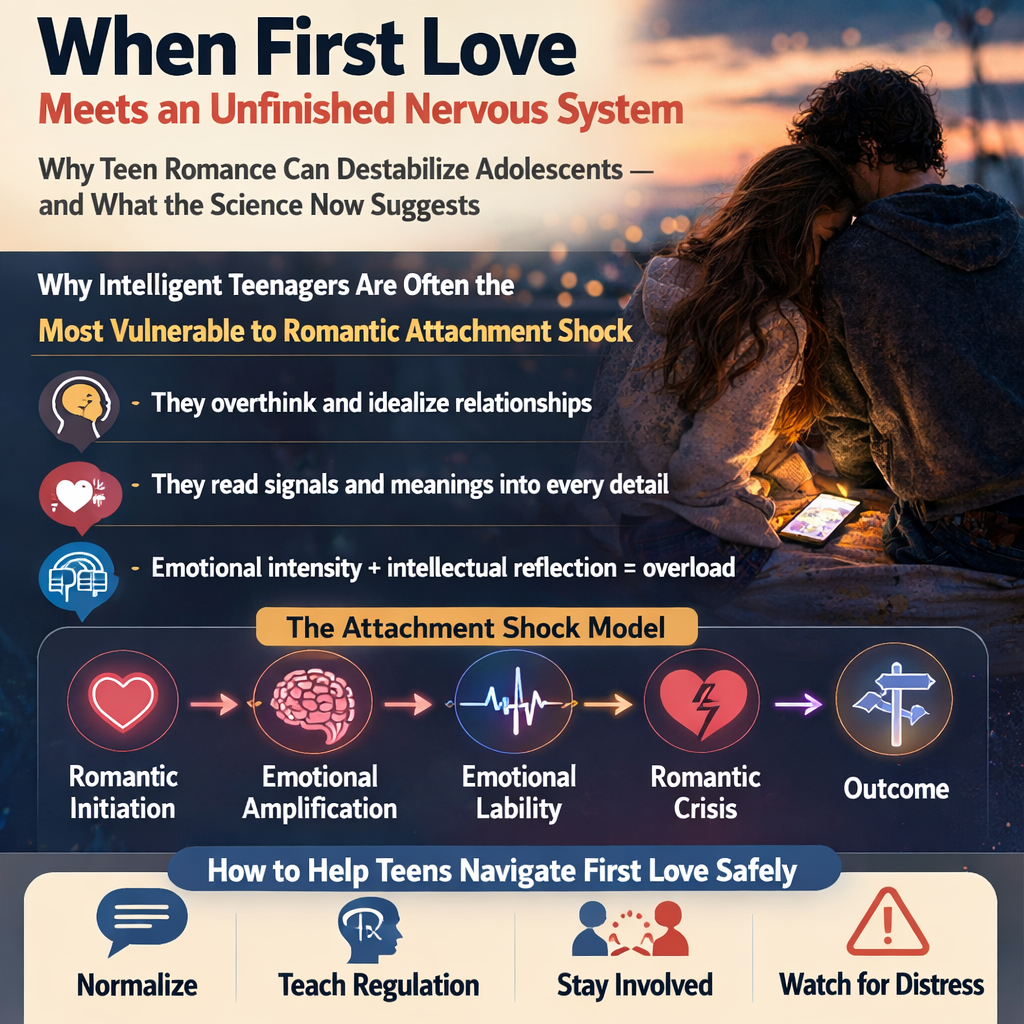
The Attachment Shock Model
The emotional sequence often unfolds in predictable stages:
Stage 1 — Romantic Initiation.
The adolescent experiences their first intense romantic attachment.
↓
Stage 2 — Emotional Amplification.
Dopamine and bonding systems intensify emotional focus on the partner.
↓
Stage 3 — Emotional Lability.
Mood swings occur due to immature emotional regulation.
↓
Stage 4 — Romantic Crisis.
Conflict, secrecy, jealousy, or rejection destabilize the emotional system.
↓
Stage 5 — Outcome Pathway.
Two outcomes are possible:
• Emotional growth through regulation and support.
• Psychological distress including depression or suicidal ideation.
The difference often lies in whether the adolescent has guidance and emotional tools available.
Media and the Amplification of Romantic Stress
Adolescents today are navigating romance in a cultural environment very different from previous generations.
Social media intensifies romantic experiences in several ways:
• relationships become publicly visible.
• breakups unfold before peer audiences.
• jealousy can be triggered through constant comparison.
• communication becomes continuous and emotionally immediate.
Romantic conflict that once unfolded privately now unfolds socially.
For adolescents already experiencing Attachment Shock, this environment can magnify emotional volatility dramatically.
Why Beginning a Relationship May Be More Stressful Than Ending One
One of the most intriguing findings in the Chinese study is that starting a relationship predicted suicide risk more strongly than breakups alone.
Beginning a relationship introduces multiple destabilizing forces simultaneously:
• emotional vulnerability.
• identity transformation.
• peer evaluation.
• fear of rejection.
• distraction from academic responsibilities.
In China there is an additional cultural factor which profoundly differs from the USA.
Teen dating is often discouraged by parents and schools.
Relationships are sometimes labeled “precocious love.”
As a result, many teenage relationships occur secretly.
Secrecy introduces chronic stress.
When the relationship ends, the secrecy often ends as well.
Paradoxically, the breakup may relieve pressure rather than intensify it.
How Schools Could Teach Relationship Literacy
One of the most promising solutions may be something surprisingly simple:
relationship education.
Adolescents receive formal instruction in mathematics, science, and literature.
But most receive no instruction at all in how romantic relationships work.
Schools could teach relationship literacy including:
• emotional regulation skills.
• recognizing healthy vs unhealthy attachment.
• coping with rejection.
• communication skills.
• understanding jealousy and insecurity.
In centralized education systems like China’s, such programs could be implemented nationally.
In the United States, where education is decentralized, implementation would likely occur on a school-by-school.
A Therapist’s Observation
Adults tend to underestimate the seriousness of teenage relationships because they assume they are temporary.
But the adolescent brain does not experience them as temporary.
It experiences them as total.
When a sixteen-year-old says:
“This is the most important person in my life,”
they are not exaggerating.
They are describing the architecture of their emotional world at that moment.
And when that world destabilizes suddenly, the consequences can be profound.
Adolescents are learning how to operate one of the most powerful emotional systems humans possess.
They are doing so without experience, often without guidance, and sometimes without language to understand what they are feeling.
It should not surprise us that the process occasionally overwhelms them.
What should surprise us is how rarely we acknowledge it.
FAQ
Is teenage romance harmful?
No. Romantic relationships are a normal developmental experience that can teach empathy, communication, and emotional intimacy.
Problems arise when adolescents face these experiences without emotional support or coping skills.
Why would starting a relationship increase suicide risk?
Beginning a relationship activates powerful attachment systems in the brain. Adolescents may lack the neurological maturity needed to regulate these emotional intensities.
Are American teenagers experiencing similar emotional volatility?
Yes. Research in the United States shows strong associations between romantic stress, depressive symptoms, dating violence, and suicidal behavior among adolescents.
Why do girls often show higher vulnerability?
Girls often experience stronger relational sensitivity and may invest more heavily in social bonds, increasing emotional risk when relationships become unstable.
What should parents do when their teenager begins dating?
Maintain open communication, avoid shaming romantic feelings, teach emotional coping strategies, and provide support during relationship conflicts or breakups.
Final thoughts
Adolescence has always been a season of emotional firsts, but modern culture asks teenagers to navigate those firsts largely alone.
We teach them algebra, chemistry, and the structure of a cell, yet we offer almost no instruction in how the human attachment system actually works.
Then we act surprised when the first experience of love overwhelms them.
The research emerging from adolescent psychology suggests that what we often dismiss as “teen drama” may actually be the nervous system encountering one of the most powerful emotional forces in human life without a compass or a map.
If there is a lesson here for parents, educators, and clinicians, it is a simple one:
teenage love is not trivial. It is developmental fire. And like all powerful forces, it must either be guided carefully—or it could burn hotter than anyone ever expected.
Be Well. Stay Kind, and Godspeed.
REFERENCES:
Collins, W. A. (2003). More than myth: The developmental significance of romantic relationships during adolescence. Journal of Research on Adolescence.
Furman, W., & Shaffer, L. (2003). The role of romantic relationships in adolescent development.
Liu, Z.-Z., Jia, C.-X., & Liu, X. (2024). Associations between start or end of a romance and suicidal behavior: A longitudinal study of Chinese adolescents. Journal of Adolescence.
Steinberg, L. (2014). Age of opportunity: Lessons from the new science of adolescence.
Tennov, D. (1979). Love and limerence: The experience of being in love.
Centers for Disease Control and Prevention. Youth Risk Behavior Surveillance System.