Taylor Swift’s “Wood”: Fertility Rites, Football Gods, and the New American Pantheon
Saturday, October 4, 2025.
Taylor Swift has long been the poet laureate of American romance.
She has sung about heartbreak (All Too Well), revenge (Reputation), and dreamy reflection (Folklore). But in 2025, she gave us something refreshingly different.
“Wood”, from The Life of a Showgirl, is her boldest and cheekiest track yet—a song laden with sexual innuendo, humor, and joy.
With its images of black cats, unlucky pennies, redwood trees, and “magic wands,” Wood celebrates the expansive confidence Swift has found in her relationship with Travis Kelce.
It’s playful, raunchy, and surprisingly tender.
And, like much of Swift’s best work, it’s also bigger than itself: the song taps into mythology, ritual, and the way Americans create meaning from love stories.
From Superstition to Love’s Certainty
Wood Lyrics
[Verse 1]
Daisy's bare naked, I was distraught
He loves me not
He loves me not
Penny's unlucky, I took him back
And then stepped on a crack
And the black cat laughed
[Pre-Chorus]
And, baby, I'll admit I've been a little superstitious (Superstitious)
Fingers crossed until you put your hand on mine (Ah)
Seems to be that you and me, we make our own luck
A bad sign is all good, I ain't gotta knock on wood
[Chorus]
(Ah) All of that bitchin', wishing on a falling star
Never did me any good, I ain't got to knock on wood
(Ah) It's you and me forever dancing in the dark
All over me, it's understood, I ain't got to knock on wood
[Post-Chorus]
Forgive me, it sounds cocky
He ah-matized me and opened my еyes
Redwood tree, it ain't hard to see
His love was thе key that opened my thighs
[Verse 2]
Girls, I don't need to catch the bouquet, mm
To know a hard rock is on the way
[Pre-Chorus]
And, baby, I'll admit I've been a little superstitious (Superstitious)
The curse on me was broken by your magic wand (Ah)
Seems to be that you and me, we make our own luck
New Heights (New Heights) of manhood (Manhood), I ain't gotta knock on wood
[Chorus]
(Ah) All of that bitchin', wishing on a falling star
Never did me any good, I ain't got to knock on wood
(Ah) It's you and me forever dancing in the dark
All over me, it's understood, I ain't got to knock on wood
[Post-Chorus]
Forgive me, it sounds cocky
He ah-matized me and opened my eyes
Redwood tree, it ain't hard to see
His love was the key that opened my thighs
Forgive me, it sounds cocky
He ah-matized me and opened my eyes
Redwood tree, it ain't hard to see
His love was the key that opened my thighs
Let’s Listen Closer
The first verse conjures the bad omens of unlucky love:
“Daisy’s bare naked, I was distraught / He loves me not … stepped on a crack / And the black cat laughed.”
Swift sets up a world of curses and failed romance. Then she flips it:
“Seems to be that you and me, we make our own luck / A bad sign is all good, I ain’t gotta knock on wood.”
Superstition gives way to partnership. Love itself becomes the protection. There’s humor here, but also relief: she no longer has to look for signs in flowers or sidewalks.
The Joy of Saying the Quiet Part Loud
Critics focused quickly on the post-chorus:
“Redwood tree, it ain’t hard to see / His love was the key that opened my thighs.”
(People, 2025)
It’s explicit, yes—but also jubilant.
Swift is no longer the tragic heroine of failed romances.
She’s celebrating intimacy with humor and pride. By casting Kelce as a “redwood tree,” she transforms the physical into something mythic, even patriotic. Desire becomes part of the American landscape.
Cosmopolitan called it a “not-so-subtle ode” to Kelce’s manhood, full of double entendres about rings, rocks, and wands (Cosmo, 2025).
The Mary Sue noted that fans were both blushing and delighted—proof that embarrassment can sometimes also manifest transcendent as a wider form of joy and arousal (Mary Sue, 2025).
Kelce and Swift in American Iconography
The reason Wood feels larger than life is because Swift and Kelce aren’t just a celebrity couple. They’ve become American symbols.
The Goddess and the Gladiator: She is the bard-priestess, narrating heartbreak and desire. He is the armored warrior, performing ritual combat every Sunday.
Together, they form a myth older than ancient Greece itself: love paired with battle.
Redwood as National Monument: By describing Kelce as a redwood, Swift ties desire to permanence, height, and national pride. Lust becomes natural and noble.
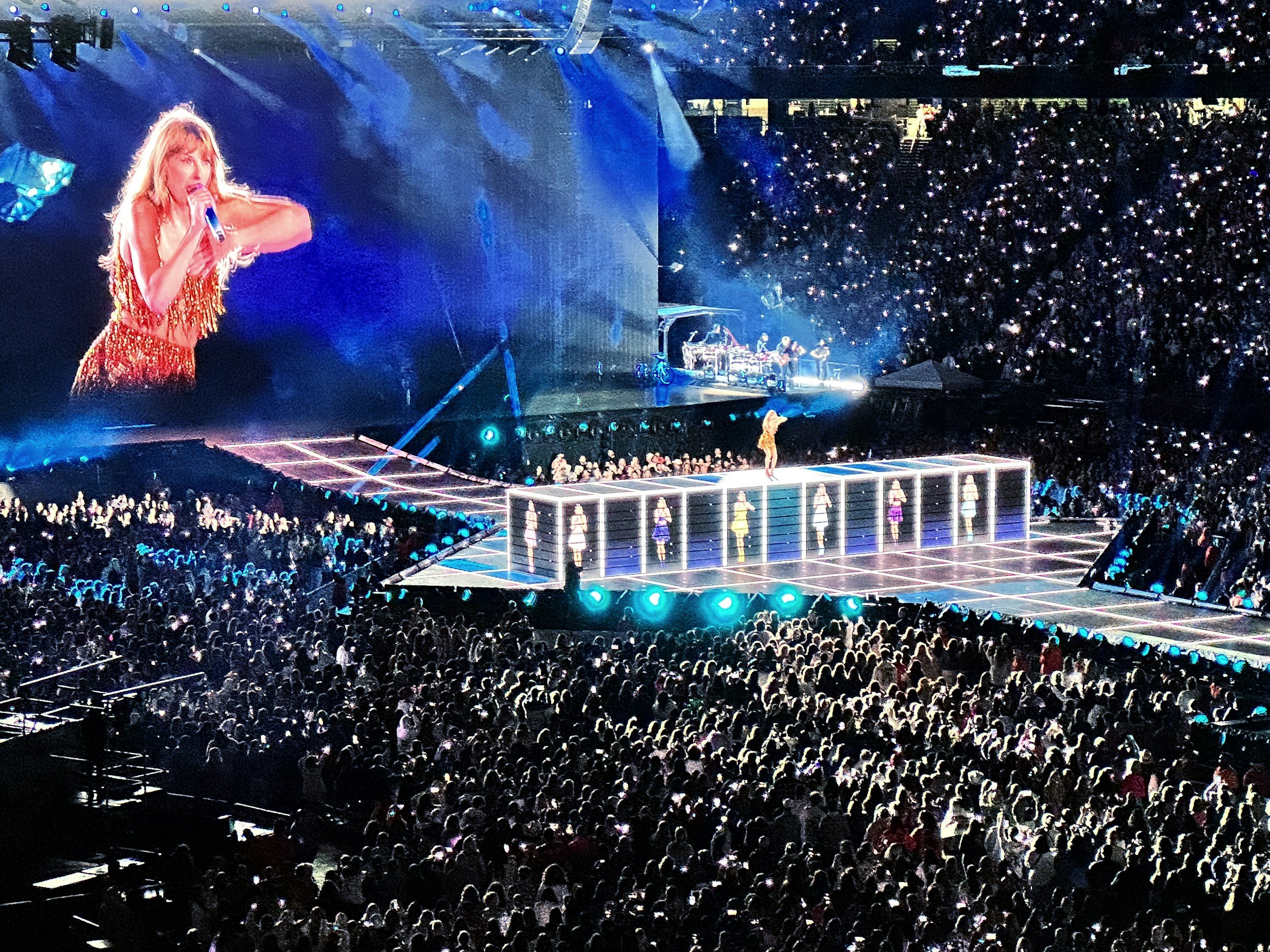
The Stadium as Temple: As Émile Durkheim (1912/1995) observed, rituals bind people together through collective effervescence. That’s what happens when thousands of Swifties shout “opened my thighs” in unison—embarrassed, laughing, but united.
Capitalism as Incense: The ancients offered sacrifices. They bought incense from the priest to toss upon the altar. We buy vinyl, jerseys, and concert tickets. Worship of the Gods has always required such offerings.
Myth as Consumer Product: Joseph Campbell (1949/2008) argued that myths survive by adapting to the culture. Swift and Kelce are our embodied proof: Aphrodite and Ares reinvented as pop star and NFL champion as a curious archetype in the modern American Soul.
The Humor and the Heart
It’s temptingly easy to see Wood only as only a parody— full of cheeky euphemisms to be sung in front of 70,000 people. Sorta like equating it to the audience reaction to Chuck Berry’s “My Ding-a-Ling” way back in 1972.
But look closer. Underneath the jokes, the song is actually about the comfort and joy of having a loving life partner.
Swift has turned the symbols of bad luck into the symbols of love fulfilled. She doesn’t need omens or protection. She has a partner who makes her feel secure, playful, and powerful.
The cultural laughter, too, is affectionate.
When fans blush and sing along, they’re not mocking her. They’re joining in with her.
As The Mary Sue pointed out, the pearl-clutching is part of the fun—it’s the collective gasp that bonds Swifties together.
The Gods Must Be Laughing
Wood isn’t just a raunchy pop song. It’s a fertility hymn, a joke, a ritual, and a declaration of joy. It transforms superstition into love, lust into laughter, and laughter into community.
Taylor Swift and Travis Kelce now embody a new American pantheon at a particularly historical time: the goddess and the gladiator, the bard and the warrior, Aphrodite and Ares with endorsement deals. Their romance is both funny and sincere, both personal and mythic.
The Greeks paraded phalluses in Dionysian festivals. We stream Wood on Spotify and shout along in stadiums. Different forms, same dynamic inclination toward the sacred
People Also Ask: Taylor Swift’s Wood
Is “Wood” really about Travis Kelce?
Yes. While she doesn’t use his name, the references to “New Heights” (his podcast) and the imagery of strength and permanence make the allusions kinda obvious (Cosmo, 2025).
What does “redwood tree” mean in the lyrics?
It’s both a metaphor for height and endurance and a cheeky sexual image. Swift turns Kelce into a natural monument—desire as landscape.
Why does she say she doesn’t have to “knock on wood”?
Because love has replaced superstition. She doesn’t need charms anymore. She has the real thing. And yes, it’s also a pun.
Why is “Wood” important in American culture?
Because it’s not just about one couple. Swift and Kelce embody archetypes: the goddess and the gladiator, art and sport, desire and ritual. Their story reflects how America blends love, sex, and celebrity into modern mythology. But doesn’t it also suggest an unconscious cultural ache for new heroes, if not New Gods?
Should I feel embarrassed singing this at a concert?
Yes—and that’s the fun. Embarrassment is part of the joy. When 70,000 people sing the same raunchy lyric together, the blush becomes a communal bond.
Final thoughts
And somewhere backstage, Swift is probably smiling—because she knows the altar isn’t only for her.
It’s for the larger drama of love itself, staged in that uniquely American way: equal parts spectacle and sincerity.
We’ve taken a relationship and treated it like national folklore, where joy and gravitas mix in equal measure.
As Turner (2014) reminds us, celebrity is never just about the person; it’s about how culture projects its own desires onto them. Swift and Kelce are, in this sense, less a couple and more a national Rorschach test.
It must be exquisitely satisfying, like watching your own happiness echoed back by a stadium.
And perhaps it must be a little too serious at times, because when love becomes myth, even the most private glance between two people can feel like a gift the culture wants to keep.
Gamson (1994) argued that celebrity culture thrives precisely because it collapses the line between intimacy and spectacle. Swift and Kelce are simply updating the script, with a little more glitter and a lot more football.
But maybe that’s the point. The myth doesn’t cheapen the love; it amplifies it.
In a world where headlines usually tell us who disappointed us today, we’re oddly relieved to see two people delight in each other.
It’s a reminder that romance can still be both intimate and collective, private and public, silly and solemn.
That paradox is the American sweet spot—and for now, at least, Swift and Kelce are living there.
As Banet-Weiser (2018) notes, we live in an age where empowerment and affect are staged for mass consumption, but that doesn’t make them fake. Sometimes performance is the truest form of intimacy.
And if we, the audience, can borrow a little hope from their love story? Well, I guess then, we’ll take it!
Call it cultural trickle-down romance. Or, as Marwick and boyd (2011) might put it, a “performative intimacy” scaled for the masses.
At its core, Wood is more than a bawdy wink at Travis Kelce.
It’s a reminder that pop music has always been our American way of laughing at desire while also celebrating it at the same time.
Taylor Swift has turned the old rituals of love and luck into a new kind of American mythology, one that feels both ancient and brand-new at the same time.
Her joy, her humor, and her refusal to hide behind subtlety give us permission to be in on the joke—and to sing it at the top of our lungs.
We may not build temples anymore, but when Swift takes the stage and thousands of voices echo her words back, we’re watching something just as sacred: love turned outward, raunch turned ritual, and laughter turned into a sort of joyful communal prayer for eternal connection.
Be Well, Stay Kind, and Godspeed.
Mock Footnotes (Because Every Myth Needs an Annotation)
Banet-Weiser, S. (2018). Empowered: Popular feminism and popular misogyny. Duke University Press.
Gamson, J. (1994). Claims to fame: Celebrity in contemporary America. University of California Press.
Marwick, A., & boyd, d. (2011). To see and be seen: Celebrity practice on Twitter. Convergence, 17(2), 139–158. https://doi.org/10.1177/1354856510394539
Turner, G. (2014). Understanding celebrity (2nd ed.). SAGE.
Durkheim, É. (1995). The elementary forms of religious life (K. E. Fields, Trans.). Free Press. (Original work published 1912). He didn’t study Swifties, but he should have.
Campbell, J. (2008). The hero with a thousand faces. New World Library. (Original work published 1949). Hero’s journey: goddess meets tight end.
Campbell, C. (1987). The romantic ethic and the spirit of modern consumerism. Blackwell. Desire always finds its way into the marketplace.
People, 2025. Confirming the raunch.
Cosmopolitan, 2025. Lyric analysis with gifs.
The Mary Sue, 2025. Pearl-clutching as ritual.
Aristophanes, The Acharnians. Ancient Athenians paraded giant phalluses. We parade lyrics. Progress, sorta.