Wednesday, November 19, 2025.
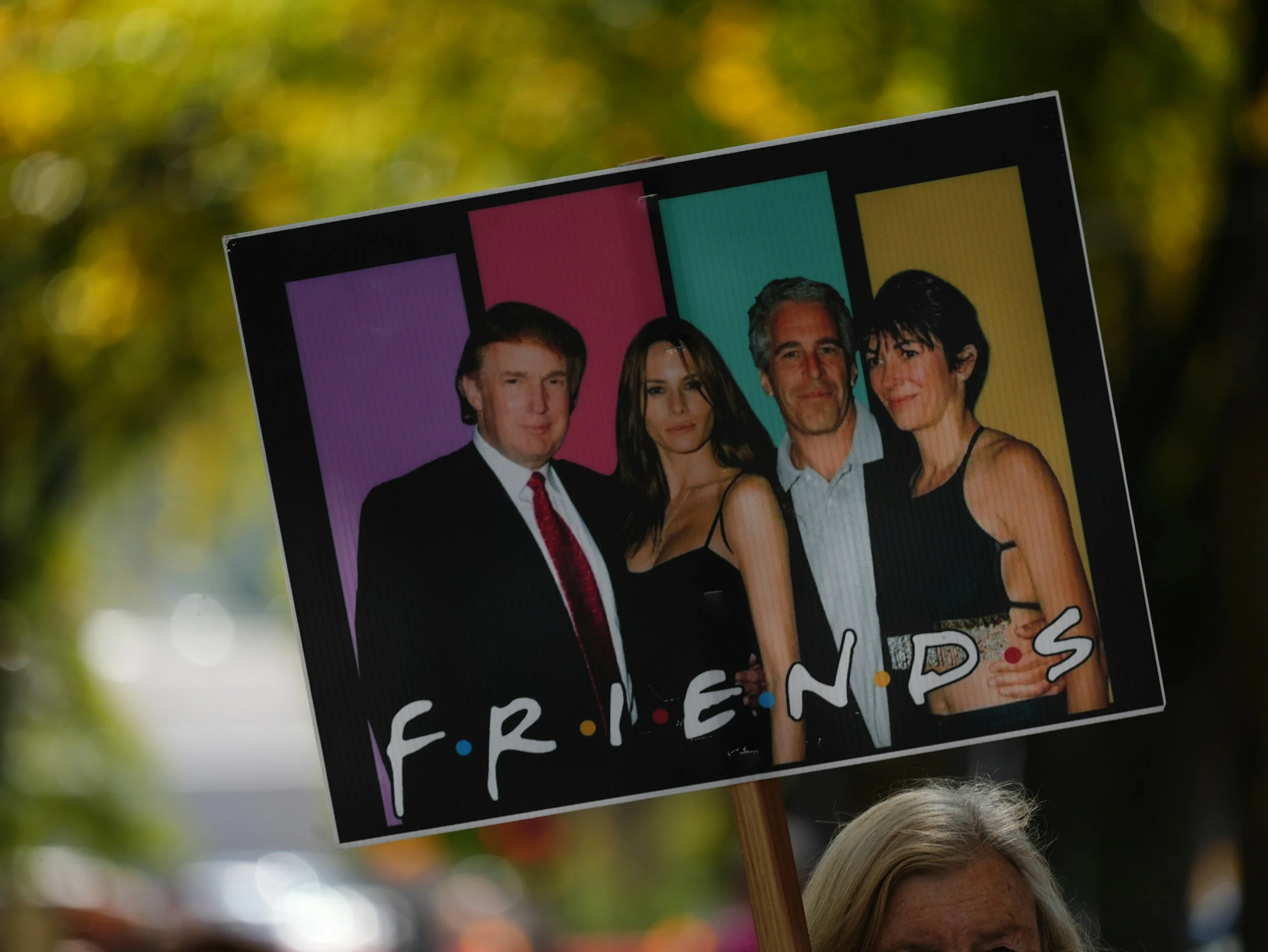
Jeffrey Epstein and Donald Trump operated not as anomalies, not as exceptions, but as men who, for a time, found the perfect conditions in which to expand.
Each represents a version of Malevolent Narcissism—the subtype marked not by wounded grandiosity, but by a purposeful, almost serene entitlement to take whatever they hell they want.
These are men who feel most themselves when others feel smaller.
Their power is not relational; it is extractive. And for a time, we were sufficiently distracted and divided, and gave them license to lust freely, and defile young girls.
But American culture begins to shift long before the Feed acknowledges it.
The change arrives in small ways—the jokes that no longer land, the public figures we stop defending, the faint but noticeable discomfort when old narratives are repeated ad nauseum.
Before anyone admits that something has shifted, the air has already been filtered with consequence.
The Engine of Malevolent Narcissism
Clinically, malevolent narcissism blends grandiosity, aggression, and a cold readiness to violate norms whenever norms feel inconvenient. The internal structure is surprisingly simple: admiration stabilizes them, dominance invigorates them, consequences barely register.
Unlike the more fragile forms of narcissism that collapse when the world pushes back, this subtype interprets limitation as insult.
A no is not refused; it is reworked. A boundary is not a barrier; it is an obstacle to be moved. Their confidence is not a performance—it is a claim of ownership.
Epstein’s version hid in exclusivity. Trump’s version insists on spectacle.
But the organizing principle is identical:
I am exempt.
Rules are ornamental.
The world exists to affirm my significance.
Two Men, One Internal Architecture
The differences between Epstein and Trump are merely surface-level.
Epstein derived power from secrecy—the curated intelligence, the whispered connections, the suggestion that he belonged to some elevated, exclusive realm. Trump derives power from presence—noise, visibility, constant motion, the demand that our collective bestowed attention never stray too far away.
One man seduced institutions behind closed doors; the other overwhelms them in public. One dealt in privilege; the other deals in grievance.
But both operate from the same internal blueprint.
Their method differs. But their shared ravenous appetites drew them close. They are not enigmas, they are quite ordinary specimens of disordered personalities.
How a Nation Becomes Tired
For years, America moved through a kind of moral fog.
Not because we didn’t know what they were seeing, but because naming it, day after day, became too fucking exhausting.
The lies were corrosive, not persuasive—designed to wear down clarity rather than sharpen it. After enough exposure, even intelligent souls start to drift. Repeating a lie over and over is a form of cognitive warfare and a cultural oppression. It was easier for us to ignore this theater than to name it.
It isn’t now.
Fatigue works like that. Not as surrender, but as a temporary suspension of knowing better, and taking the time to say so.
The danger is that malevolent narcissists flourish precisely during these sort of interludes.
Their influence expands when we’re too tired to point out the obvious. Their grandiosity feels less absurd when everyone else has also stopped noticing our collective moral exhaustion.
But fatigue has an endpoint. We Americans eventually recover our cognitive footing. And when we do, we tend to recover our standards as well.
A Reawakening of Moral Clarity
The most interesting shift in American public life right now is not outrage—it’s a return to moral sobriety.
Americans have stopped explaining away what they see.
Our indulgence is gone. Our willingness to reinterpret cruelty as strength, evasion as strategy, chaos as authenticity—it’s evaporating by the minute.
There is a subtle recalibration happening in America: a return to a clearer sense of moral gravitas..
It’s not always loud, or dramatic.
It’s often a quiet refusal to applaud performances that once dazzled, a growing recognition that malevolent narcissists do not run on intelligence or vision—they can only rape and ravage freely with our silent, ongoing compliance.
Epstein lost that compliance in private, probably kicking and screaming as the life was choked out of him. Trump is losing it in public in real time, and is gasping for air.
Accused serial sex offender Bill Clinton, Harvard’s Larry Summers, Ehud Barak, and many others, will also have their own long, dark, night of the soul.
The mechanism is the same: our illusions are degrading. It’s morning for public shame in America.
The argument has been made that the stench of Epstein will be impossible to scrub off. Therefore, no one need explain themselves to the survivors.
Final Thoughts
Malevolent narcissists don’t lose power because they change.
They lose power because the culture stops rearranging itself to accommodate and gratify them.
Epstein’s network collapsed when institutions were exposed and could no longer justify the contortions required for them to maintain his myth.
Trump’s mythology is thinning for the same reason: the oxygen that sustained it—attention, indulgence, suspended disbelief—it’s now running on fumes.
Clarity is doing what outrage could not. It makes their world smaller. It makes the story of the survivors thicker.
It makes the excuses increasingly impossible to utter out loud.
And once Americans begins to see clearly again—even briefly—we rarely return to the fantasies that once blinded us.
But we did it this time. And we are becoming remorseful. Maybe even ashamed.
Be Well, Stay Kind, and Godspeed.
REFERENCES:
Kernberg, O. F. (2016). The inseparable nature of love and aggression: Clinical and theoretical perspectives. American Psychiatric Publishing.
Miller, J. D., Campbell, W. K., & Pilkonis, P. A. (2007). Narcissistic personality disorder: Relations with distress and functional impairment. Comprehensive Psychiatry, 48(2), 170–177. https://doi.org/10.1016/j.comppsych.2006.10.003
Ronningstam, E. (2011). Narcissistic personality disorder: A clinical perspective. Psychoanalytic Inquiry, 31(3), 308–322. https://doi.org/10.1080/07351690.2011.563546
Sedikides, C., & Campbell, W. K. (Eds.). (2017). Narcissism and the self: Insights from social and personality psychology. Routledge.
Twenge, J. M., & Campbell, W. K. (2018). The narcissism epidemic: Living in the age of entitlement. Atria Books.