Thursday, June 4, 2026.
Long before artificial intelligence arrived, America had already developed a habit.
We started describing human beings the way accountants describe office furniture.
Workers became labor costs.
Patients became utilization rates.
Students became performance metrics.
Citizens became demographics.
Customers became eyeballs.
Somewhere along the way, the language of management escaped the conference room and began colonizing everything else.
This happens so gradually that nobody notices.
One day you wake up and discover that an entire society has become remarkably skilled at calculating what human beings cost.
Less attention is devoted to calculating what human beings are worth.
Artificial intelligence did not create this habit.
Artificial intelligence merely wandered into a culture that was already halfway there.
That observation sits beneath a recent economic idea known as the AI Layoff Trap.
The theory itself is straightforward. Individual firms have strong incentives to replace workers with increasingly capable technologies.
The danger emerges when every firm follows the same logic simultaneously.
Workers lose income. Consumers reduce spending. Demand weakens.
The economy that seemed to be growing more efficient gradually discovers it has been firing its own customers.
The theory is new.
The pattern is not.
Anyone who has spent time studying labor history has seen some version of this movie before.
The cast changes.
The machinery changes.
The management consultants change.
The PowerPoint presentations become more colorful.
The plot remains remarkably familiar.
Every Generation Invents a New Way to Forget Who the Customer Is
One of the enduring fantasies of modern management is the dream of production without complication.
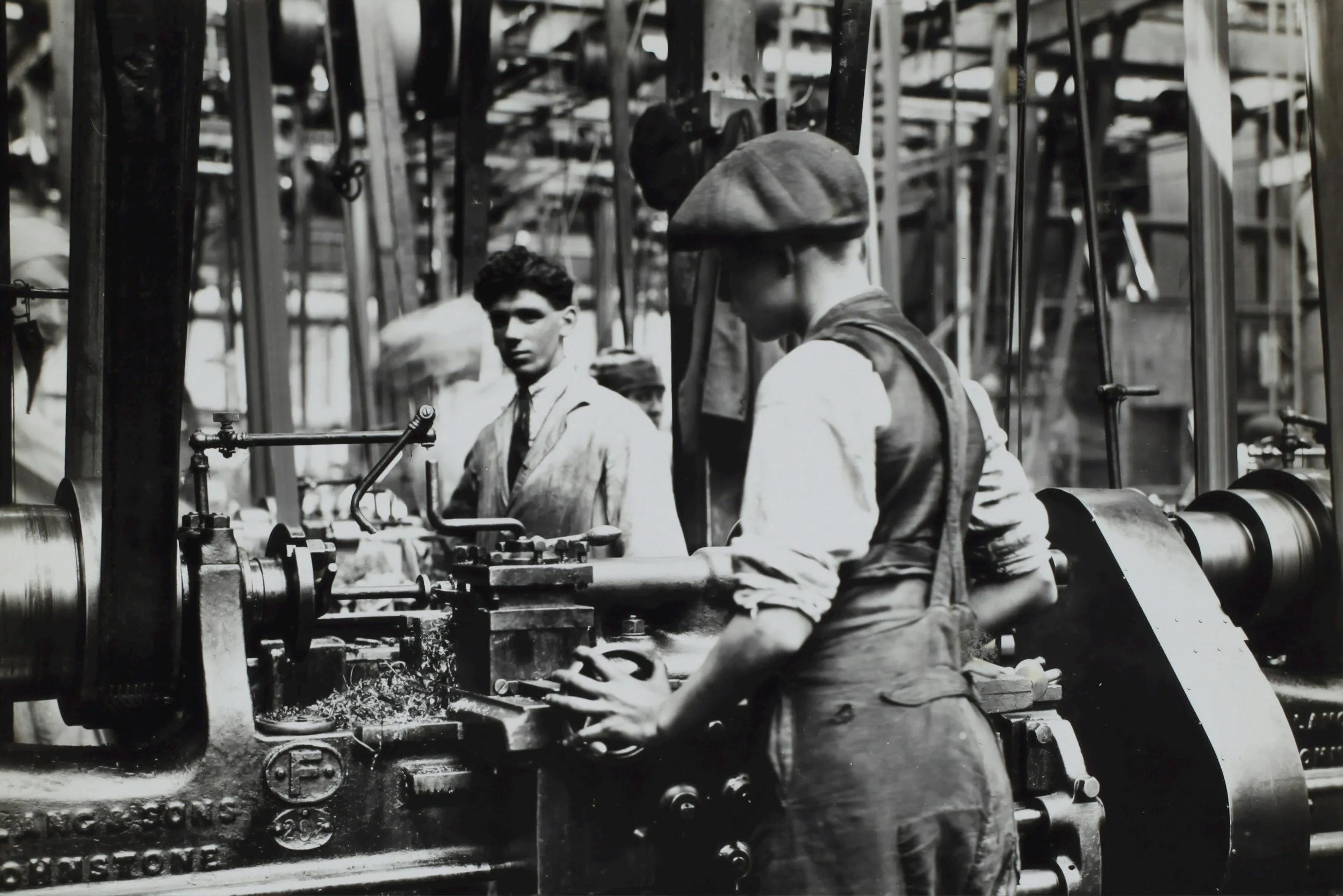
A factory without grievances. Jack Welch fantasized a factory that was a barge capable of immediate relocation. Untethered to people or local concerns and regulation.
An office without conflict.
A workforce without turnover.
A business without labor costs.
Every generation discovers a new mechanism that appears capable of delivering this dream.
The assembly line.
Scientific management.
Offshoring.
Outsourcing.
Automation.
Artificial intelligence.
The technologies differ.
The aspiration remains remarkably consistent.
Reduce friction.
Reduce cost.
Increase efficiency.
The difficulty is that economies are not engineering projects.
They are social systems.
And social systems behave differently.
Henry Ford understood something that many contemporary executives seem to rediscover and then forget every twenty years.
Workers are customers wearing different clothes.
The worker building the car may eventually buy the car.
The teacher hires the plumber.
The plumber visits the dentist.
The dentist hires the accountant.
The accountant pays the teacher.
An economy is not a machine.
It is a circle.
Healthy societies remember this.
Unhealthy societies begin breaking the circle apart.
The worker becomes a cost center.
The customer becomes a revenue source.
The relationship between the two disappears on the spreadsheet.
Reality remains less cooperative.
Reality insists they are often the same person.
The Strange Religion of Efficiency
Modern societies possess many religions.
Some are officially recognized.
Some are not.
Efficiency may be the most influential unofficial religion in America.
Efficiency sounds unquestionably virtuous.
Efficient schools.
Efficient hospitals.
Efficient governments.
Efficient corporations.
Efficient marriages.
The word itself feels impossible to criticize.
Yet efficiency is a tool.
Not a purpose.
A marriage optimized entirely for efficiency becomes emotionally sterile.
Partners stop asking questions because they already know the answers.
Conversations become logistical.
Curiosity quietly leaves through a side door.
The relationship still functions.
Until one day it doesn't.
Organizations can suffer the same fate.
Communities can suffer the same fate.
Civilizations can suffer the same fate.
The problem is not efficiency.
The problem is forgetting what efficiency is supposed to serve.
The twentieth century taught us how to produce more.
The twenty-first century may force us to remember why.
The Assembly Line Comes for the Mind
Most technological revolutions replaced muscle.
Artificial intelligence may become the first major technological revolution aimed directly at portions of cognition.
That distinction matters.
The assembly line required workers to adapt themselves to machines.
Knowledge workers largely escaped that experience.
Lawyers.
Teachers.
Writers.
Accountants.
Therapists.
Consultants.
Engineers.
For generations, these professions assumed they occupied relatively protected territory.
Now many are discovering what industrial workers learned long ago.
A machine does not have to perform a task perfectly.
It merely has to perform it cheaply enough.
That realization has introduced a new anxiety into the professional classes.
Not merely the fear of unemployment.
Something deeper.
The fear of becoming optional.
And beneath that fear lies an even older concern.
The fear of becoming unnecessary.
The Empty Factory Problem
Every generation imagines the ideal workplace.
No absenteeism.
No turnover.
No grievances.
No wage negotiations.
No healthcare costs.
No retirement obligations.
No interpersonal conflicts.
No difficult personalities.
No humans.
The fantasy sounds efficient.
The trouble begins when you remember that workers are not merely workers.
They are taxpayers.
Neighbors.
Parents.
Volunteers.
Caregivers.
Mentors.
Little League coaches.
Church members.
Customers.
Citizens.
Remove enough workers and eventually you discover you were not merely eliminating labor.
You were dismantling participation.
That distinction matters.
Because healthy societies depend upon participation at least as much as productivity.
Perhaps more.
The Participation Economy
Economists spend enormous amounts of time discussing productivity.
They should.
Productivity matters.
But productivity is not the only thing holding a society together.
Participation matters too.
A healthy society gives citizens ways to contribute.
Ways to matter.
Ways to feel useful.
Ways to feel necessary.
Ways to believe their presence changes something.
Work is one of those ways.
Parenthood is another.
Friendship is another.
Citizenship is another.
Religious communities provide it.
Volunteer organizations provide it.
Neighborhoods provide it.
Families provide it.
The question beneath the AI Layoff Trap is not whether machines can contribute.
Of course they can.
The question is whether human beings will continue to have meaningful opportunities to do so.
That may become one of the defining cultural questions of the twenty-first century.
Not whether machines become more capable.
Whether human beings continue to feel necessary.
The Loneliness Economy
Across America, there are already millions of citizens who feel economically and culturally peripheral.
Former factory workers.
Older workers.
Young adults struggling to launch.
Workers whose skills suddenly lost market value.
Communities that watched opportunity leave and never quite return.
Artificial intelligence arrives in a society where many citizens already wonder whether they matter.
That may be one reason the conversation feels unusually emotional.
The technology is new.
The fear is not.
Work has always provided more than income.
Work provides identity.
Structure.
Status.
Community.
Meaning.
A reason to get out of bed on a Monday morning.
Human beings can survive feeling tired.
Human beings can survive feeling poor.
Human beings struggle when they begin feeling unnecessary.
That distinction deserves more attention than it receives.
The Corporation That Ate Its Customers
Economists describe the AI Layoff Trap as a coordination problem.
I prefer a simpler description.
It is the story of a corporation accidentally firing its own customers.
Imagine a restaurant owner who concludes that customers are the most expensive part of running a restaurant.
No customers.
No complaints.
No delays.
No special requests.
No mess.
No revenue.
The absurdity becomes obvious immediately.
Yet economic systems repeatedly produce similar outcomes.
The local incentive makes sense.
The collective outcome does not.
Every participant behaves rationally.
Everyone arrives somewhere irrational.
History contains many examples.
Overfishing.
Housing bubbles.
Attention economies.
Debt crises.
The AI Layoff Trap belongs to this family of mistakes.
No villain is required.
Only incentives.
The Marriage Analogy Nobody Asked For
Every troubled marriage eventually develops a fantasy.
Life would be easier without this difficult partner.
No arguments.
No misunderstandings.
No disappointments.
No conflict.
Just peace.
Then separation arrives.
And many partners discover something surprising.
The friction they hated was also where much of the meaning lived.
Human relationships are inefficient.
That is partly why they matter.
Civilizations may be developing a similar fantasy about labor.
Human beings are expensive.
Human beings are emotional.
Human beings are unpredictable.
Human beings ask inconvenient questions.
Artificial intelligence promises relief from many of these frustrations.
The question is whether removing the friction also removes the point.
The Question Beneath the Question
Most discussions about artificial intelligence focus on capability.
Can AI reason?
Can AI write?
Can AI replace knowledge workers?
Can AI outperform professionals?
Important questions.
Necessary questions.
Possibly secondary questions.
The deeper question concerns purpose.
What kind of civilization are we attempting to build?
One organized around maximizing human flourishing?
Or one organized around minimizing human cost?
Those goals overlap.
Until suddenly they don't.
And that moment may become one of the defining choices of the century.
Frequently Asked Questions
What is the AI Layoff Trap?
The AI Layoff Trap is an economic theory suggesting that firms may rationally automate jobs with artificial intelligence, but widespread automation can reduce consumer demand and ultimately harm the broader economy.
Why are workers also customers?
Workers earn income that is spent throughout the economy. When employment falls, purchasing power can decline, reducing demand for goods and services.
Is AI replacing knowledge workers?
AI is increasingly capable of performing portions of cognitive work once associated with lawyers, accountants, writers, analysts, programmers, and other professionals.
What is the participation economy?
The participation economy is the idea that healthy societies require opportunities for citizens to contribute, feel useful, and participate in meaningful social and economic roles.
What is the difference between productivity and participation?
Productivity measures output. Participation measures involvement and contribution. Societies need both.
Is the AI Layoff Trap really about artificial intelligence?
Not entirely. Artificial intelligence is simply the newest iteration of a much older tension between labor, technology, productivity, and participation. The deeper question concerns how societies distribute opportunity and whether economic systems continue creating meaningful roles for ordinary citizens.
Why does this idea matter beyond economics?
Because work provides more than income. Work provides identity, status, structure, social connection, and a sense of usefulness. Debates about automation are ultimately debates about belonging.
Haven't technological revolutions always created new jobs?
Historically, yes. New technologies have often generated entirely new industries and occupations. The unresolved question is whether AI's impact on cognitive labor differs in scale or speed from previous technological transitions, and whether institutions can adapt quickly enough.
What’s another difference between productivity and participation?
Productivity measures output.
Participation measures involvement.
A healthy society needs both. Citizens generally want more than consumption. They want opportunities to contribute, influence outcomes, and feel necessary to the communities around them.
Why compare this issue to marriage?
Because both involve a temptation to eliminate friction. Many of the things that make relationships meaningful are also inefficient. The same may be true of work, citizenship, and community life.
What is the central question raised by the AI Layoff Trap?
Not whether machines can contribute.
Whether human beings still feel they can.
Final Thoughts
The AI Layoff Trap may turn out to be an important economic theory.
Or it may eventually be remembered as a footnote in the larger history of automation.
Either way, it points toward a deeper concern.
For generations, modern institutions have become increasingly sophisticated at measuring efficiency.
Increasingly sophisticated at measuring productivity.
Increasingly sophisticated at measuring cost.
What remains harder to measure is human significance.
A worker's value is not exhausted by a paycheck.
A citizen's value is not exhausted by consumption.
A person's value is not exhausted by economic output.
Markets need customers.
Communities need participants.
Families need caregivers.
Democracies need citizens.
The danger is not that machines become useful.
The danger is that we become so impressed by usefulness that we forget why economies exist in the first place.
Perhaps the AI Layoff Trap is not really a warning about machines.
Perhaps it is a warning about ourselves.
Every civilization eventually decides what human beings are for.
The next few decades may reveal what we have decided.
If we are careful, artificial intelligence may become one of the greatest tools ever created.
If we are careless, it may simply reveal a belief we have been quietly rehearsing for years:
That human beings are the expensive part.
History suggests the opposite.
Human beings are the point.
Be Well, Stay Kind, and Godspeed.
REFERENCES:
Brynjolfsson, E. (2022). The Turing Trap: The promise and peril of human-like artificial intelligence. arXiv. https://arxiv.org/abs/2201.04200
Falk, B. H., & Tsoukalas, G. (2026). The AI Layoff Trap. arXiv. https://arxiv.org/abs/2603.20617
Ford, H., & Crowther, S. (1922). My Life and Work. Doubleday, Page & Company.
Keynes, J. M. (1930). Economic Possibilities for Our Grandchildren. In Essays in Persuasion. Macmillan.
Mokyr, J., Vickers, C., & Ziebarth, N. L. (2015). The history of technological anxiety and the future of economic growth: Is this time different? Journal of Economic Perspectives, 29(3), 31–50.