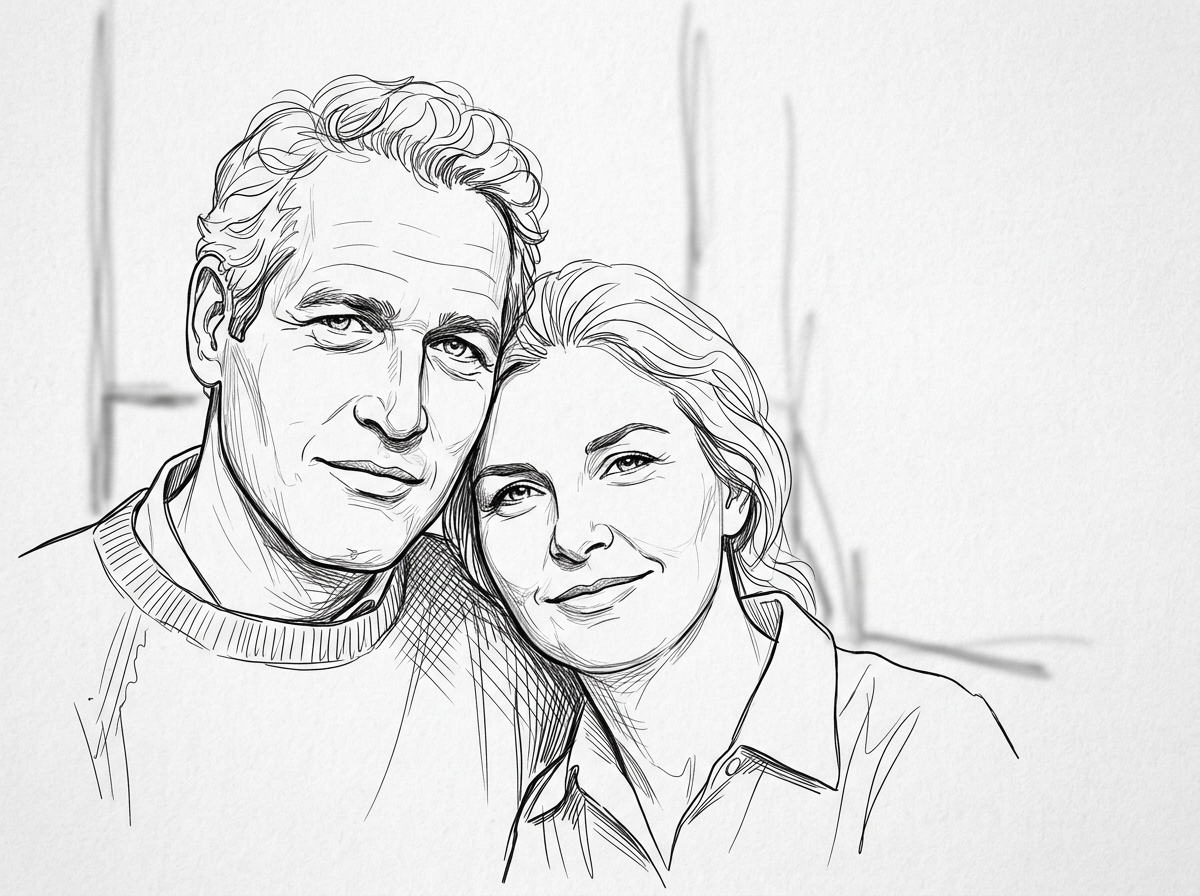
Paul Newman and Joanne Woodward: The Love Letters Behind a 50-Year Marriage
Sunday , August 9, 2026.
There are worse things to find in your parents’ attic than their love letters.
Tax returns.
A NordicTrack.
Thirty-seven years of National Geographic preserved under the assumption that somebody, someday, will urgently require the April 1986 issue.
Melissa Newman found something considerably more significant:
Her parents’ desire.
Years after her father, Paul Newman, died in 2008, Melissa Newman discovered early letters her father had written to Joanne Woodward.
She later described encountering correspondence that could be sweet, romantic, and sufficiently intimate that not everything belonged in a book assembled by their daughter.
Which may be the strongest endorsement of a love letter ever offered.
We already knew Paul Newman was beautiful. There is an extensive photographic record.
What the letters reveal is more interesting.
He was besotted.
And decades later, after the beautiful young man was gone, the evidence remained.
The marriage had lasted fifty years before ending in the only way a lifelong marriage ultimately can.
One of them died.
And among the family papers, the young Paul Newman was still trying to tell Joanne Woodward something lovers have been trying to say since we first figured out how to write things down:
Of all the people in the world, I choose you.
Before They Became Paul and Joanne
Celebrity marriages acquire mythology the way old houses acquire ivy.
Eventually you can barely see the structure underneath.
Paul Newman and Joanne Woodward became one of America's favorite marital myths:
The blue eyes.
The brilliant actress.
The Connecticut home.
The photographs in which they appear constitutionally incapable of standing beside one another without touching.
Fifty years.
It is lovely.
It is also incomplete.
Newman and Woodward met while working on the Broadway production of Picnic in 1953.
Newman was married to Jackie Witte and had three young children.
Their romance subsequently became an extramarital affair—a fact explored candidly in Ethan Hawke's documentary series The Last Movie Stars.
The consequences were painful.
In the documentary, Newman's daughter Stephanie described the divorce as devastating for her mother, Jackie, and called the story from her mother's perspective “unbearable.”
That belongs here.
Not because it cancels what Newman and Woodward subsequently built.
Because it complicates it.
A relationship can become deeply meaningful without its origins becoming retroactively innocent.
Human beings are often inconvenient in that way.
Then There Was Joanne
Paul Newman's physical beauty has received adequate coverage.
Those eyes have have had a fabulous run.
Joanne Woodward is more interesting.
She was never merely Mrs. Paul Newman, lucky recipient of America's most famous blue-eyed gaze.
When the couple married in 1958, Woodward was already a formidable actress. She had won the Academy Award for Best Actress for The Three Faces of Eve.
And accounts from their family make clear that the marriage contained two serious artists, not a movie star and his adoring wife.
Woodward also spoke candidly about the costs of balancing acting and motherhood.
In interviews later incorporated into The Last Movie Stars, she described the impossible guilt of being on set and thinking she should be home, then being home and wondering why she wasn't working.
That changes the frame.
The popular version makes Woodward the woman fortunate enough to have been loved by Paul Newman.
Their story suggests something more interesting.
Paul Newman was fortunate enough to be known by Joanne Woodward.
Being desired is intoxicating.
Being known and still desired is something else entirely.
The Letters Preserve What Marriage Tends to Misplace
Melissa Newman has described discovering ten early letters her father had written to her mother.
What comes through in her account is how smitten he was.
Not Newman the movie star.
Not Newman the philanthropist.
Not Newman of the race cars and salad dressing.
Paul.
A man writing to a woman he wanted.
That person can become difficult to locate after thirty years of marriage.
Not necessarily because love disappears.
Because administration arrives.
The mortgage.
The children.
The orthodontist.
The leaking roof.
The dog.
Whose turn is it to call the insurance company?
Why is there one tablespoon of milk left in the carton?
Eventually two people who once couldn't keep their hands off each other are standing under fluorescent lighting in Costco debating whether forty-eight rolls of toilet paper constitute prudence or hoarding.
This is not necessarily tragedy.
It is intimacy undergoing zoning changes.
But underneath the magnificent bureaucracy of a long marriage remains the original astonishment:
You chose me.
The letters preserve that astonishment.
Apparently, They Had Chemistry
Accounts subsequently published by Newman himself and members of the family leave little mystery about whether Newman and Woodward experienced sexual chemistry.
They did.
Newman wrote candidly about Woodward's importance to his sexual life, and one particularly colorful detail from their Beverly Hills home has become part of Newman-Woodward lore.
Woodward reportedly created a private bedroom retreat for the couple.
The family's name for it was considerably more direct.
We shall call it the Marital Enrichment Annex.
Melissa Newman has also described some of her parents' correspondence as intimate enough that she decided against publishing everything.
There is something useful underneath the family embarrassment.
Long-term eroticism is often treated as a technical problem.
Schedule sex.
Have date night.
Buy lingerie.
Put the phones away.
Try something involving batteries.
Perfectly reasonable.
But desire is not merely a behavior.
It is also a way of seeing.
The person across the breakfast table must occasionally stop being completely familiar.
He cannot only be the man who forgot the dishwasher tablets.
She cannot only be the woman asking whether the dog has been fed.
Somewhere inside the spouse, the lover has to remain visible.
The Newman-Woodward story suggests they retained some capacity for that.
That may be rarer than blue eyes.
Now We Complicate the Story
Here is where we should resist turning them into evidence that True Love Conquers All.
The surviving record doesn't support such a tidy conclusion.
The Last Movie Stars deliberately complicates the image of the perfect Newman-Woodward marriage.
Newman's children described their father's drinking as a serious problem. Woodward herself discussed the strain it placed on the marriage.
Newman's family history also included profound grief.
His son Scott, from his marriage to Jackie Witte, died in 1978 at age twenty-eight from an accidental overdose involving alcohol and Valium. Newman subsequently established the Scott Newman Foundation, which supported drug-abuse prevention efforts.
Newman's own posthumously assembled memoir, The Extraordinary Life of an Ordinary Man, further dismantles the idea that he regarded himself as some sort of marital saint.
He didn't.
Neither should we.
Which is precisely why the marriage becomes useful.
Long marriages aren't proof that two people behaved beautifully for fifty consecutive years.
They are evidence that fifty years occurred.
There were difficulties.
Compromises.
Career conflicts.
Family losses.
Periods of strain.
Some marriages survive these things.
Some shouldn't.
Some remain legally intact while the relationship inside them quietly disappears.
And some appear to accomplish something more difficult:
They metabolize disappointment without allowing disappointment to become the entire story.
Marriage Is a Private Civilization
Which brings us back to the letters.
Paul Newman died on September 26, 2008.
No more conversations.
No more arguments.
No more touching.
No more possibility of saying tomorrow what should have been said today.
But the relationship did not simply vanish.
It had deposited itself everywhere.
In children.
Photographs.
Houses.
Habits.
Stories.
And in letters written by a young man who had no idea that strangers would still care whom he loved generations later.
This is what long attachment does.
It leaves residue.
Your husband's ridiculous pronunciation of a particular word.
The way your wife reaches across the car when you brake suddenly, as though you are still five years old.
The restaurant you visited every anniversary until it closed.
The song neither of you particularly liked but somehow became yours.
The private joke requiring seventeen minutes of explanation that would cease being funny somewhere around minute four.
The particular way someone calls your name from another room.
A marriage becomes a private civilization.
It develops its own language.
Its own constitution.
Its own disputed territories.
Its own holidays.
Its own mythology.
Its own archaeological sites.
And much of it exists nowhere except inside two nervous systems.
Until one of them disappears.
Then something extraordinary happens.
One life partner becomes the last native speaker.
The Last Native Speaker
Bereavement researchers have described continuing bonds: the ways we sometimes maintain an internal relationship with someone who has died.
Earlier approaches to grief often placed greater emphasis on detachment and moving forward.
Contemporary bereavement scholarship has made room for something human beings seem to have understood intuitively for a very long time:
We don't always stop relating to someone merely because they have died.
Life partners talk to dead spouses.
They consult dead parents in their imagination.
They keep sweaters.
Recipes.
Birthday cards.
Voicemail messages.
A chipped coffee cup worth approximately eighty-nine cents to everyone else on Earth.
The relationship changes.
It loses reciprocity.
But it doesn't necessarily lose psychological presence.
You still know what he would probably say.
You can imagine her laugh.
You make a decision and think:
She would have liked this.
Something happens and, for half a second, you think:
I have to tell him.
That half second may contain an entire marriage.
A Love Letter Changes the Tense
Old love letters perform an especially strange trick.
Death says:
He loved me.
The letter says:
I love you.
The dead life partner becomes grammatical again.
Present tense.
The handwriting is there.
The joke is there.
The desire is there.
A young man reaches across decades and speaks to exactly one woman.
This is why the Newman letters are more interesting than celebrity memorabilia.
They are evidence.
Not that Paul Newman and Joanne Woodward had a perfect marriage.
Something much more believable.
At one particular moment, one human being looked at another and thought:
Of all the people in the world, I choose you.
And he wrote it down.
Decades passed.
Careers happened.
Children happened.
Trouble happened.
Ordinary Tuesdays happened.
And eventually, one of them died.
But the sentence remained.
Write Something Down
So here is the couples exercise.
No worksheet.
No rating scale.
No laminated communication wheel.
Write your partner a letter.
On paper.
Tell them what you noticed when you first met.
Tell them what surprised you.
Tell them what still does.
Be embarrassingly specific.
The snort before the real laugh.
The way he becomes tender around frightened animals.
The way she removes her glasses when she's trying to understand something important.
The absurd dance performed while waiting for the microwave.
The expression your partner makes while pretending not to enjoy a compliment.
Don't write it because your marriage is in trouble.
Write it because memory is.
Memory edits.
Memory compresses.
Memory eventually turns twenty years into eleven scenes, three vacations, somebody's surgery, and a kitchen renovation.
Write down what happened while you still remember.
Someday one of you may become the last native speaker of the civilization you built together.
Leave a dictionary.
Why Work with Daniel?
Most couples don't seek therapy because love has completely disappeared.
They come because access to it has become unreliable.
The original relationship can become buried beneath conflict, children, careers, sexual disappointment, betrayal, resentment, illness, aging, or simply the relentless administrative burden of adult life.
After enough years, partners can become astonishingly knowledgeable about each other's defects and strangely forgetful about each other's interior lives.
Science-based Couples therapy does not manufacture sentimentality.
And it shouldn't require pretending the painful chapters didn't happen.
The work is to understand the architecture of the relationship more clearly:
the attachment underneath the argument,
the injury underneath the anger,
the fear underneath the withdrawal,
the longing underneath the criticism,
and sometimes the lover still hiding inside the spouse.
For couples facing entrenched conflict, infidelity, emotional distance, sexual disconnection, or a relationship that simply seems to have gone missing, focused couples therapy can make room for a different conversation.
Not:
How do we get back to who we were?
You probably can't.
Those partners don't exist anymore.
The more interesting question is:
Knowing everything we know now, who could we become?
FAQ
Did Paul Newman arrange for Joanne Woodward to receive love letters after his death?
There is no reliable evidence that he did.
The documented story is different. Newman wrote letters to Woodward during their relationship. Their daughter Melissa later discovered early correspondence among the family's papers and incorporated some of that material into her book about her parents.
The letters survived Newman.
They were not, as far as the published record establishes, a planned message from beyond the grave.
The real story may be better.
He wasn't writing for posterity.
He was writing for Joanne.
Did Paul Newman really write passionate letters to Joanne Woodward?
Yes. Melissa Newman has publicly discussed discovering early letters her father wrote to Woodward and using family correspondence, photographs, and other material in Head Over Heels: Joanne Woodward and Paul Newman: A Love Affair in Words and Pictures.
Were some of the letters sexually explicit?
Melissa Newman has described some of her parents' correspondence as sufficiently intimate that she chose not to publish all of it.
Which suggests Paul Newman did not restrict himself to:
Thinking of you. The weather is fine.
Did Paul Newman and Joanne Woodward have a perfect marriage?
The available family accounts suggest something much more complicated.
Their fifty-year marriage appears to have contained tremendous affection and attraction alongside difficulties involving drinking, careers, parenting, and other strains.
Deep love and difficult marriage are not opposites.
They frequently occupy the same house.
Did Paul Newman's relationship with Joanne Woodward begin as an affair?
Yes.
Newman was married to Jackie Witte and had three young children when his relationship with Woodward developed.
In The Last Movie Stars, Newman's daughter Stephanie described the divorce's impact on her mother in deeply painful terms.
That history deserves acknowledgment.
A beautiful later chapter does not rewrite a painful earlier one.
How long were Paul Newman and Joanne Woodward married?
They married on January 29, 1958.
Newman died on September 26, 2008.
Their marriage lasted just over fifty years.
What can couples learn from Paul Newman and Joanne Woodward?
Probably not that true love produces a perfect marriage.
Something more useful.
Marriage gradually converts lovers into administrators of a shared life.
Someone has to pay the electric bill.
Someone has to call the plumber.
Someone has to remember the password.
The danger isn't domesticity itself.
The danger is forgetting that the person helping you administer the household was once—and perhaps still is—the most astonishing person in the room.
The letters preserve that gaze.
Long-term love may depend partly on learning to recover it.
Free Introductory Consultation
A long relationship accumulates everything.
Love.
History.
Sex.
Injuries.
Private jokes.
Disappointments.
Children.
Silences.
Things forgiven.
Things not yet forgiven.
Couples therapy does not require pretending only the beautiful parts happened.
The work is discovering whether everything that happened can become part of a larger story rather than its final sentence.
If your relationship has become buried beneath its own history, I offer focused science-based couples therapy and intensive work designed to help couples understand what happened, what remains, and what might still be possible.
Schedule a free introductory consultation with me.
You don't have to become the couple you used to be.
Those people have already lived their lives.
The question is whether the two people standing here now still have something still worth writing down.
Be Well, Stay Kind, and Godspeed.
REFERENCES:
Hawke, E. (Director). (2022). The last movie stars [Documentary series]. CNN Films.
Klass, D., Silverman, P. R., & Nickman, S. L. (Eds.). (1996). Continuing bonds: New understandings of grief. Taylor & Francis.
Newman, M. (2023). Head over heels: Joanne Woodward and Paul Newman: A love affair in words and pictures. Voracious.
Newman, P. (2022). The extraordinary life of an ordinary man: A memoir (D. Rosenthal, Ed.). Alfred A. Knopf.
Stroebe, M., Schut, H., & Boerner, K. (2010). Continuing bonds in adaptation to bereavement: Toward theoretical integration. Clinical Psychology Review, 30(2), 259–268.